 Casacrunched
15 Dark Green Accent Wall Ideas That Add Depth Without Darkness
Dark green is the moody color that actually loves small rooms — if the light is right. Fifteen dark green accent wall ideas, from forest matte to emerald panels, with light rules and brass pairings that keep the depth without the cave.

Dark green is the accent color small rooms were afraid of — and the one they needed most. Done wrong, a dark green accent wall swallows daylight and turns a small room into a cave. Done right, it recedes like a forest shadow, so the wall reads farther away, the furniture pops forward, and the room gains a depth light colors can only fake. The difference is never the paint. It is the light, the wall, and the discipline around them.
Fifteen ideas, each built for real rooms: which greens actually work (forest, deep emerald, dark sage, green-black), how much light each one demands, what to pair it with (brass, cream, warm wood), and which finishes keep dark green soft — plus which wall to choose, renter rules, and the mistakes that turn moody into murky.
Quick comparison: cost, time, light need, renter score
| # | Idea | Light need | Cost / wall | Time | Renter-friendly? |
|---|---|---|---|---|---|
| 1 | Matte forest green paint | Needs one good light source | $30–$70 | Half day | Yes (repaint) |
| 2 | Deep green behind the sofa | Daylight + one lamp | $30–$70 | Half day | Yes (repaint) |
| 3 | Green + cream two-tone | Any light | $30–$80 | Half day | Yes (repaint) |
| 4 | Dark green limewash texture | Needs daylight to show texture | $70–$140 | Full day | Yes (repaint) |
| 5 | Dark green + brass accents | Needs a warm lamp | $60–$180 | An afternoon | Yes (no holes) |
| 6 | Dark green wood slats | Daylight + one lamp | $140–$320 | Weekend | Backer panel: yes |
| 7 | Dark botanical wallpaper | Any light | $60–$160 | Half day | Peel-and-stick: yes |
| 8 | Dark green board and batten | Needs daylight | $120–$280 | Weekend | Ask first |
| 9 | Dark green fireplace wall | Firelight counts | $40–$150 | Half day | Yes (repaint) |
| 10 | Dark green TV wall | Low light is fine | $30–$90 | Half day | Yes (repaint) |
| 11 | Dark green + warm wood | Any light | $80–$250 | Weekend | Yes (furniture) |
| 12 | Dark green reading alcove | Needs a dedicated lamp | $40–$120 | Half day | Yes (repaint) |
| 13 | Green + cream wainscoting | Any light | $100–$260 | Weekend | Ask first |
| 14 | Peel-and-stick dark green | Any light | $40–$120 | Half day | Yes (peels off) |
| 15 | Dark green + mirror panels | Needs a window to reflect | $150–$400 | Half day | Leaning panels: yes |
IDEA 01Matte Forest Green Paint — the Classic Starter
The purest dark green accent wall is also the cheapest: one wall in a matte forest green, two coats, half a day, and the room changes character completely. Forest green is the safest dark green because it sits in the middle of the family — not so blue it reads as teal, not so yellow it reads as olive. Matte is non-negotiable: it keeps dark green soft and velvety, while gloss shows every drywall flaw.
Technique: primer first if the wall is currently light (dark green over white needs a tinted primer or a third coat), then two coats in matte. $30–$70, half a day. Put it behind the sofa, not behind the window: dark green eats daylight at its source if it sits on the window wall.
Tinted primer is the difference between two coats and four. A gray-tinted primer under dark green covers in two coats; white primer under dark green can take three or four, and every extra coat is another chance for roller marks.
IDEA 02Deep Green Behind the Sofa — the Anchor Wall
The sofa wall is where dark green earns its reputation. A deep green wall behind a light sofa does two things at once: it recedes like a shadow, so the wall reads farther away, and it throws the sofa forward, so the seating looks intentional. This is the single highest-impact dark green move in a small room, and it works because the sofa breaks up the dark field — the wall is never one unbroken slab of green.
Technique: pick a green one shade deeper than you think you want — dark green dries lighter than it looks wet. Two coats in matte, $30–$70, half a day. Add one warm lamp aimed at the wall itself: lit dark green glows, unlit dark green sulks. For sofa-wall sizing and placement rules, see our accent wall behind sofa guide.
Dark green behind a dark sofa is the one pairing that fails every time — the furniture’s outline disappears into the wall and the seating looks swallowed. Dark green walls need a light sofa, cream cushions, or both.
IDEA 03Green + Cream Two-Tone — the Small-Room Safety Net
If a full dark green wall feels like a leap, the two-tone wall is the safety net: dark green below, warm cream above, with a clean split line. The dark lower half grounds the furniture and gives the room its moody depth, while the cream upper half keeps the ceiling feeling high and the room feeling bright. It is the dark green idea that works in any light, including rooms with one small window.
Technique: the split line sits at 30 to 36 inches for a classic proportion, or at picture-rail height for a modern block. Seal the tape edge with cream first so the green cannot bleed under it, then paint the lower section in two matte coats. $30–$80, half a day. Keep both tones warm — warm cream with warm green — or the wall reads as two unrelated colors.
The split line is the whole idea, so it must be razor-sharp: seal tape edges with the base color before the dark coat goes on, and peel the tape while the second coat is still slightly damp.
IDEA 04Dark Green Limewash Texture — Depth Without Flatness
Flat dark green paint can look dead in a dim room — one unbroken field of color with nothing for the eye to catch. Limewash fixes that: the cloudy, hand-brushed mineral texture catches light differently across the day, so a dark green wall reads as layered and alive even in low light. It is the most forgiving dark green paint idea, because the texture hides roller marks, patch lines, and imperfect walls.
Technique: mineral primer first, then two thin coats with a block brush in loose, random crisscross strokes — the randomness is the finish. Limewash dries lighter than it looks wet, so judge the color only after a full 24-hour dry. $70–$140, a full day. Our limewash accent wall guide covers the technique in full.
Limewash’s wet wall lies — it dries noticeably lighter. Repainting a wall that was already right, because the wet coat looked too pale, is the most common limewash mistake.
IDEA 05Dark Green + Brass Accents — the Pairing Trick
Dark green and brass are the pairing the whole moody-room trend is built on, and the reason is simple physics: brass is warm metal, green is a cool color, and warm metal on a cool dark field glows. A brass floor lamp, brass picture frames, brass curtain rod, or brass hardware against a dark green wall reads as jewelry on velvet — the green gets richer and the brass gets warmer.
Technique: this is a styling idea, not a construction idea — no paint, no holes beyond picture hooks. Swap in three to five brass pieces (a lamp, two frames, a tray or a rod) and stop there — brass works by accent. $60–$180 for the pieces, an afternoon. One warm lamp aimed at the green wall doubles the effect, because brass and lit green feed each other.
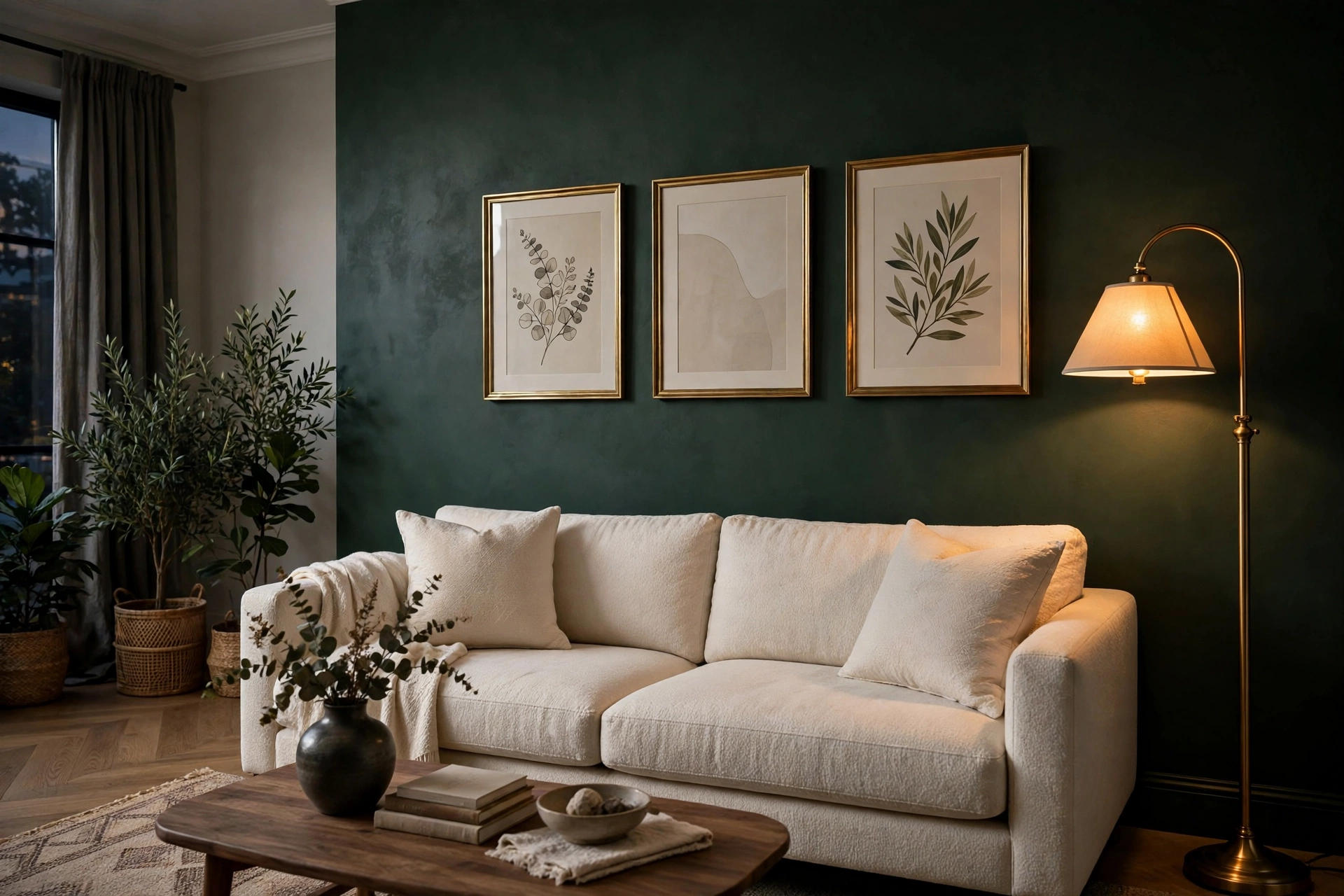
Three to five brass pieces is the sweet spot. Fewer reads as an accident, more reads as a costume — count the brass before you buy the next piece.
IDEA 06Dark Green Wood Slats — Shadow Lines on Shadow Color
Wood slats painted dark green add shadow lines to a dark wall, so the green reads as texture rather than a single flat field. The slats’ gaps catch light and throw thin shadows, which keeps a dark wall from looking dead even in a dim room — and the vertical lines lift a low ceiling at the same time.
Technique: slats run truly vertical, gaps of half an inch to an inch, painted the same dark green as the wall behind them for a tonal effect. A backer panel is the renter move — the whole panel lifts off in one piece. $140–$320, a weekend. Stop the slats at the ceiling, not at picture-rail height — cutting them short kills the height illusion.
Slats painted a different color from the wall behind them chop the wall into stripes and kill the moody effect — tonal green-on-green is what makes this idea read as one wall, not a fence.
IDEA 07Dark Botanical Wallpaper — the Pattern Move
Dark green wallpaper with a botanical print — large leaves, ferns, or jungle foliage on a deep green ground — is the pattern version of the dark green wall, and it solves the flatness problem the way limewash does: the print gives the eye somewhere to travel, so the wall reads as layered even in low light. The small-room rule is strict: one wall only, and a print with breathing room between the leaves. A dense, edge-to-edge jungle print closes a small room in; a spaced botanical opens it up.
Technique: paste-the-wall papers need a smooth wall and patience; peel-and-stick botanicals are the renter-safe, budget version. Panels hung top to bottom with a plastic smoother — bubbles are the giveaway that separates a good job from a dorm-room job. $60–$160, half a day. For surface compatibility in detail, see our peel-and-stick accent wall guide.
Dense jungle prints are the one dark green wallpaper that backfires in a small room — edge-to-edge foliage with no breathing room reads as a wall closing in, not a garden opening up.
IDEA 08Dark Green Board and Batten — Architecture in One Color
Board and batten painted dark green is the most traditional dark green idea and the most structured: vertical battens spaced evenly up a dark green wall give a flat room architecture, rhythm, and shadow lines in one move. Painted one color throughout, it reads as paneling, not stripes, and the room gains a tailored, almost library-like feel.
Technique: battens run floor to ceiling, spaced 12 to 16 inches apart, painted the same dark green as the wall for a tonal panel look. $120–$280, a weekend. The spacing rule matters: too wide reads as random stripes, too narrow reads as a fence. For spacing math and paint choices, see our board and batten guide.

Board and batten that stops at chair-rail height wastes the paneling effect — in a dark green room, battens earn their keep only when they run floor to ceiling and read as full architecture.
IDEA 09Dark Green Fireplace Wall — the Fire Is the Star
A fireplace wall already has a focal point, and dark green makes it work harder: the deep green recedes behind the firebox, so the flames and mantel pop forward against a moody backdrop. Firelight itself counts as a light source here — it warms the green from below and keeps the wall glowing on winter evenings when daylight is gone.
Technique: heat-safe paint or panels around the firebox itself (check the manufacturer’s clearance first), matte finish elsewhere. $40–$150, half a day. Keep the mantel light — cream, natural wood, or brass — so the firebox does not disappear into a dark-on-dark hole. The full playbook is in our fireplace accent wall guide.
A light mantel against a dark green fireplace wall is the whole trick — cream or natural wood keeps the firebox visible, while a dark mantel on a dark wall erases the fireplace’s outline entirely.
IDEA 10Dark Green TV Wall — the Screen Disappears
The television wall is where dark green is not just allowed but ideal: a dark green wall hides the black rectangle of a switched-off screen, because the screen’s black blends into the green instead of floating on pale paint like a hole. It is also the one dark green idea that genuinely prefers low light — a TV wall is watched in dim rooms, and dark green looks best exactly there.
Technique: paint the TV wall in a matte deep green, mount the screen, and hide cables in a channel or behind a panel so nothing white breaks the dark field. $30–$90, half a day. Add a floating console in light wood for contrast — it keeps the wall from reading as a void. Our accent TV wall guide covers console and cable rules in full.
White cables, white consoles, and white frames on a dark green TV wall are the giveaway that ruins the effect — every white line breaks the dark field and pulls the eye straight to the clutter.
IDEA 11Dark Green + Warm Wood — the Nature Pairing
Dark green and warm wood are the pairing that needs no explanation, because nature already made it: forest green against oak, walnut, or warm pine reads as a woodland interior, and the wood’s warmth stops the green from feeling cold. This is the dark green idea for rooms that already own wooden furniture, because the pairing is already half-built before the paint goes on.
Technique: this is mostly a styling idea built on one painted wall (idea 1 or 2) plus wood already in the room, with one or two warm wood additions — a floating shelf, a wood-framed mirror, a walnut console — if the room needs more. $80–$250, a weekend.
Gray-washed wood against dark green is the one wood tone that backfires — it drains the warmth out of the room and turns moody into chilly. Warm oak, walnut, or pine only.
IDEA 12Dark Green Reading Alcove — the Cozy Corner
Dark green’s cave effect, the thing that ruins a whole room, is exactly what makes a small alcove magical: a reading nook or window seat recess painted deep green becomes a room within a room, while the rest of the room stays light and open. The darkness is contained, so it reads as intention instead of gloom.
Technique: paint the alcove’s back and side walls in matte deep green, add one dedicated lamp (the alcove needs its own light source, since the room’s light will not reach into it), and a chair that fits the niche. $40–$120, half a day. The lamp is not optional: an unlit dark alcove is just a dark hole.

An alcove lamp aimed at the green wall, not at the reader, is what makes the nook glow — light washing the dark surface turns the cave into a lantern.
IDEA 13Green + Cream Wainscoting — the Two-Tone Upgrade
Wainscoting is the two-tone idea (idea 3) with architecture added: dark green panels on the lower wall, warm cream above, divided by a chair rail. The panels give the lower wall structure and shadow lines that flat two-tone paint cannot, and the cream upper wall keeps the room bright — so this is the dark green idea that works in any light, including windowless hallways and north-facing rooms.
Technique: panels run from the floor to chair-rail height (30 to 36 inches), painted deep green in matte, with the upper wall in warm cream and the chair rail in cream or wood for a crisp dividing line. $100–$260, a weekend.
Green above and cream below is the one reversal that breaks this idea — a dark upper wall drags the ceiling down and turns a classic look into a cave. Green stays low, cream stays high.
IDEA 14Peel-and-Stick Dark Green — the Renter Hero
Peel-and-stick dark green wallpaper is the renter’s only true no-commitment dark green wall: it goes up in an afternoon, peels off at move-out, and delivers the full moody depth of a painted wall without a single drop of paint. The pattern rules for dark green are the same as for any dark wall — one wall only, spaced prints over dense ones — but the stakes are lower, because a peel-and-stick mistake peels off in minutes instead of needing three primer coats.
Technique: panels hung top to bottom with a plastic smoother, on a clean, smooth wall — textured walls are the one surface peel-and-stick genuinely struggles with. $40–$120, half a day. For surface compatibility in detail, see our peel-and-stick accent wall guide.
Peel-and-stick on a textured wall is the one surface failure that wastes a whole roll — the paper lifts at the texture peaks within weeks. Smooth the wall or pick a different idea.
IDEA 15Dark Green + Mirror Panels — the Light Multiplier
Dark green and mirrors solve dark green’s biggest weakness: mirrors multiply whatever light the room has and throw it back onto the green wall, so a dark wall that would sulk in a dim room glows instead. Framed mirror panels on a dark green wall read as architecture — green fields between mirror fields, light bouncing between them — and the room gains both depth and brightness from a single wall.
Technique: mirror panels hung level with mirror adhesive or French cleats, facing the window so they double daylight rather than a blank wall. Leaning panels are the renter move — no holes at all. $150–$400, half a day with a second pair of hands. Face the window, not the television: facing the window doubles daylight, facing the TV doubles glare.
Mirror panels facing a blank wall double a blank wall — the trick only works when the mirrors face a window and have daylight to multiply. Check the reflection before you hang, not after.
Which Wall? Placement Rules for Dark Green
The wall you choose matters more for dark green than for any other color, because dark green punishes wrong placement harder. Rule one: the sofa wall first. The wall behind the largest piece of furniture is the natural focal point — it is the wall you see from the doorway, and the sofa breaks up the dark field so the wall never reads as one unbroken slab. Our living room and behind-sofa guides both start here for the same reason. Rule two: the TV wall second — dark green hides the screen’s black rectangle better than any other color. Rule three: the fireplace wall third, where firelight warms the green. Rule four: never the window wall. Dark green on the window wall eats daylight at its source and flattens every texture on it.
Rule five: one wall, full stop. Two dark green walls do not read as drama; they read as a box. Rule six: check the light before you commit. Stand in the doorway at 4 p.m.: if visible light falls on your chosen wall, dark green will glow. If it sits in permanent shadow, add a lamp first — unlit dark green is just dark.
The 4 p.m. test: stand in the doorway in late afternoon light and look at your chosen wall. If light visibly falls on it, dark green will work. If the wall sits in shadow at 4 p.m., it will sit in shadow all evening too — add a lamp or pick another wall.
A dark green wall behind a door’s swing arc is a wasted accent — the door hides it half the time and bangs into it the rest. Pick a wall the door never touches.
The Dark Green Shade Guide: Forest, Emerald, Dark Sage, Green-Black
Dark green is a family, not a color, and the shade you pick decides whether the room reads as moody, muddy, or magnificent. Forest green is the safe middle — balanced, pairs with everything, and the default first dark green wall. Deep emerald leans slightly blue and reads as jewel-toned, but it needs more light than forest green — emerald in a dim room turns cold. Dark sage is the softest dark green, gray enough to behave almost like a neutral, and the best pick for rooms with weak light or for renters who want mood without commitment. Green-black — green so dark it reads as black in low light — is the boldest shade and the riskiest: it needs strong light and light furniture, or the wall simply disappears.
Pairing rules: brass warms any dark green up; cream keeps it from feeling cold; natural wood (oak, walnut, warm pine) grounds it; black furniture disappears into it, so keep furniture light. Finish rule: matte for every dark green wall — gloss shows every flaw. For the wider color picture, see our accent wall colors guide and our bedroom accent wall guide, where dark green plays the same anchoring role.
Emerald is the shade most people fall in love with in the store and regret at home — its blue undertone turns cold in dim rooms. If your room has one small window, pick forest green or dark sage instead.
The most common dark green shade disaster: a green that leans yellow reads as olive, then as muddy, once it covers a whole wall. Test a large swatch in your room’s actual light — a two-inch chip lies about undertones every time.
Renter Rules: What You Can and Can’t Do
- Always safe: peel-and-stick dark green wallpaper (idea 14), brass styling with no holes (idea 5), leaning mirror panels (idea 15), dark green furniture and wood pieces that move with you (idea 11), and any repaint you reverse at move-out (ideas 1, 2, 3, 9, 10, 12).
- Safe with care: dark green repaint in general (budget two primer coats at move-out — dark pigment ghosts through one coat), dark green limewash in a lighter tone (idea 4), dark green slats or board and batten on a backer panel that lifts off in one piece (ideas 6, 8).
- Ask first, in writing: board and batten or wainscoting nailed directly to the wall (ideas 8, 13), floating consoles on a dark green TV wall (idea 10). Photograph the wall on move-in day.
- Never: assume one primer coat hides a dark green accent, drill into tile or masonry without permission, or hang a floating console on drywall alone. Keep the original paint color name for the move-out repaint.
Dark green walls are the repaint landlords notice most — budget two primer coats at move-out, or the color ghosts through the new paint for years.
5 Mistakes to Avoid
- Two dark green walls in one room. One dark green wall focuses a room; two divide it into a box. The second dark wall competes with the first, the room loses its light walls, and moody turns murky. One wall, one idea, full stop.
- Dark green on the window wall. The fastest way to shrink a room: dark paint on the wall that brings the daylight in eats the light at its source. Dark green belongs behind the sofa, the TV, or the fireplace — never behind the window.
- Dark sofa against a dark green wall. Dark on dark erases the furniture’s outline and the seating looks swallowed whole. Dark green walls need a light sofa or cream cushions — contrast is what makes the wall work.
- Gloss finish on dark green. Gloss turns a velvet dark wall into a hard, reflective surface that shows every drywall flaw, roller mark, and patch line. Matte is the only finish for dark green, no exceptions.
- Skipping the light plan. Dark green without a light source aimed at it is just dark. Every dark green wall needs daylight, a lamp washing the surface, or both — paint the wall, then light the wall, in that order.
FAQs
01Does a dark green accent wall make a small room look smaller?
Only when it breaks the rules. A dark green wall behind the sofa, with light walls everywhere else, actually recedes like a forest shadow and adds depth — the room gains a backdrop instead of losing space. A dark green wall fails when it sits on the window wall (it eats daylight), covers two walls (it becomes a box), or matches a dark sofa (the furniture disappears into it).
02What shade of dark green is best for a small room?
Start with forest green — the balanced middle shade that pairs with everything and behaves in average light. Dark sage is the softest option and the best pick for weak light, while deep emerald needs real daylight (its blue undertone turns cold in dim rooms) and green-black needs strong light and light furniture or the wall simply disappears.
03What colors go with a dark green accent wall?
The proven pairings are brass and warm gold (warm metal on a cool dark field glows), cream and warm white (keeps the room from feeling cold), and natural wood (oak, walnut, warm pine ground the green). Avoid black furniture against dark green — it disappears into the wall — and avoid gray-washed wood, which drains the room’s warmth.
04Which wall should be dark green?
Start with the sofa wall — the wall behind the largest piece of furniture, the one you see from the doorway. The TV wall is the second choice, because dark green hides the screen’s black rectangle, and the fireplace wall is third, where firelight warms the green. Never the window wall: dark paint there eats daylight at its source.
05Can renters do a dark green accent wall?
Yes, three ways. Peel-and-stick dark green wallpaper peels off at move-out with zero paint commitment. Dark green repaint works if you budget two primer coats at move-out, since dark pigment ghosts through one coat. Backer panels — slats or board and batten on a panel that lifts off in one piece — give you the built-in look with no wall damage. Ask first, in writing, for anything nailed directly into the wall.
06How much does a dark green accent wall cost?
For one standard wall, budget $30–$90 for paint-only ideas (forest green, sofa wall, two-tone, TV wall), $40–$160 for wallpaper and styling ideas (peel-and-stick, botanical print, brass, alcove), and $100–$400 for build ideas (slats, board and batten, wainscoting, mirrors).
Key takeaways
- Dark green recedes like a shadow — if you let it. One dark wall behind the sofa, with light walls everywhere else, pushes the wall back and throws the furniture forward. Two dark walls, or dark on the window wall, do the opposite.
- Light is part of the paint job. Every dark green wall needs daylight, a lamp washing the surface, or both. Paint the wall, then light the wall — unlit dark green is just dark.
- Matte, one wall, light furniture. Matte finish only, one accent wall only, and a light sofa or cream cushions against it. Break any one of those three rules and the room pays for it.
- Pair it warm. Brass, cream, and warm wood are what keep dark green feeling moody instead of cold — three to five brass pieces, warm wood tones, and warm whites, never gray-washed wood or black furniture.