 Casacrunched
15 Accent Wall Behind Sofa Ideas That Make the Living Room’s Face
The sofa wall is the living room’s face — it is what you see from the doorway. Fifteen accent wall behind sofa ideas with sofa-scale rules, hanging heights, and colors that complement your sofa.

The sofa wall is the living room’s face. It’s the wall you see from the doorway, the wall behind the biggest piece of furniture in the room, the wall every guest’s eyes land on first. A bare wall behind a sofa makes the whole room feel unfinished — no matter how nice the sofa is. An accent wall behind sofa fixes that in one move: it gives the sofa a backdrop, the room a focal point, and the doorway view a composition instead of a blank expanse.
Fifteen ideas built specifically for this one wall — how each relates to the sofa’s size, color, and height, the hanging rules that make or break it, and honest costs, times, and renter-safe options for every one.
On this page
- Quick comparison table
- 1. Dark paint behind sofa
- 2. Gallery wall above sofa
- 3. Wood slat wall
- 4. Board and batten
- 5. Wallpaper feature wall
- 6. Limewash texture
- 7. Two-tone wall
- 8. Shiplap
- 9. Built-in shelving
- 10. Geometric painted pattern
- 11. Large-scale art wall
- 12. Floating shelf display wall
- 13. Peel-and-stick for renters
- 14. Brick veneer
- 15. Mirror + paint combo
- Sofa wall rules
- Sofa-complement colors
- Renter rules
- 5 mistakes to avoid
- FAQs
Quick comparison: cost, time, renter score
| # | Idea | Cost / wall | Time | Renter-friendly? |
|---|---|---|---|---|
| 1 | Dark paint behind sofa | $35–$70 | Half day | Yes (repaint) |
| 2 | Gallery wall above sofa | $40–$180 | Half day | Command strips: yes |
| 3 | Wood slat wall | $80–$250 | Full day | French cleat: yes |
| 4 | Board and batten | $60–$150 | Full day | Removable trim: yes |
| 5 | Wallpaper feature wall | $60–$220 | 3–5 hours | Peel-and-stick: yes |
| 6 | Limewash texture | $50–$90 | Half–full day | Yes (repaint) |
| 7 | Two-tone wall | $30–$60 | Half day | Yes (repaint) |
| 8 | Shiplap | $80–$200 | Full day | Adhesive: partial |
| 9 | Built-in shelving | $150–$400 | Weekend | Freestanding: yes |
| 10 | Geometric painted pattern | $30–$70 | Half–full day | Yes (repaint) |
| 11 | Large-scale art wall | $50–$300 | Half day | Leaning art: yes |
| 12 | Floating shelf display wall | $40–$120 | Half day | Ask first: screws |
| 13 | Peel-and-stick for renters | $40–$120 | 2–3 hours | Fully removable |
| 14 | Brick veneer | $120–$300 | Weekend | Peel panels: partial |
| 15 | Mirror + paint combo | $60–$200 | Half day | Leaning mirror: yes |
IDEA 01Dark Paint Behind the Sofa — the Instant Backdrop
One dark wall behind the sofa does what no throw pillow can: it gives the sofa a stage. Deep green, charcoal, or navy makes a light sofa glow forward and a dark sofa read as intentional instead of lost. From the doorway, the dark wall anchors the whole seating area — the room suddenly has a front and a back.
$35–$70, half a day — the highest impact-per-dollar here. The sofa-scale rule that matters most: the paint runs wall-to-wall, never sofa-width — a dark rectangle exactly as wide as the sofa reads as a backdrop cutout, not a wall. And the sofa’s own color decides the shade: light sofa, go as dark as you like; dark sofa, keep one shade of separation so the sofa doesn’t melt into the wall.
Paint the wall before judging the sofa against it — wet paint reads two shades darker, and dry paint is the only honest test.
Dark wall + dark sofa with no contrast is camouflage, not design — keep at least one shade of separation, or lighten the cushions.
IDEA 02Gallery Wall Above the Sofa — Art as the Accent
The classic for a reason: a tight gallery above the sofa turns the wall into a personal exhibition without touching the paint. Thrifted frames, family photos, prints you actually love — the mix is the point. The wall stays neutral; the art carries the color.
Two rules make or break it. Width: the gallery should span roughly two-thirds of the sofa’s width — narrower reads timid, wider overwhelms. Height: the bottom of the lowest frame sits 6–8 inches above the sofa back — higher and the art floats away from the sofa; lower and heads bump it. $40–$180 depending on frames (thrift + spray paint = cheapest gallery on earth). Renters: Command strips rated for each frame’s weight.
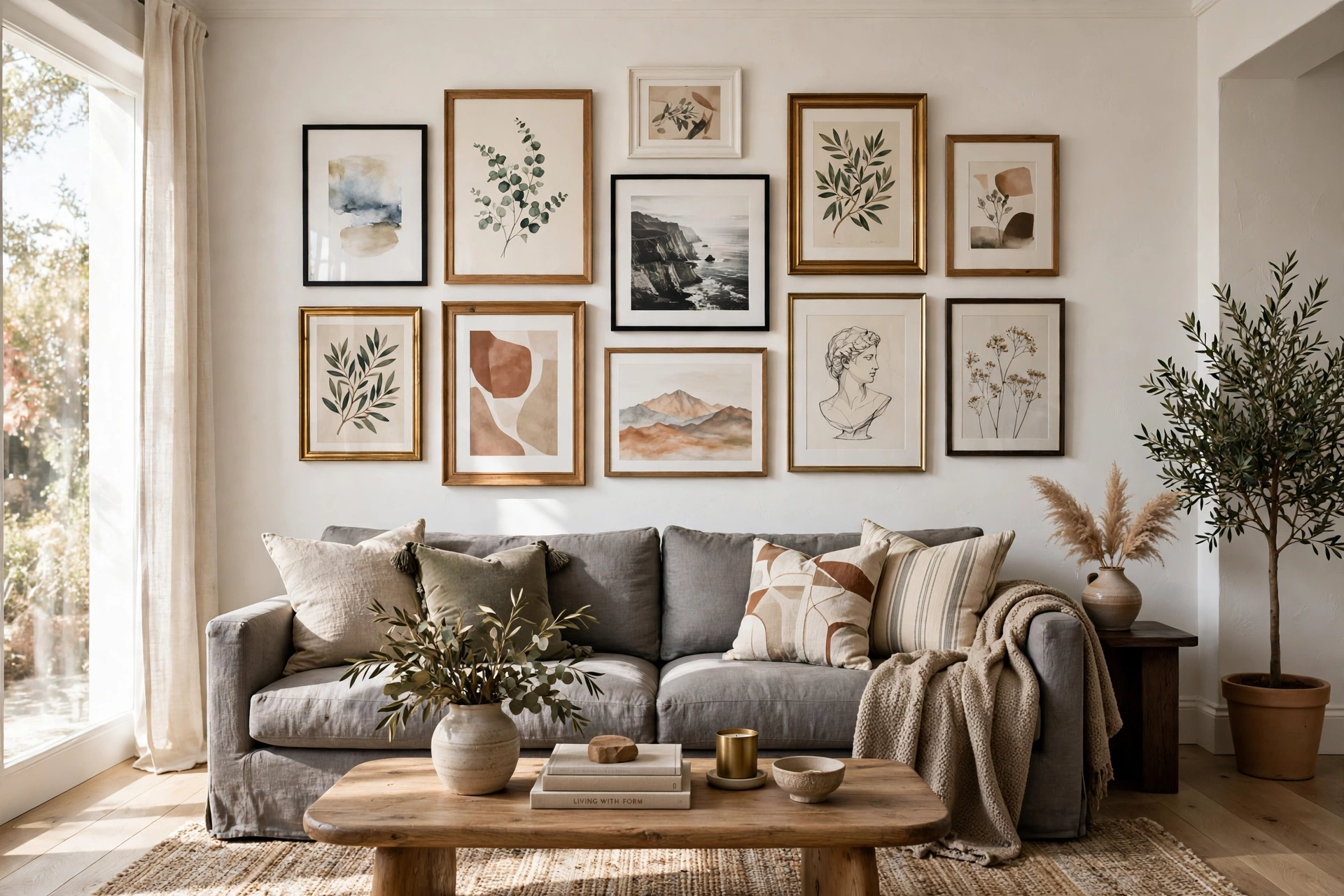
Lay the gallery on the floor first and photograph it — what looks balanced on the floor translates directly to the wall.
Tiny frames scattered wide read as clutter, not gallery — keep the arrangement tight, roughly two-thirds of the sofa’s width.
IDEA 03Wood Slat Wall — Warmth Behind the Sofa
Vertical wood slats bring the warmth of a full wood wall at a fraction of the cost and visual weight — the gaps between slats keep it airy, and the vertical lines quietly stretch a low ceiling. Behind the sofa it reads as a designed backdrop: the slats and a wooden coffee table share a material language without matching.
1×2 or 1×3 furring strips ($80–$250 for one wall), spaced 1/2 to 1 inch apart on a painted backer — paint the backer dark (charcoal, deep green) so gaps read as shadow, not drywall. Run slats wall-to-wall, not sofa-width — stopping at the sofa’s edges shrinks the room. Full day with a nail gun. Light oak for calm, walnut stain for drama. Renters: build slats on a plywood backer hung from a French cleat — the whole wall comes down in minutes.

Run slats behind side tables too — stopping them at the sofa’s edges makes the wall read narrower than it is.
Slats spaced wider than 1 inch start reading as fence, not design — keep gaps tight and even, and pre-finish every strip before mounting.
IDEA 04Board and Batten — Instant Architecture
Board and batten’s trim grid gives the sofa wall paneled depth flat paint can’t: shadows fall in the grooves, the wall gains rhythm, and the sofa sits against something with presence. Behind a low-profile sofa it reads classic; behind a chunky sectional, tailored.
Layout rule: verticals wider than the sofa by one panel each side, horizontals at chair-rail height or full-height — full-height suits tall sofa backs, two-thirds suits low ones. $60–$150 in 1×2 or 1×3 pine, painted wall-color (tone-on-tone = calm) or a shade deeper (definition). One full day with a miter saw and nail gun. Renters: heavy-duty removable strips, or a freestanding panel the sofa hides behind.
Paint the wall behind the trim first in the final color — gaps between boards disappear and the grid reads seamless.
Uneven panel spacing is the #1 giveaway of a DIY batten job — dry-lay the full grid with painter’s tape on the wall before cutting a single board.
IDEA 05Wallpaper Feature Wall — Pattern at Sofa Scale
Wallpaper behind the sofa is the fastest way to a finished, furnished look: botanicals, geometrics, grasscloth textures — the sofa grounds even the boldest print, because the solid sofa mass calms the pattern. One wall of print reads as design; four walls read as a theme park.
Scale rule: pattern scale follows sofa scale — a three-seater carries large-scale prints; a loveseat drowns in them. $60–$220 for 2–4 rolls, 3–5 hours. Paste-the-wall is renter-feasible; peel-and-stick is renter-perfect. The sofa hides the bottom edge, so start hanging from the top and let the sofa cover any imperfect trim line.

Start the first panel at the sofa’s centerline and work outward — the seam pattern stays symmetrical where it matters most.
A busy print behind a patterned sofa is visual war — rule: one of them leads. Patterned sofa → quiet wall. Plain sofa → go bold.
IDEA 06Limewash — Old-World Walls in an Afternoon
Limewash’s hand-brushed, cloud-like texture gives the sofa wall movement that flat paint can’t — the wall shifts subtly with the light, which reads as depth in small living rooms. Behind a simple linen sofa it’s pure Mediterranean calm: warm white, clay, sage, or dusty rose.
$50–$90 and half to a full day with a block brush — the technique is forgiving by design (the “mistakes” are the texture). Living rooms have no moisture worries, so leave it unsealed for true matte depth. Renters: it repaints like any paint. Keep sofa cushions simple — limewash plus busy patterns fights for attention.
Work in 3-foot sections with a loaded brush — limewash dries fast, and reworking a dry edge leaves lap lines the texture can’t hide.
IDEA 07Two-Tone Wall — Geometry in Two Cans
A crisp horizontal line splitting the wall into two colors is the fastest architectural trick here: darker below, lighter above (or vice versa) creates a dado-rail effect with zero carpentry. Behind the sofa, align the split with the sofa back’s top — the line extends the sofa’s silhouette across the whole wall.
$30–$60 for two quarts, half a day. The line is everything: laser level, quality tape, and seal the tape edge with the base color first so the top color can’t bleed under. Classic split at 36 inches; bolder at two-thirds height. Deep below anchors the sofa; deep above lifts the ceiling — pick the illusion your room needs.
Paint the lighter color first across the whole wall, then tape and roll the darker half — the light base seals the tape edge for a razor line.
A wavy split line ruins the entire effect — this is the one idea where a $30 laser level isn’t optional.
IDEA 08Shiplap — Farmhouse Lines That Frame the Sofa
Shiplap’s clean horizontal (or vertical) lines add instant architecture to the flat box behind the sofa — and unlike a full wood wall, the shadow gaps keep it from feeling heavy. Horizontal planks widen a narrow living room; vertical planks lift a low ceiling. Behind a simple sofa it reads as the seating area’s natural backdrop.
$80–$200 in 1×6 or 1×8 boards, a full day. Paint it: white for coastal, black for modern farmhouse drama, sage for the middle path. Run it wall-to-wall, not sofa-width — stopping at the sofa’s edges shrinks the room. Renters: adhesive-mounted lightweight planks on smooth walls, removed with heat.
Caulk the top edge where shiplap meets the ceiling — the shadow line there is where DIY shiplap looks unfinished.
Butt joints landing randomly across the wall scream DIY — stagger them like brickwork, never stacked in a column.
IDEA 09Built-In Shelving — Storage as the Accent
Shelving flanking and spanning above the sofa turns the wall into a library backdrop: books, plants, and objects frame the seating area like a stage set. It’s the only idea here that adds storage and accent in one move — and in small living rooms, that double duty is gold.
$150–$400 for two bookcases plus a bridging shelf, or a weekend of DIY built-ins. Layout: shelves start at sofa-back height or above — nothing at head-bump level behind seated guests. Keep the bottom shelf clear of the sofa back by a few inches so cushions don’t knock objects. Renters: two freestanding bookcases + a top bridge shelf, no screws in the wall at all.
Leave 20% of shelf space empty — packed shelves read as storage, breathing shelves read as display.
Shelves at head height behind a sofa are a concussion risk — nothing heavy, nothing sharp, nothing below 6 feet over seated heads.
IDEA 10Geometric Painted Pattern — Wallpaper Looks for $40
Tape-and-paint geometry — arches, triangles, color blocks, half-moons — delivers wallpaper’s rhythm at a tenth of the price. Behind the sofa it’s ideal because the sofa covers the bottom: any slight wobble hides where nobody looks, while the visible upper pattern reads crisp.
$30–$70 for tape and two to three quarts. Center the design on the sofa’s centerline and let it extend past the sofa’s width on both sides — a pattern exactly sofa-wide reads as a poster. Bold contrast for modern rooms; tone-on-tone for calm ones. Half to a full day. Renters: repaints clean.
Seal every tape edge with the base color first — crisp lines are the entire difference between geometric and kindergarten.
A pattern that stops exactly at the sofa’s edges looks like a backdrop board — extend it at least 12 inches past each side.
IDEA 11Large-Scale Art Wall — One Piece, Done
Sometimes the accent is one enormous piece of art: a 4-foot canvas, a textile hanging, a framed print that spans two-thirds of the sofa. One decision, one hanging, and the wall is finished — no gallery math, no paint, no pattern matching.
Scale rule, non-negotiable: the art spans two-thirds to three-quarters of the sofa’s width and hangs with its center at eye level when standing — which, above a sofa, usually means 6–8 inches above the sofa back. $50–$300 (thrifted canvas + paint, or a printed textile). Renters: lean oversized art on the sofa back’s top edge — zero holes, gallery energy intact.
Lean the art against the wall on top of a console or the sofa back first — if it looks right leaning, it will look right hung.
One small frame centered above a big sofa is the saddest wall in design — if the art is under half the sofa’s width, it needs company or a bigger frame.
IDEA 12Floating Shelf Display Wall — the Rotating Gallery
Two or three floating shelves above the sofa create a gallery you can restyle in minutes: lean art, stack books, rotate plants and objects with the seasons. Unlike a fixed gallery, nothing is permanent — the wall evolves without new holes.
$40–$120 for two to three shelves and brackets, half a day. Height: lowest shelf 8–10 inches above the sofa back (higher than art, because objects sit on the shelf and need head clearance). Stagger lengths or keep them equal — equal reads calm, staggered reads collected. Renters: this one needs screws, so ask first in writing; the holes are small and spackle-clean.
Put the heaviest object closest to the bracket, not the shelf’s free end — sagging shelves are a slow-motion disaster.
Shelves above a sofa need a lip or rail for leaning art — one bump from a tall guest and unsecured frames slide off.
IDEA 13Peel-and-Stick Wallpaper — the Renter’s Power Move
The living room’s renter champion: vinyl peel-and-stick wallpaper on the sofa wall delivers mural-level impact with a clean exit. Botanicals, geometrics, textured grasscloth-looks — the sofa wall is the perfect single-wall commitment because the solid sofa grounds even the boldest print.
$40–$120 for 2–3 rolls, two to three hours. Behind-sofa rules: scale the pattern to the sofa — three-seaters carry large-scale prints; a loveseat drowns in them. Hang with the sofa pulled out, smooth from the center out, trim at the baseboard. Fully removable, zero repaint — no landlord conversation needed.
Start the first panel at the sofa’s centerline and work outward — the seam pattern stays symmetrical where it matters most.
Textured or dirty walls defeat the adhesive — wipe the wall down and let it dry fully before a single panel goes up.
IDEA 14Brick Veneer — Industrial Character, Thin Profile
Thin brick veneer gives the sofa wall industrial permanence — the texture of a loft wall without structural work. Behind a leather or linen sofa it reads as collected-over-time character: the brick’s roughness against soft upholstery is the whole contrast.
$120–$300 for thin-brick panels or individual veneers, a weekend. Whitewash or limewash the brick if raw red fights your palette — the wash keeps the texture, softens the color. Mortar lines should be consistent; the eye forgives color variation, not crooked joints. Renters: peel-and-stick brick panels on smooth walls, removed with heat — partial, so test a hidden patch first.
Seal the brick after install — unsealed veneer sheds dust onto the sofa below for months.
Brick behind a sofa collects dust in every groove — if you hate dusting, this is the wrong wall for you.
IDEA 15Mirror + Paint Combo — Light Doubled, Room Doubled
Paint the sofa wall a rich supporting color (deep green, warm clay, ink blue), then hang one large mirror above the sofa. The paint makes the mirror deliberate; the mirror doubles the room’s light and visually pushes the wall back — the best small-living-room trick in this list.
$60–$200 for paint plus a large mirror (thrift + spray-painted frame = cheapest). Size rule: mirror width two-thirds of the sofa’s width, bottom 6–8 inches above the sofa back — same as art, because a mirror is art here. Angle check: stand where guests sit and confirm the mirror reflects something worth doubling — a window or art, never a blank wall or the TV. Renters: lean an oversized mirror on the sofa back’s top edge, secured at the top.
Hang the mirror to reflect the room’s best feature — a window, a plant, art. A mirror reflecting clutter doubles the clutter.
A mirror hung too high above the sofa reflects the ceiling — 6–8 inches above the sofa back, no higher.
Sofa Wall Rules: Why the Sofa Wall Wins
The sofa wall is the accent wall by physics, not opinion. Rule one: it’s the sight-line wall. You see it the moment you enter — the sofa faces the doorway in most layouts, so the wall behind it is the room’s billboard. An accent anywhere else competes with this focal point; an accent here amplifies it. Rule two: the sofa anchors it. The sofa gives the accent a base — every idea above uses the sofa as composition, not competition.
Rule three: symmetry starts at the sofa. Center every treatment — galleries, mirrors, patterns, shelving — on the sofa’s centerline, not the wall’s. Sofas sit off-center in real rooms; centering on the wall is the #1 behind-sofa mistake. Rule four: respect sofa height. Low sofa? The accent carries the upper wall (galleries, tall panels, mirrors). High-back sofa? The accent frames it (batten, slats, two-tone aligned to its top).
The two genuine exceptions: a TV wall and a fireplace wall. If the sofa faces a TV or a fireplace, that wall is already the focal point — accenting the sofa wall too splits the room’s attention. In those rooms, keep the sofa wall quiet (tone-on-tone, one large piece) and let the TV or fire lead.
Stand in the doorway and squint — the blur test. If the accent reads clearly at a squint, its scale is right; if it dissolves, it’s too timid for the wall.
Never accent the window wall instead of the sofa wall in a living room — curtains fight the accent, light washes it out, and the sofa wall sits there looking unfinished.
Sofa-Complement Colors: Contrast vs. Tone-on-Tone
The wall’s job is to make the sofa look good — and that means two strategies. Contrast: the wall sits opposite the sofa on the color wheel or in lightness — dark green behind a beige sofa, ink blue behind a cream one. Contrast makes the sofa pop and the room read as designed. Tone-on-tone: the wall sits a shade or two from the sofa — sage wall behind an olive sofa, warm white behind cream. Tone-on-tone reads calm, expensive, and cohesive — but demands texture (slats, batten, limewash) so the room doesn’t flatten into one blob.
Sofa fabric rules the choice. Patterned sofa → quiet wall (solid color, subtle texture) — the sofa is already the pattern. Plain sofa → the wall can carry the pattern (wallpaper, geometry, gallery). Leather sofa → warm walls (clay, olive, warm charcoal) beat cool ones; velvet sofa → deep jewel walls (emerald, navy) echo the luxury. Finish: eggshell everywhere — matte shows scuffs where heads rest; semi-gloss is too shiny for a living wall. Sample on a board behind the actual sofa cushions, in evening light — living rooms live at night, and chips lie in daylight.
The 60-30-10 of the sofa wall: 60% wall color, 30% sofa in a related tone, 10% contrast in cushions or art. Break it and the wall fights the sofa.
Test the color behind your actual sofa cushions — hold the swatch between cushion and wall. If the sofa disappears into it, go a shade deeper or lighter.
Painting the sofa wall to match the sofa exactly creates a visual blob — the sofa needs contrast against its backdrop to read as furniture, not camouflage.
Renter Rules: What You Can and Can’t Do
- Always safe: repainting the sofa wall (primer covers everything), peel-and-stick wallpaper and murals, leaning oversized art and mirrors, fabric panels on cleats or strips, Command-strip galleries, freestanding bookcases flanking the sofa. The sofa hides mounting hardware.
- Safe with care: lightweight trim on removable strips (test hidden first — “removable” varies by paint age), adhesive shiplap on smooth walls (heat to remove), floating shelves with small anchors (spackle-clean).
- Ask first, in writing: anything nailed or screwed (batten, slats, cleats, heavy shelves). Photograph the wall on move-in day so “original condition” is documented.
- Never: assume spackle hides everything — large anchors need proper patching, and textured walls show repairs. Keep the original color name: “landlord white” is a real paint-matching headache.
The sofa wall takes the most abuse in a rental — heads rest against it, cushions scuff it. Photograph it on move-in day or you’ll pay for “damage” that was already there.
A $40 gallon of paint plus $15 of primer is the cheapest lease negotiation in existence. Keep receipts — some landlords reimburse “improvements.”
5 Mistakes to Avoid
- Art too small for the sofa. One small frame centered above a big sofa is the saddest wall in design. The treatment — art, gallery, mirror, pattern — must span roughly two-thirds of the sofa’s width, or it reads as an afterthought.
- Treatment narrower than the sofa. Paint, slats, shiplap, or batten stopping exactly at the sofa’s edges reads as a backdrop board, not a wall. Extend treatments wall-to-wall or at least 12 inches past each side.
- Art hung too high. Art floating a foot above the sofa disconnects from the seating area entirely. Bottom of frames or mirror: 6–8 inches above the sofa back — no higher. Shelves: 8–10 inches, because objects need head clearance.
- Busy pattern fighting the sofa fabric. Patterned sofa plus patterned wall is visual war. Rule: one of them leads. Statement sofa → quiet wall. Statement wall → plain sofa.
- Ignoring the sofa’s color. A wall chosen without the sofa in the room — dark wall behind a dark sofa (camouflage), clashing undertones (warm wall, cool sofa) — makes both look wrong. Always sample against the actual cushions, in evening light.
FAQs
01What is the best accent wall behind a sofa?
The best all-rounder is one dark painted wall — deep green, charcoal, or navy — because it costs $35–$70, takes half a day, and instantly gives any sofa a backdrop. If you want personality without paint, a gallery wall above the sofa is the classic; if you want texture, wood slats or board and batten. The right pick depends on your sofa: plain sofa → go bold with pattern or color; patterned sofa → keep the wall quiet and textured.
02How high should I hang art above a sofa?
6–8 inches above the sofa back — measured from the top of the sofa cushions to the bottom of the lowest frame. Higher and the art floats away from the seating area; lower and seated heads bump it. The same rule holds for mirrors. For floating shelves, go slightly higher — 8–10 inches — because objects sitting on the shelf need head clearance. Center everything on the sofa’s centerline, not the wall’s.
03How wide should an accent wall treatment be compared to the sofa?
For art, galleries, and mirrors: roughly two-thirds of the sofa’s width — narrower reads timid, wider overwhelms. For paint, slats, shiplap, batten, and wallpaper: wall-to-wall, or at least 12 inches past each side of the sofa. A treatment stopping exactly at the sofa’s edges reads as a backdrop board, not a wall. When in doubt, go wider — the sofa wall is big, and timid treatments shrink against it.
04What works as an accent wall behind a sofa in a small living room?
Small living rooms reward light-doubling and vertical thinking: a mirror + paint combo (the mirror pushes the wall back visually), vertical slats or stripes that lift the ceiling, and light-to-mid tones that stay airy. The dark-wall trick works too — dark recedes — but only with real layered lighting. Avoid tiny art, fussy small patterns, and anything stopping short of the wall’s edges. Scale up 20% past what feels safe.
05What are the best renter-friendly options for the wall behind a sofa?
Ranked by impact and reversibility: peel-and-stick wallpaper (fully removable, biggest transformation), one-wall repaint (primer covers everything), leaning oversized art or mirrors (zero holes), Command-strip galleries, and freestanding bookcases flanking the sofa. The sofa hides mounting hardware, which makes this the most renter-forgiving accent wall in the house. Photograph the wall on move-in day.
06Can I put wallpaper behind a sofa?
Yes — it’s one of the best wallpaper walls in the house. The solid sofa grounds even bold prints, and the sofa hides the bottom edge, so imperfect trim lines disappear. Scale the pattern to the sofa: three-seaters carry large-scale prints; a loveseat drowns in them. Paste-the-wall is renter-feasible; peel-and-stick is renter-perfect. One caution: patterned sofa plus patterned wallpaper is visual war — one of them must stay quiet.
Key takeaways
- The sofa wall is the living room’s face. Sight line from the doorway, sofa as anchor — every accent wall behind sofa idea here amplifies the room’s natural focal point instead of fighting it.
- Center on the sofa, not the wall. Galleries, mirrors, patterns, shelving — all measured from the sofa’s centerline, since real sofas sit off-center.
- Two-thirds for art, wall-to-wall for treatments. Art spans two-thirds of the sofa’s width; paint, slats, and wallpaper run past the sofa’s edges, never stopping at them.
- 6–8 inches above the sofa back. Art and mirrors hang low and connected; shelves sit slightly higher for head clearance.
- One of them leads. Statement sofa → quiet wall. Statement wall → plain sofa. Never both shouting.