 Casacrunched
15 Fireplace Accent Wall Ideas That Make the Fire the Star
The fireplace wall is already the focal point of the room — the fire does half the work. Fifteen ideas that make it the star, with heat-safety rules for every material.

Every living room already has a focal wall: the fireplace wall. It’s the wall the sofa faces, the wall the mantel anchors, the wall every eye lands on first. The question isn’t whether to accent it — it’s how to do it without fighting the one constraint no other accent wall has: heat. Fifteen fireplace accent wall ideas built around that constraint — clearances, heat-safe materials, and mantel proportions — with honest costs, times, and renter-safe options.
One safety note: the rules below follow common manufacturer guidance — combustibles 6 inches from the opening, high-heat paint on hot surfaces, and your fireplace manual first. Your specific unit always outranks a blog post, including this one.
On this page
- Quick comparison table
- 1. Dark paint behind fireplace
- 2. Shiplap chimney breast
- 3. Stone veneer
- 4. Wood slat chimney
- 5. Limewash brick fireplace
- 6. Tile surround accent
- 7. Board and batten chimney
- 8. Bold color chimney
- 9. Two-tone chimney breast
- 10. Wallpaper on chimney
- 11. Built-in shelves + paint
- 12. Mantel styling with accent
- 13. Peel-and-stick for renters
- 14. Brick whitewash
- 15. Ceiling-height color block
- Which wall?
- Heat-safe paint guide
- Renter rules
- 5 mistakes to avoid
- FAQs
Quick comparison: cost, time, renter score
| # | Idea | Cost / wall | Time | Renter-friendly? |
|---|---|---|---|---|
| 1 | Dark paint behind fireplace | $35–$70 | Half day | Yes (repaint) |
| 2 | Shiplap chimney breast | $80–$200 | Full day | Adhesive: partial |
| 3 | Stone veneer | $150–$400 | Weekend | No (adhesive: partial) |
| 4 | Wood slat chimney | $80–$250 | Full day | French cleat: yes |
| 5 | Limewash brick fireplace | $50–$90 | Half–full day | Yes (repaint) |
| 6 | Tile surround accent | $100–$300 | Weekend | No (adhesive: partial) |
| 7 | Board and batten chimney | $60–$150 | Full day | Removable trim: yes |
| 8 | Bold color chimney | $35–$70 | Half day | Yes (repaint) |
| 9 | Two-tone chimney breast | $30–$60 | Half day | Yes (repaint) |
| 10 | Wallpaper on chimney | $40–$150 | 2–4 hours | Peel-and-stick: yes |
| 11 | Built-in shelves + paint | $150–$500 | Weekend+ | No (freestanding: yes) |
| 12 | Mantel styling with accent | $20–$100 | 1–2 hours | Fully removable |
| 13 | Peel-and-stick for renters | $40–$120 | 2–3 hours | Fully removable |
| 14 | Brick whitewash | $30–$60 | Half day | Yes (repaint) |
| 15 | Ceiling-height color block | $35–$70 | Half–full day | Yes (repaint) |
IDEA 01Dark Paint Behind the Fireplace — the Instant Focal Point
The cheapest transformation on this list: paint the chimney breast dark and matte — charcoal, deep forest green, ink navy — and the fireplace stops being a hole in a white wall and becomes the room’s anchor. The fire reads brighter against dark, the mantel pops, and the whole wall gains evening drama for the price of a gallon.
Heat rule: standard latex paint is fine on the chimney breast itself — the wall face away from the opening rarely exceeds 100°F — but never use it on the firebox surround or any surface that gets genuinely hot. Those need high-heat paint rated to 1200°F. Keep the dark paint at least 6 inches from the opening, and let the surround stay brick, stone, or tile. $35–$70, half a day.
Use matte finish on the breast — sheen near a fire catches flickering light and turns the wall into a distraction.
Dark breast + white mantel = a floating shelf effect. Paint the mantel the same dark tone, or go dark wood, so the composition reads as one unit.
IDEA 02Shiplap Chimney Breast — Texture the Fire Can’t Fight
Shiplap’s clean horizontal lines give the chimney breast texture that doesn’t compete with the flame: the eye reads planks as background, not content. That’s the key test for any fireplace treatment — interest without pulling focus from the fire. Shiplap passes. Paint it white for coastal calm, charcoal for drama, sage for the middle path.
Heat rule: shiplap is wood, so it is combustible — keep it outside the 6-inch clearance zone around the opening, and never run planks across the firebox face. On gas fireplaces, check the manual: many require non-combustible facing within 12 inches of the opening. Planks go on the breast face only; the surround stays brick, stone, or tile. $80–$200, a full day.
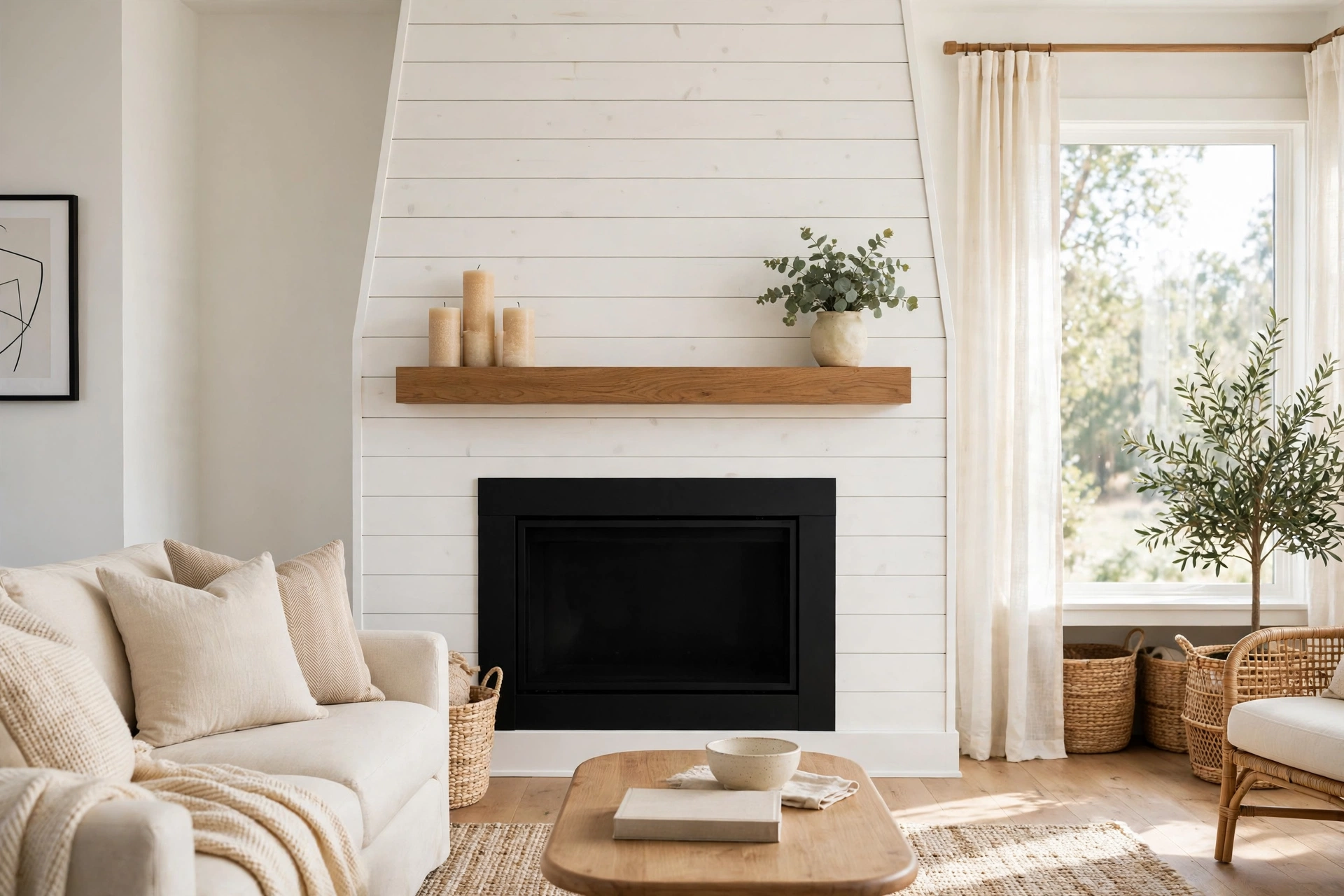
Wood planks across or inside the clearance zone are a fire risk, not a design choice — measure the 6-inch zone before the first plank goes up.
IDEA 03Stone Veneer — the Hearth, Floor to Ceiling
Faux stone veneer gives the fireplace wall the gravitas of a real hearth — stacked stone, ledgestone, river rock — floor to ceiling, so the fireplace reads as architecture rather than an appliance in a wall. It’s the most transformative idea here.
Heat rule: stone veneer is non-combustible, which is why it’s the right material closest to the opening — it can run right up to the firebox face where wood and paint cannot. Panels fix with adhesive and screws into studs; the mantel mounts through the stone. $150–$400, a weekend. Confirm stud framing before hanging stone plus a heavy mantel.
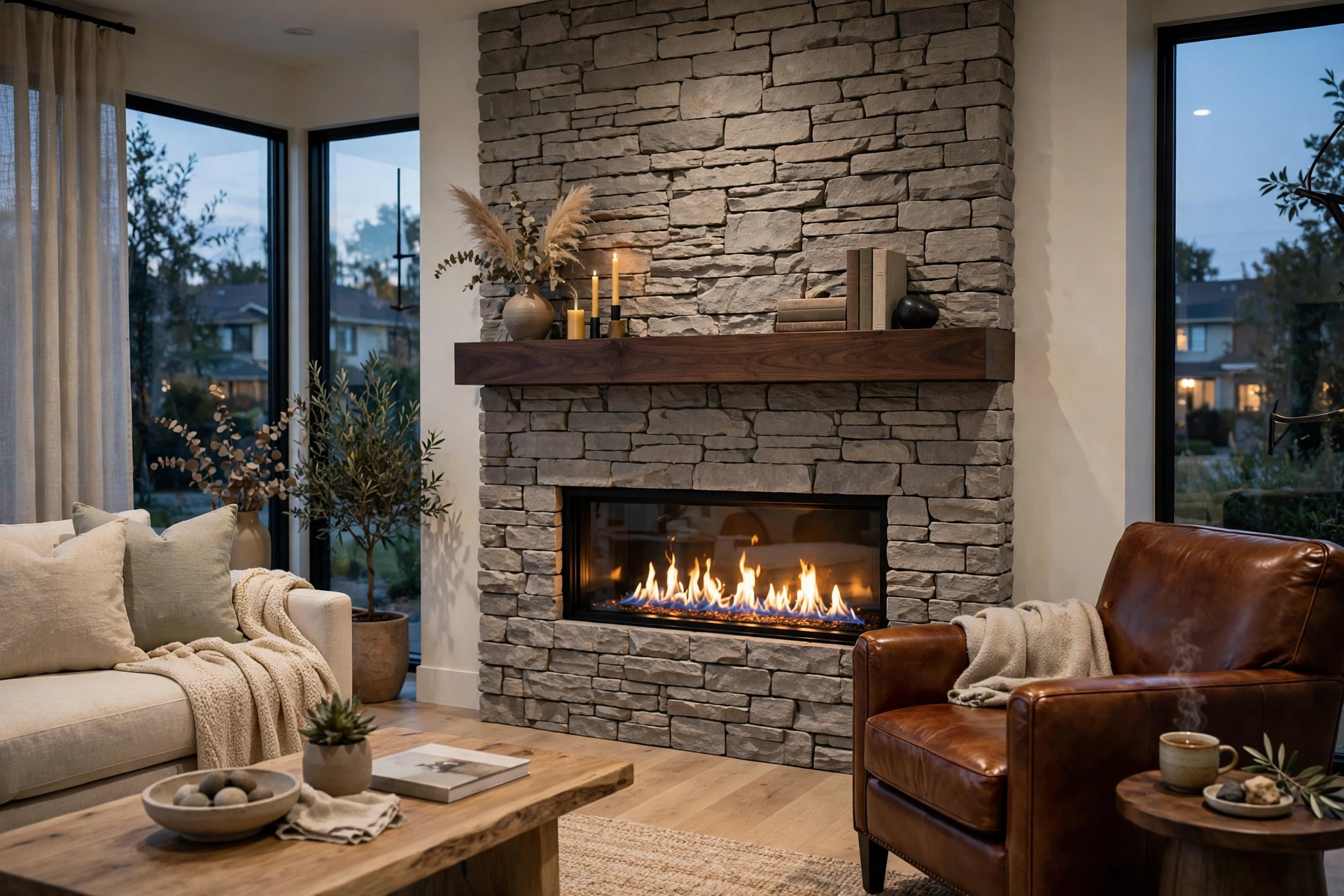
Stone plus a solid-wood mantel is heavy — if the mantel bracket isn’t in studs, it will creep down over months.
IDEA 04Wood Slat Chimney — Warmth, Kept at a Distance
Vertical wood slats bring the living room’s warmest texture to the fireplace wall: light oak for calm, walnut for drama, the slat rhythm stretching the breast’s height. The fireplace sits inside the slat field like a hearth in a timber frame.
Heat rule: same as shiplap — slats are combustible, so they stay outside the 6-inch clearance zone and off the firebox face. Build the slat field on the breast face around a brick or tile surround, never over it. On wood-burning units, extend clearance to 12 inches if the manual calls for it. $80–$250 in furring strips on a dark backer. Renters: slats on a French-cleat backer.
Paint the backer dark before slats go up — light gaps between slats read as stripes; dark gaps read as shadow.
Slats spaced wider than 1 inch start reading as fence — and wide gaps near a firebox invite stray sparks toward the backer. Keep gaps tight.
IDEA 05Limewash Brick Fireplace — Old-World Walls in an Afternoon
If you already have a brick fireplace, limewash is the gentlest revolution: a thin, breathable mineral wash that softens red brick into warm white, clay, or sage while letting the brick’s texture show through. It turns a dated red-brick fireplace into a Mediterranean focal point in an afternoon.
Heat rule: limewash is mineral-based and heat-safe on brick — it’s the rare finish that can go right onto the surround, since brick itself is the heat barrier and limewash bonds to it without off-gassing the way latex can when overheated. Still, keep it off the firebox interior and metal parts. $50–$90, half to a full day with a block brush; the technique is forgiving.
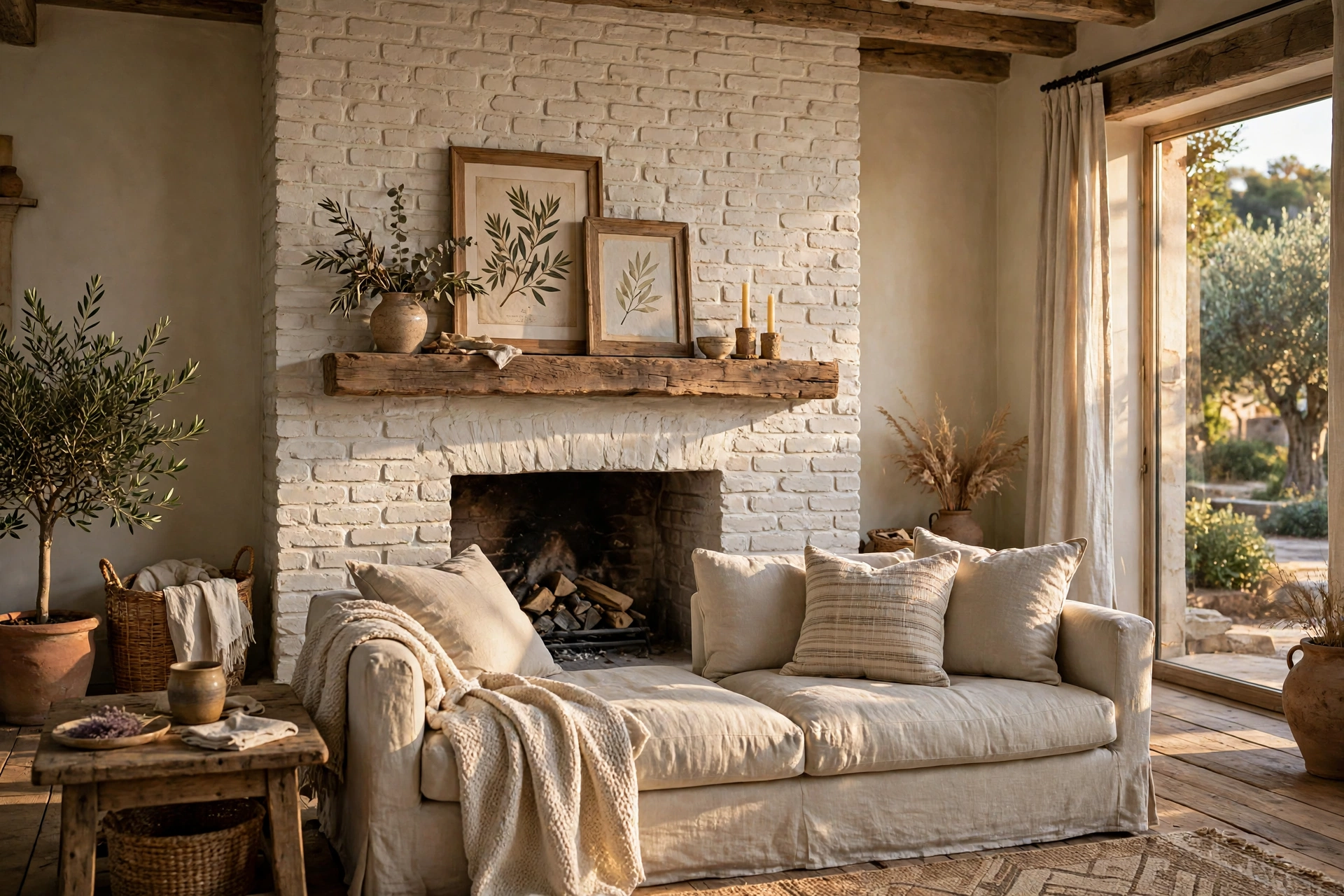
Test the wash on one hidden brick first — limewash dries lighter than it looks wet, and two thin coats beat one thick one.
Limewash over previously painted brick needs a bonding primer first, or it peels within months — check whether your brick is already painted.
IDEA 06Tile Surround Accent — the Jewel Box Frame
Tile is the fireplace’s natural jewelry: a bold surround — encaustic pattern, zellige shimmer, deep-green subway, terracotta hex — framing the opening while the breast above stays quiet paint. The tile becomes the accent, the fire the centerpiece — the two never compete because tile literally frames the flame.
Heat rule: tile and grout are non-combustible, so the surround is the safest place for bold material — it can touch the opening. Use heat-rated thinset and grout, and seal porous tile (terracotta, encaustic) against soot. $100–$300, a weekend including grout cure. Keep the breast above simple — tile plus a busy breast is two accents fighting.
Carry the tile 6–12 inches past the opening on each side — a surround exactly opening-wide reads as trim, not design.
Unsealed porous tile near a wood fire absorbs soot permanently — seal before the first fire, not after.
IDEA 07Board and Batten Chimney — Tailored Architecture
Trim boxes applied to the chimney breast read as tailored architecture: the fireplace sits inside a paneled grid. It suits traditional rooms where slats feel too modern — classic molding, wall-color for quiet luxury or a shade deeper for definition.
Heat rule: trim is wood, so it follows the combustible rule — outside the 6-inch clearance zone, breast face only, surround left in brick, stone, or tile. Layout: one large central panel sized to the fireplace plus 6–10 inches, flanked by narrower panels, so the firebox becomes the grid’s centerpiece. $60–$150, a full day. Renters: trim on heavy-duty removable strips, tested on a hidden spot first.
Paint the trim and the breast the same color — contrasting trim chops a chimney breast into boxes; same-color trim reads as architecture.
IDEA 08Bold Color Chimney — the Room’s Exclamation Point
Not every fireplace wall wants to be dark and moody. A bold chimney — terracotta, ochre, deep teal, burnt sienna — turns the breast into the room’s exclamation point, especially in otherwise neutral rooms where one saturated wall is all the color the space needs. The fire warms the color further at night.
Heat rule: same as dark paint — standard latex on the breast face, high-heat paint only on surfaces that get genuinely hot, 6-inch clearance from the opening. Bold colors show soot faster than dark ones near a wood fire, so wipe the breast face monthly in burning season. $35–$70, half a day. Sample at night with the fire lit.
Repeat the chimney color once elsewhere — a throw, a vase, one cushion — or the bold wall reads as an accident.
IDEA 09Two-Tone Chimney Breast — Geometry in Two Cans
Instead of one color for the whole breast, paint two tones — a deep tone on the lower breast, a lighter one above the mantel, split at the mantel line or at a chair-rail height. The split gives the chimney breast geometry without trim, and the darker lower half grounds the firebox while the lighter upper half keeps the room from feeling top-heavy.
Heat rule: both coats are latex on the breast face — same 6-inch clearance, same high-heat rule for hot surfaces. The split line’s edges are the design: laser level, quality tape, seal the tape edge with the base color first so the second coat can’t bleed under. $30–$60, half a day. Renters: it’s just paint.
A wavy split line ruins the entire effect — this is the one idea where a $30 laser level isn’t optional.
IDEA 10Wallpaper on the Chimney — Pattern, Kept Cool
Wallpaper on a chimney breast works — with one condition: distance from heat. Grasscloth, tone-on-tone geometrics, or soft botanicals on the breast face, kept clear of the opening and the surround, add pattern no paint can match. The fireplace grounds even a bold choice, and the breast becomes the room’s most decorated wall.
Heat rule: this is the idea where heat matters most. Paper and vinyl are combustible — keep wallpaper at least 12 inches from the opening, never on the surround, and never above a wood-burning firebox where rising heat concentrates. On electric fireplaces, which barely warm the wall, the rule relaxes — but on wood or gas, measure twice. $40–$150, 2–4 hours. Renters: peel-and-stick is the obvious pick, fully removable.
Choose a pattern whose repeat is larger than the firebox — small busy repeats shimmer in firelight and distract from the flame.
Wallpaper above a wood-burning opening is the #1 heat mistake on this list — rising heat dries paste, curls seams, and in the worst case chars paper.
IDEA 11Built-In Shelves + Paint — the Library Fireplace
The full-commitment answer: shelving flanking the fireplace — painted the breast color, filled with books, ceramics, and one or two plants — so the fire sits inside a library wall rather than alone on a blank breast. The paint unifies shelves, breast, and mantel into one composition.
Heat rule: shelves are wood, so they follow the combustible rule — keep shelf uprights outside the 6-inch clearance zone, and never store books or decor within 12 inches of the opening. Heat rises, so the shelf above the mantel needs the most clearance: check the manual’s mantel-height rules before loading it. $150–$500, a weekend or more. Renters: freestanding bookcases deliver 80% of the look with zero screws.
Books stored within a foot of the opening dry out, warp, and in the worst case scorch — the clearance zone is for air, not storage.
IDEA 12Mantel Styling With Accent — Zero Paint, Full Effect
The no-commitment idea: leave the breast alone and let the mantel do the accent work. A dark-stained mantel beam on a light breast, tall candlesticks, one oversized mirror above — the mantel becomes the accent, the breast stays quiet, and the whole composition changes in an afternoon with nothing permanent.
Heat rule: the mantel is the closest decor to the fire, so it follows the strictest rules: keep decor off the mantel’s front edge above a wood fire (rising heat), never hang fabric or dried flowers directly above the opening, and check the manual’s mantel-height clearance before adding a tall mirror. $20–$100 for styling pieces, one to two hours. Fully removable — the ultimate renter move.
One tall piece beats five small ones above a mantel — a single mirror or large art anchors the breast; clutter competes with the fire.
Dried flowers and fabric garlands directly above a wood fire are kindling with good intentions — keep flammables off the mantel’s front edge.
IDEA 13Peel-and-Stick for Renters — the Electric-Fireplace Special
The renter’s fireplace champion: vinyl peel-and-stick panels — faux brick, stone-look, grasscloth — applied to the breast face, peeling off clean at move-out. On an electric fireplace, which barely warms the wall, this is a free pass: full transformation, zero landlord conversation.
Heat rule: the electric-only caveat matters. Peel-and-stick vinyl is combustible — on wood or gas fireplaces, keep it 12 inches from the opening and off the surround, exactly like wallpaper (idea 10). On electric units, the wall rarely exceeds room temperature, so the breast face is fair game. $40–$120 for 2–3 rolls, two to three hours. Fully removable, zero repaint.
Peel-and-stick on a wood-burning breast is the renter version of idea 10’s mistake — vinyl near real flame heat curls, warps, and off-gasses.
IDEA 14Brick Whitewash — the 50/50 Rescue
Halfway between limewash and paint: a thinned white latex wash — roughly 50/50 paint and water — brushed over red brick so the brick shows through in patches. One morning, one bucket, a fireplace that looks limewashed for a third of the effort.
Heat rule: whitewash is latex-based, so unlike mineral limewash it should stay off the firebox surround and any surface that gets genuinely hot — thinned latex overheats faster than full-strength paint. On the breast face and outer brick, it’s fine: those surfaces stay cool. $30–$60, half a day. Wipe brick clean and dry first.
Work brick by brick, not wall by wall — dabbing each brick individually keeps the wash patchy and natural instead of flat white.
Whitewash over sooty brick seals the soot in — clean with a brick cleaner first, or grey patches will haunt the finish.
IDEA 15Ceiling-Height Color Block — the Full-Height Slab
The boldest paint-only move: a full-height color block — floor to ceiling, the chimney breast’s full width — in a deep tone, rest of the wall left light. The breast becomes a dark slab anchoring the fire and stretching the room’s height.
Heat rule: same as dark paint — latex on the breast face, 6-inch clearance from the opening, high-heat paint only on hot surfaces. The block’s edges are the design: laser level, quality tape, seal the tape edge with the base color first. $35–$70, half to a full day. Align the block’s edges with the mantel below, and keep it the breast’s full width — a narrow stripe reads as an accident. Renters: it’s still just paint.
A block narrower than the breast reads as a stripe, not architecture — go full breast width or don’t bother.
Which Wall? The Fireplace Wall Picks Itself — Mostly
The fireplace wall is usually the living room’s focal wall by default — the wall the sofa faces, the wall with the mantel. But three checks decide whether it works as the accent. Check one: the seating axis. The sofa should face the fireplace squarely, not at an angle — an angled sofa splits focus between fire and television, and no accent fixes a split room. Check two: the television. If the TV shares the fireplace wall, the accent must serve both — dark and quiet wins, busy patterns fight the screen. Mount the TV low, keep the mantel minimal, or move the TV to a side wall.
Check three: the breast’s proportions. The accent should follow the breast’s real edges — floor to ceiling, wall to wall of the breast itself — not an arbitrary rectangle painted around it. Accenting the breast’s full width reads as architecture; accenting a slice of it reads as a mistake.
Stand in the doorway and squint — the first shape your eye finds should be the fireplace, not the television, not a bookshelf. If it isn’t, the accent belongs on the fireplace wall.
The fireplace wall and the TV wall are often the same wall by default — and that’s the worst of both worlds: heat, height, and a mantel fighting the screen. If you must combine them, mount low and keep the mantel minimal.
Heat-Safe Paint: What Goes Where
This is the one accent-wall question with a safety answer, not just a style answer. Three zones, three rules. Zone one: the breast face — the flat wall more than 6 inches from the opening. Standard latex paint, any color, matte finish; this surface rarely exceeds 100°F, and every “paint” idea here means this zone. Zone two: the surround — the brick, stone, or tile immediately around the opening. Non-combustible materials only, or high-heat paint rated to 1200°F. Never standard latex here.
Zone three: the firebox interior and metal parts. Nothing decorative, ever — only manufacturer-approved high-heat coatings, or nothing at all. Within the safe zones: dark matte tones make fire read brighter and hide soot; bold colors need monthly wiping in burning season; white shows soot fastest. Sample colors at night, with the fire lit.
The hand test: hold your palm 6 inches from the opening while the fire runs. If the wall there feels hot to the touch, that surface is zone two — high-heat paint or non-combustible material only.
Buy high-heat paint in spray form for metal surrounds and brush form for masonry — the wrong applicator on the wrong surface is the most common high-heat mistake.
Standard latex on a hot surround doesn’t just peel — it off-gasses, blisters, and can scorch. If a surface gets genuinely hot, it gets high-heat paint or nothing.
Renter Rules: What You Can and Can’t Do
- Always safe: repainting the breast (primer covers everything), mantel styling, freestanding bookcases flanking the fireplace, peel-and-stick on electric-fireplace breasts, leaning art above the mantel.
- Safe with care: peel-and-stick wallpaper on wood or gas breasts (12 inches from the opening, never on the surround), lightweight trim on removable strips (test hidden first), slat fields on French-cleat backers, adhesive shiplap on smooth breast faces.
- Ask first, in writing: stone veneer, tile surrounds, built-in shelving, anything screwed into the breast, any change to the mantel itself. Photograph the fireplace on move-in day.
- Never: paint the surround or firebox, wallpaper within 12 inches of a wood or gas opening, store anything flammable within a foot of the opening, or assume the landlord won’t notice a changed fireplace — it’s the room’s focal point, and they will.
The fireplace is the one feature landlords photograph on move-in day — assume any change will be compared against those photos, and keep the original finish documented.
A $40 gallon of paint plus $15 of primer is the cheapest lease negotiation in existence — and a dark fireplace breast is the one repaint landlords rarely object to, since it reads as an upgrade.
5 Mistakes to Avoid
- Regular paint near heat. Standard latex on the surround or any surface that gets genuinely hot peels, blisters, off-gasses, and can scorch. Hot surfaces get high-heat paint rated to 1200°F or non-combustible material — no exceptions, no “it’ll be fine.”
- Blocking vents. Built-ins, slats, and panels that cover air vents or combustion-air intakes starve the fire and trap heat behind the treatment. Map every vent before the first board goes up, and leave them open.
- Ignoring mantel proportions. A mantel too small for the breast looks lost; one too large swallows the firebox. The mantel should span roughly the breast’s width minus a few inches each side, and sit at the manual’s minimum clearance height — never lower.
- Busy pattern fighting the fire. High-contrast wallpaper or gallery clutter on the breast pulls the eye during the fire’s best moments. Fireplace-wall patterns stay subtle, matte, low-contrast — texture, not content — or the fire loses to the wallpaper.
- Dark wall, no lighting. A dark breast without a light source — sconces, picture light, or the fire itself — reads as a black hole by day. Dark fireplace walls need dedicated light: flank the mantel with sconces, or the drama dies when the fire’s out.
FAQs
01What is the best paint for a fireplace accent wall?
Standard latex paint in a matte finish for the breast face — the flat wall more than 6 inches from the opening, which rarely exceeds 100°F. For the surround or any surface that gets genuinely hot, use high-heat paint rated to 1200°F only — never standard latex there: it peels, blisters, off-gasses, and can scorch. Dark matte tones are the most forgiving choice — they hide soot and make the fire read brighter.
02Can I put wallpaper near a fireplace?
Yes, with distance. Keep wallpaper at least 12 inches from the opening, never on the surround, and never above a wood-burning firebox where rising heat concentrates. On electric fireplaces, which barely warm the wall, the rule relaxes considerably. Peel-and-stick vinyl is the renter pick — fully removable — but follows the same 12-inch rule on wood or gas units. If the wall feels hot to the touch, paper doesn’t belong there.
03What are the heat-resistant options for a fireplace wall?
Ranked by heat tolerance: stone, brick, and tile (non-combustible, safe right up to the opening); high-heat paint rated to 1200°F (for surrounds and hot surfaces); mineral limewash on brick (heat-safe because brick is the barrier); then everything else — latex paint, wood, wallpaper, fabric — kept outside the 6-inch clearance zone, or 12 inches for wallpaper. The zone, not the material alone, decides safety.
04What are the best renter-friendly fireplace accent options?
Ranked by impact and reversibility: mantel styling (zero commitment, full effect), one-wall repaint of the breast in dark matte (primer covers everything at move-out), peel-and-stick panels on electric-fireplace breasts (fully removable), freestanding bookcases flanking the fireplace, leaning art above the mantel. Photograph the fireplace on move-in day.
05Is shiplap safe near a fireplace?
Yes, outside the clearance zone. Shiplap is wood, so it’s combustible — keep it at least 6 inches from the opening, on the breast face only, never across the firebox face. On gas fireplaces, check the manual: many require non-combustible facing within 12 inches of the opening. On wood-burning units, extend the clearance if the manual calls for it. The surround stays brick, stone, or tile — never wood.
06What works for a fireplace wall in a small living room?
Small rooms reward dark-and-simple: a dark matte breast (idea 1) recedes and anchors the fire, a ceiling-height color block (idea 15) stretches the room’s height, and mantel styling (idea 12) adds personality without bulk. Skip heavy treatments like full stone veneer, and keep the mantel minimal — one tall piece, not clutter. Dark recedes; busy shrinks. And always add sconces: a dark breast without light reads as a black hole by day.
Key takeaways
- Heat decides everything for fireplace accent wall ideas. Three zones: breast face (latex paint, fine), surround (non-combustible or high-heat paint only), firebox interior (nothing decorative, ever).
- Clearances are not suggestions. Combustibles 6 inches from the opening, wallpaper 12 inches, mantel at the manual’s minimum height. Measure before the first board goes up.
- Dark and matte wins again. It makes fire read brighter, hides soot, and anchors the room — but only with dedicated light, or the drama dies when the fire’s out.
- The fireplace wall picks itself. It’s the focal wall by default; the accent’s job is to serve the fire, not fight it — texture, not content, around the flame.