 Casacrunched
15 Small Living Room Accent Wall Ideas That Make It Feel Bigger
A small living room doesn’t need a bigger floor plan — it needs a wall that works harder. Fifteen small living room accent wall ideas built on depth tricks: vertical lines, mirrors, light, and furniture-scale rules that make the room feel bigger, not busier.

A small living room does not need a bigger footprint. It needs a smarter wall. In a tight living room, one well-chosen accent wall does the work of an extra few feet: it pulls the eye where you want it, pushes a wall back, lifts a low ceiling, or bounces light into a dark corner. Pick the wrong wall and the same room feels smaller, busier, and harder to sit in. A small living room accent wall is not a decoration decision — it is a space decision, and the rules are different from the ones that govern big rooms.
Fifteen ideas, each built for tight living rooms: depth tricks, light tricks, vertical lines, furniture-scale rules, and honest costs — plus which wall to choose, which colors actually open a room up, and what renters can safely do.
Quick comparison: cost, time, depth trick, renter score
| # | Idea | Depth trick | Cost / wall | Time | Renter-friendly? |
|---|---|---|---|---|---|
| 1 | Soft white paint wall | Light recedes, room breathes | $30–$60 | Half day | Yes (repaint) |
| 2 | Vertical wood slats | Vertical lines lift the ceiling | $120–$300 | Weekend | Cleat backer: yes |
| 3 | Mirror panel wall | Doubles the room visually | $150–$400 | Half day | Leaning panels: yes |
| 4 | Peel-and-stick vertical wallpaper | Pattern pulls the eye up | $40–$120 | Half day | Yes (peels off) |
| 5 | One large artwork, sofa wall | Scale trick: one big beats many small | $60–$250 | An afternoon | Yes (one hook) |
| 6 | Dark wall, done right | Dark recedes behind the sofa | $30–$70 | Half day | Yes (repaint) |
| 7 | Limewash texture wall | Depth without darkness | $70–$140 | Full day | Yes (repaint) |
| 8 | TV wall + floating console | Visible floor = bigger room | $80–$250 | Weekend | Floating: ask first |
| 9 | Floor-to-ceiling curtain wall | Curtains fake a taller wall | $60–$180 | An afternoon | Yes (rod holes patch) |
| 10 | Vertical board and batten | Architecture + height | $100–$250 | Weekend | Ask first |
| 11 | Painted arch accent | Curve draws the eye up | $30–$70 | Half day | Yes (repaint) |
| 12 | Picture-ledge wall | Display without bulk | $40–$120 | Half day | Yes (patch holes) |
| 13 | Half-wall color block | Light on top lifts the ceiling | $30–$70 | Half day | Yes (repaint) |
| 14 | Metallic light-bouncing wallpaper | Reflects light into dark corners | $60–$160 | Half day | Peel-and-stick: yes |
| 15 | Vertical geometric stripes | Eye movement stretches the wall | $30–$90 | Half day | Yes (repaint) |
IDEA 01Soft White Paint Wall — the Light-Recedes Starter
The simplest small living room accent wall is also the most misunderstood: paint one wall a soft white slightly warmer or cooler than the other three, and the room gains a focal point without losing a single inch of perceived space. The trick is contrast you can feel but barely see — a warm white against cool white walls, or a whisper of greige against plain white. Light colors recede, so the accent wall reads as farther away than it is, and the whole room breathes easier.
Technique: primer only if the wall is patched or dark, then two coats in matte or eggshell — matte hides flaws, eggshell survives sofa scuffs better. Put it behind the sofa, not behind the television, so the eye lands on seating, not a screen. $30–$60, half a day.
The white-on-white trick only works if the two whites genuinely differ — hold swatches against the existing wall in daylight, not under store lighting. Two identical whites are a wasted weekend.
IDEA 02Vertical Wood Slats — the Ceiling-Lifter
Vertical lines are the oldest height trick in design, and wood slats are how you buy it for a living room wall. Floor-to-ceiling slats pull the eye upward in one continuous movement, so a standard 8-foot ceiling reads taller — and because the slats are thin, they add texture without stealing floor space the way a bookshelf would. In a small living room, that combination is gold: visual height, zero footprint.
Technique: slats run truly vertical, gaps of half an inch to an inch, on a backer board or directly on the wall — backer boards are the renter move, since the whole panel lifts off in one piece. $120–$300, a weekend. Stop the slats at the ceiling, not at picture-rail height — cutting them short kills the height illusion.
Horizontal slats do the opposite of what you want — they widen a wall that is already wide enough and chop the height. If the slats run sideways, you bought the wrong illusion.
IDEA 03Mirror Panel Wall — the Double-the-Room Trick
No accent wall opens a small living room faster than mirrors. A mirrored wall does not decorate the room — it duplicates it, bouncing light and doubling the visual square footage in a way no paint color can. The trick is doing it without turning the living room into a dance studio: framed mirror panels with thin gaps between them, or one large leaning panel flanked by paint, read as architecture.
Technique: panels hung level to the millimeter with mirror adhesive or French cleats — a tilted panel doubles a crooked room instead of a straight one. Face the window, not the television: facing the window doubles daylight, facing the TV doubles glare. $150–$400, half a day with a second pair of hands. Renters: leaning panels need no holes at all.
Never put a mirror wall opposite the television. Reflected glare makes the screen unwatchable from the sofa, and the room gains light it cannot use.
IDEA 04Peel-and-Stick Vertical Wallpaper — the Renter Hero
Peel-and-stick wallpaper is the small living room’s best friend and the renter’s only true no-commitment accent wall: it goes up in an afternoon, peels off at move-out, and vertical patterns give you the same ceiling-lifting effect as wood slats at a third of the price. The pattern rules for small rooms are strict, though. Vertical stripes, thin botanicals, and tone-on-tone textures open a room up; large-scale florals and busy geometrics close it in.
Technique: one wall only, panels hung top to bottom with a plastic smoother — bubbles are the giveaway that separates a good job from a dorm-room job. $40–$120, half a day. For surface compatibility in detail, see our peel-and-stick accent wall guide.
One wall, not four. Peel-and-stick on every wall of a small living room turns a pattern into a cage — the accent works because the other three walls stay quiet.
IDEA 05One Large Artwork Behind the Sofa — the Scale Trick
Here is the furniture-scale rule that fixes more small living rooms than any paint color: one large piece of art beats ten small ones. A gallery of tiny frames chops a small wall into visual confetti and makes the room feel cluttered; one oversized canvas — roughly two-thirds the width of the sofa — anchors the whole wall and makes the sofa look intentional instead of shoved against a blank surface.
Technique: hang the center at eye level, about 57 inches from the floor, and 6 to 8 inches above the sofa back — higher and the art floats away from the furniture, lower and it collides with heads. One hook, one afternoon, $60–$250 for a large print or canvas. For sofa-wall sizing rules in depth, see our accent wall behind sofa guide.

The two-thirds rule: art above a sofa should span about two-thirds of the sofa’s width. Smaller reads as an afterthought; wider reads as a billboard. Measure the sofa before you buy the art, not after.
IDEA 06Dark Wall, Done Right — the Recede Trick
Dark accent walls in small living rooms have a bad reputation, and most of it is earned — by people who painted the wrong wall. The rule that makes dark work: one dark wall, behind the sofa, with light walls everywhere else, and one strong light source in the room. A dark wall recedes the way a shadow recedes, so the sofa wall reads farther away, and the room gains depth instead of losing it.
Technique: deep green, navy, or charcoal in a matte finish — matte keeps dark walls soft, gloss turns them into mirrors that show every flaw. Two coats, half a day, $30–$70. The failure mode is always the same: dark on the window wall, which kills daylight, or dark on two walls, which turns depth into a box.
Dark on the window wall is the single fastest way to shrink a small living room — it eats the daylight at its source. Dark belongs behind the sofa, never behind the window.
IDEA 07Limewash Texture Wall — Depth Without Darkness
Limewash is the small living room’s secret weapon because it solves the dark-wall dilemma: it gives a wall depth without darkness. The cloudy, hand-brushed mineral texture catches light differently across the day, so the wall reads as layered and dimensional even in a pale color — the room gains visual interest without losing brightness or perceived space.
Technique: mineral primer first, then two thin coats with a block brush in loose, random crisscross strokes — the randomness is the finish, and straight strokes ruin it. Limewash dries lighter than it looks wet, so judge the color only after a full 24-hour dry. $70–$140, a full day. Our limewash accent wall guide covers colors and technique in full.
Limewash’s wet wall lies — it dries noticeably lighter. Repainting a wall that was already right, because the wet coat looked too pale, is the most common limewash mistake.
IDEA 08TV Wall + Floating Console — the Floor-Space Trick
In a small living room, the television wall is usually the most wasted wall: a big black rectangle floating on blank paint, with a bulky console eating floor space underneath. The fix turns that wall into the accent and gives the floor back at the same time. A floating console — mounted to the wall with visible floor beneath it — makes the room read larger because the eye travels under the furniture instead of stopping at it.
Technique: paint or panel the TV wall in a mid-tone or dark color (dark is ideal here — it hides the screen’s black rectangle), mount the console where the remote still reaches comfortably, and hide cables in a channel or behind the panel. $80–$250, a weekend. The full playbook is in our accent TV wall guide.

Visible floor under furniture is free square footage for the eye. Every inch of floor you can see reads as room you own — floating consoles, leggy sofas, and wall-mounted shelves all buy it.
IDEA 09Floor-to-Ceiling Curtain Wall — the Fake-Taller Trick
Curtains are not window dressing in a small living room — they are a wall treatment. A full wall of floor-to-ceiling curtains, hung from a rod mounted at the ceiling rather than at the window frame, fakes a taller wall and turns the window into a soft, textured accent that adds warmth no paint can.
Technique: mount the rod as close to the ceiling as possible and extend it 6 to 12 inches past the window on each side, so the window reads wider than it is. Linen or linen-look fabric in a light tone keeps the room airy; heavy velvet does the opposite. $60–$180, an afternoon. Renters: rod holes patch with filler at move-out.
Short curtains are the enemy in a small living room — panels that stop at the sill chop the wall in half and drag the ceiling down with them. Floor-length or nothing.
IDEA 10Vertical Board and Batten — Architecture + Height
Board and batten is the small living room’s architectural shortcut: vertical battens spaced evenly up a painted wall give a flat room structure, rhythm, and height in one move, and because the battens are shallow, they cost no floor space at all. The vertical lines lift the ceiling the way slats do, but the painted finish keeps the wall lighter and more traditional.
Technique: battens run floor to ceiling for the full height effect, spaced 12 to 16 inches apart, painted the same color as the wall for subtlety or one shade deeper for definition. $100–$250, a weekend. The spacing rule matters: too wide reads as random stripes, too narrow reads as a fence. For spacing math and paint choices, see our board and batten guide.
Board and batten that stops at chair-rail height wastes the height trick — in a small living room, battens earn their keep only when they run floor to ceiling.
IDEA 11Painted Arch Accent — the Eye-Up Trick
A painted arch is the cheapest architectural feature you can buy: a curved shape painted on a flat wall, usually behind the sofa or framing a piece of furniture, that gives a plain room a focal point with a curve — and curves draw the eye upward, which is exactly what a low-ceilinged small living room needs. The arch reads as intentional design, not decoration, because it frames something: the sofa, a console, a plant, a reading chair.
Technique: tape the outline (a nail, string, and pencil draw a perfect arc), paint inside with two coats, peel the tape while the second coat is still slightly damp for the cleanest edge. $30–$70, half a day. Color rule: one or two shades deeper than the wall, or a warm accent like terracotta against a light wall — contrast is what makes the curve visible from the doorway.
An arch earns its keep by framing something — sofa, console, chair. Paint the arch, then place the furniture inside its curve, and the room gains a zone it did not have before.
IDEA 12Picture-Ledge Wall — Display Without Bulk
Small living rooms need display space, but bookshelves eat floor space and gallery walls eat visual calm. Picture ledges solve both: shallow shelves, mounted in a row or a grid, that hold art, plants, and objects without the depth of a shelf and without the commitment of a nailed gallery.
Technique: ledges mounted level, spaced 18 to 24 inches apart vertically so frames overlap slightly without colliding, anchored into studs for anything heavier than a print. $40–$120 for two to four ledges, half a day. The restraint rule: leave breathing room on each ledge — a ledge crammed edge to edge reads as a shelf, and a shelf reads as clutter in a small room.
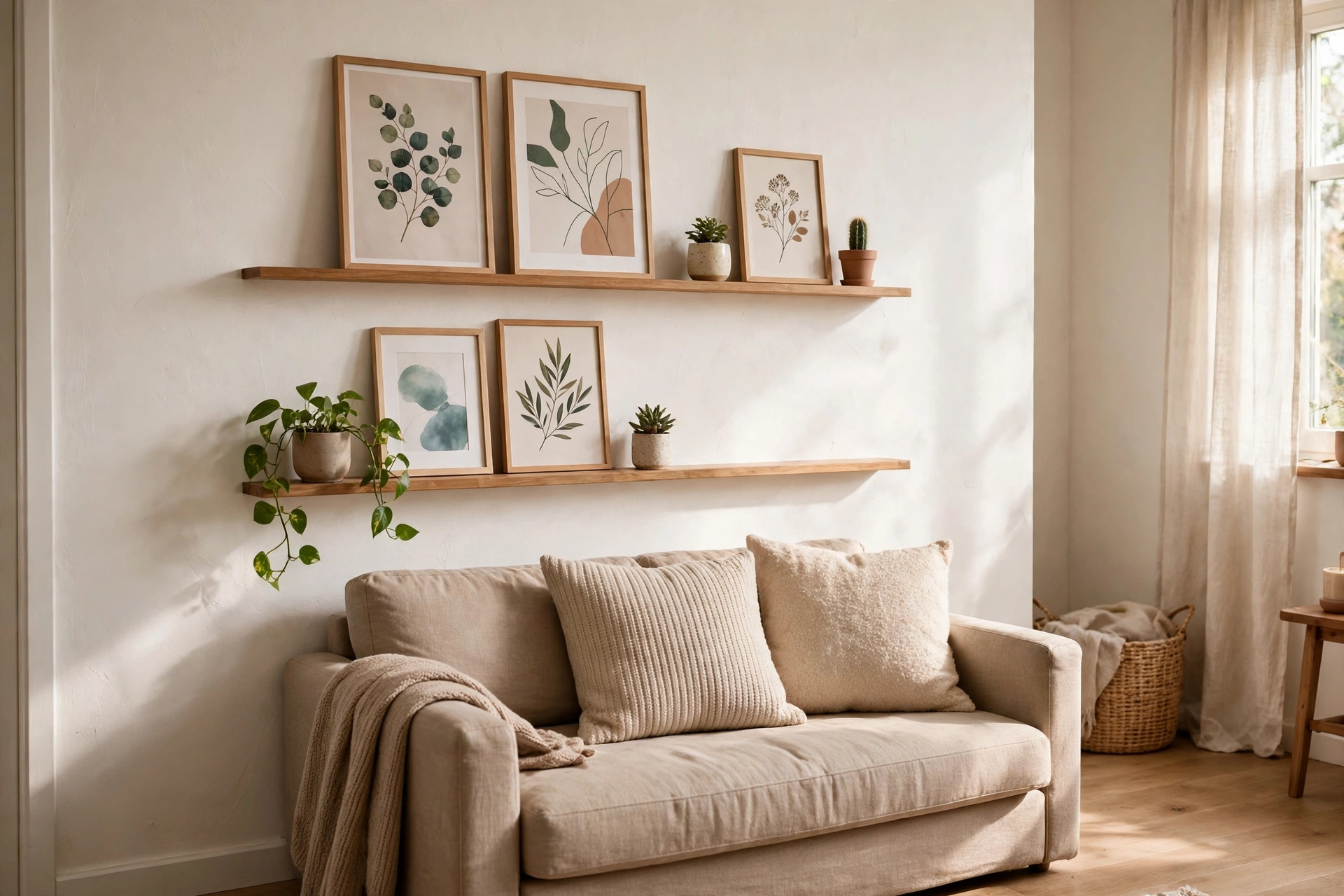
A ledge loaded edge to edge is a shelf, and a shelf in a small living room reads as clutter. Leave a third of each ledge empty — negative space is what makes the display look curated instead of crowded.
IDEA 13Half-Wall Color Block — the Ceiling-Height Trick
The half-wall color block is the small living room’s most underused trick: paint the lower third of the accent wall in a deeper tone and leave the upper two-thirds light, and the ceiling reads higher because the eye travels from the dark base up through the light field to the ceiling without stopping. The darker lower half grounds the furniture — sofas and consoles sit against a color that anchors them — while the light upper half keeps the room airy.
Technique: the split line sits at 30 to 36 inches for a classic proportion, or at two-thirds up for a modern block. Tape the line, seal the tape edge with the base color first so the darker tone cannot bleed under it, then paint the lower section in two coats. $30–$70, half a day. Keep both tones in the same family — warm with warm, cool with cool — or the wall reads as two unrelated colors.
Seal the tape edge with the base color before painting the darker section — the darker paint cannot bleed under sealed tape, and the split line stays razor-sharp.
IDEA 14Metallic Light-Bouncing Wallpaper — the Dark-Corner Fix
Small living rooms almost always have one dark corner — the wall farthest from the window, where daylight dies and lamps cannot quite reach. Metallic wallpaper is the fix built for that wall: a subtle gold, silver, or champagne sheen woven into a quiet pattern reflects whatever light reaches it back into the room, so the dark corner glows instead of sulking. The key word is subtle — a soft metallic sheen reads as light.
Technique: peel-and-stick metallic papers are the renter-safe version; paste-the-wall metallics need a smoother wall and more patience. One wall only, and keep the pattern quiet — tone-on-tone texture with a metallic thread beats a bold metallic print in a tight room. $60–$160, half a day. Pair with a lamp aimed at the wall itself: reflected light is the whole point.
Aim a lamp at the metallic wall, not just near it. Metallic wallpaper only bounces light that actually hits it — a lamp washing the surface is what turns the sheen into a glow.
IDEA 15Vertical Geometric Stripes — the Eye-Movement Trick
Vertical geometric stripes are the pattern version of wood slats: painted stripes, tape-defined and tone-on-tone, that send the eye up and down the wall in one continuous movement, stretching a low ceiling and a short wall at the same time. The trick that keeps stripes from feeling like a circus tent is restraint — two tones close together, matte finish, stripes 4 to 8 inches wide, on one wall only.
Technique: tape every stripe with a level — a stripe that drifts even slightly reads as a mistake from the doorway. Seal tape edges with the base color first, then paint the stripe tone in two coats, peeling tape while the second coat is slightly damp. $30–$90, half a day. The vertical-only rule is absolute: horizontal stripes widen a wall that is already wide enough and drag the ceiling down.
Horizontal stripes in a small living room are the one pattern mistake that actively shrinks the room — they widen the wall and chop the height. If the stripes run sideways, repaint them vertical.
Which Wall? Placement Rules for Small Living Rooms
The wall you choose matters more in a small living room than the finish you put on it. Rule one: the sofa wall first. The wall behind the largest piece of furniture is the natural focal point — it is the wall you see from the doorway, and it anchors the seating arrangement. Our living room accent wall guide and behind-sofa guide both start here for the same reason. Rule two: the TV wall second — but only in a mid-tone or dark finish that hides the screen. Rule three: never the window wall. An accent wall with a window cut into it reads as fragments, and backlight flattens texture and kills pattern.
Rule four: the longest unbroken wall wins. Every doorway cut into an accent wall breaks the pattern and shrinks the effect. Rule five: one wall, full stop. Rule six: check the light. Stand in the doorway at 4 p.m. and pick the wall with visible light and shadow on it — texture, metallics, and dark tones all need light to work.
The doorway test: stand in the doorway and look at each wall. The first wall your eye lands on, with the fewest interruptions, is your accent wall. If two walls compete, pick the sofa wall.
An accent wall behind a door’s swing arc is a wasted accent — the door hides it half the time and bangs into it the rest. Pick a wall the door never touches.
The Small Living Room Color Guide: Light First, One Dark, Warm or Cool
Small living room colors follow one hierarchy: light first, one dark, and a clear warm-or-cool direction. Light colors — soft white, pale greige, whisper sage — are the default accent in a tight room because they recede and keep the room breathing. They suit every light direction, which is why ideas 1, 4, and 13 all start from light. One dark wall — deep green, navy, or charcoal behind the sofa — is the bold move that works, but only as a single wall with light walls everywhere else and one strong light source in the room. Two dark walls do not read as drama; they read as a box.
Warm or cool, not both. Warm whites, terracotta, and warm wood tones suit north-facing rooms that need wrapping warmth; cool whites, sage, and soft blue-grays suit south-facing rooms that already get warm sun. Mixing warm and cool accents in a tight room makes the room feel unsettled. Light direction decides the shade: north-facing rooms need warmer, slightly deeper tones (flat white goes cold in north light), south-facing rooms can carry cooler, paler tones. Finish rule: matte for dark walls and textured finishes, eggshell for light walls that take sofa scuffs — gloss belongs nowhere on a small living room accent wall.
North-facing living rooms are where most small-room color mistakes happen: a cool white that looks crisp in the store turns icy under north light. Warm the white by one shade and the room stops feeling like a fridge.
The most common small-room color disaster: painting the accent wall the same dark tone as the sofa. Dark on dark erases the furniture’s outline and the wall swallows the seating whole.
Renter Rules: What You Can and Can’t Do
- Always safe: peel-and-stick wallpaper (idea 4), one large artwork on a single hook (idea 5), leaning mirror panels (idea 3), floor-to-ceiling curtains on a rod mount (idea 9), picture ledges with patched holes (idea 12), and any light-tone repaint you reverse at move-out (ideas 1, 11, 13, 15).
- Safe with care: dark repaint (budget two primer coats at move-out — dark pigment ghosts through one coat), limewash in a light tone (idea 7), vertical slats or board and batten on a backer panel that lifts off in one piece (ideas 2, 10).
- Ask first, in writing: floating consoles (idea 8), board and batten nailed directly to the wall (idea 10), metallic paste-the-wall wallpaper (idea 14). Photograph the wall on move-in day.
- Never: assume one primer coat hides a dark accent, drill into tile or masonry without permission, or hang a floating console on drywall alone. Keep the original paint color name for the move-out repaint.
Dark accent walls are the repaint landlords notice most — budget two primer coats at move-out, or the color ghosts through the new paint for years.
5 Mistakes to Avoid
- Two accent walls in a small room. One accent wall focuses a tight room; two divide it. The second accent competes with the first, the eye bounces between them, and the room feels busy instead of designed. One wall, one idea, full stop.
- Tiny art scattered across the accent wall. Ten small frames chop a small wall into visual confetti and make the room feel cluttered. One large piece at two-thirds the sofa’s width anchors the wall — scale is the whole game in a tight room (idea 5).
- Heavy built-ins that eat floor space. A deep bookshelf or a bulky media console against the accent wall costs the floor space the accent was supposed to save. Floating consoles, picture ledges, and shallow storage buy the look without the footprint (ideas 8, 12).
- Busy pattern on every surface. A bold wallpaper, a patterned rug, and patterned cushions in one small room fight each other until nothing wins. The accent wall carries the pattern; everything else stays quiet, or the room reads as noise.
- Ignoring furniture scale. An accent wall that ignores the sofa — art hung too high, a dark wall behind a dark sofa, slats that stop at picture-rail height — wastes the wall’s whole effect. Measure the furniture first, then design the wall around it, not the other way around.
FAQs
01What is the best accent wall for a small living room?
The best all-round pick is a light-toned accent wall with vertical interest — soft white paint, vertical wood slats, or peel-and-stick vertical wallpaper behind the sofa. Light tones recede and keep the room breathing, while vertical lines lift a low ceiling, so you get both a focal point and a bigger-feeling room.
02Does a dark accent wall make a small living room look smaller?
Only when it breaks the rules. A dark wall behind the sofa, with light walls everywhere else, actually recedes like a shadow and adds depth — the room gains a backdrop instead of losing space. A dark wall fails when it sits on the window wall (it eats daylight), covers two walls (it becomes a box), or matches a dark sofa (the furniture disappears into it).
03What color accent wall makes a small living room look bigger?
Light colors, consistently: soft white, pale greige, and whisper sage recede and keep the room breathing, which reads as more space. Warm the white by one shade in north-facing rooms, where cool white turns icy, and keep the finish matte or eggshell — gloss shows every flaw.
04Which wall should be the accent wall in a small living room?
Start with the sofa wall — the wall behind the largest piece of furniture, the one you see from the doorway. It anchors the seating and carries texture, color, or art better than any other wall. The TV wall is the second choice, but only in a mid-tone or dark finish that hides the screen. Never the window wall: a window cut into an accent breaks the pattern, and backlight flattens texture and color.
05What are the best renter-friendly accent walls for a small living room?
Ranked by impact and reversibility: peel-and-stick vertical wallpaper (peels off at move-out), one large artwork on a single hook (one hole, patched in minutes), leaning mirror panels (no holes at all), floor-to-ceiling curtains (rod holes patch with filler), and picture ledges (swappable display, patched holes). Ask first, in writing, for floating consoles and anything nailed directly into the wall.
06How much does a small living room accent wall cost?
For one standard living room wall, budget $30–$70 for paint-only ideas (soft white, dark wall, arch, stripes, half-wall block), $40–$160 for wallpaper and ledge ideas (peel-and-stick, metallic, picture ledges), and $100–$400 for build ideas (wood slats, board and batten, mirror panels, floating console).
Key takeaways
- A small living room accent wall is a space decision, not a decoration decision. Every idea here earns its place by doing spatial work — lifting a ceiling, pushing a wall back, bouncing light, or freeing floor — not just by looking good.
- One wall, sofa wall first, vertical lines always. Pick the longest unbroken wall behind the sofa, keep the accent to one wall, and let vertical movement — slats, stripes, curtains, arches — do the height work that a small room needs most.
- Light recedes, dark recedes only with discipline. Light tones are the safe default; one dark wall works only behind the sofa, with light walls everywhere else and light washing the dark surface itself.
- Scale beats quantity. One large artwork, one bold pattern, one clear idea — a small room rewards one confident choice and punishes ten small ones. Measure the sofa first, then design the wall around it.