 Casacrunched
15 Terracotta Accent Wall Ideas That Warm a Room Without Shrinking It
Terracotta is warmth you can live in — baked-clay tones that make a room feel sunlit, not small. Fifteen terracotta accent wall ideas, from cloudy limewash to half-wall blocks, with pairings and finishes that keep small rooms glowing.

Terracotta is not a color you choose. It is a temperature you set. A terracotta accent wall takes a room that feels flat, white, and a little cold, and wraps it in baked-clay warmth — the color of sun-dried earth, clay pots, and Mediterranean courtyards. Done right, it makes a small room feel cozy without feeling smaller. Done wrong, it turns that same room into a dark, heavy box. The difference is never the color itself. It is the wall you pick, the finish you use, and what you put next to it.
Fifteen ideas, from classic terracotta paint to limewash, plaster, tile, and renter-safe peel-and-stick — plus which wall to choose, which colors pair with terracotta, and the small-room rules that keep warmth from shrinking your space.
Quick comparison: cost, time, warmth & finish, renter score
| # | Idea | Warmth & finish | Cost / wall | Time | Renter-friendly? |
|---|---|---|---|---|---|
| 1 | Classic terracotta paint | Flat matte warmth | $30–$70 | Half day | Yes (repaint) |
| 2 | Terracotta limewash | Cloudy mineral glow | $70–$140 | Full day | Yes (repaint) |
| 3 | Clay plaster wall | Raw earth matte | $90–$200 | Weekend | Ask first |
| 4 | Terracotta zellige tile | Glazed shine, light play | $150–$400 | Weekend | Peel-and-stick tile: yes |
| 5 | Terracotta half-wall block | Warm base, light top | $30–$70 | Half day | Yes (repaint) |
| 6 | Terracotta painted arch | Soft curve, warm focal point | $30–$70 | Half day | Yes (repaint) |
| 7 | Terracotta + wood slats | Warmth + vertical texture | $120–$300 | Weekend | Cleat backer: yes |
| 8 | Terracotta peel-and-stick wallpaper | Printed warmth, zero commitment | $40–$120 | Half day | Yes (peels off) |
| 9 | Terracotta + sage green pairing | Earthy calm, balanced warmth | $30–$90 | Half day | Yes (repaint) |
| 10 | Terracotta + navy pairing | Bold warm-cool contrast | $30–$90 | Half day | Yes (repaint) |
| 11 | Terracotta brick-look wall | Rustic texture, deep warmth | $60–$180 | Weekend | Faux panels: yes |
| 12 | Terracotta + rattan boho wall | Natural texture, sunlit warmth | $60–$200 | An afternoon | Yes (hooks only) |
| 13 | Terracotta gallery wall | Warm backdrop for art | $30–$70 | Half day | Yes (repaint) |
| 14 | Terracotta geometric pattern | Patterned warmth, modern edge | $30–$90 | Half day | Yes (repaint) |
| 15 | Terracotta in a dark small room | Warmth balanced with light | $30–$120 | Half day | Yes (repaint) |
IDEA 01Classic Terracotta Paint Wall — the Warmth Starter
The simplest terracotta accent wall is also the one most people get right on the first try: one wall in a true terracotta paint, matte finish, behind the sofa or the bed. Terracotta sits between orange and brown, so it reads as warm without shouting, and a matte finish keeps that warmth soft — gloss would turn baked clay into plastic. In a small room, the rule is one wall only, with the other three in a warm white or cream, so the warmth has somewhere to breathe.
Technique: two coats over primer if the wall is patched or dark, and test the shade on the wall itself before committing — terracotta shifts dramatically between store lighting and your room’s daylight. $30–$70, half a day. Pick a mid-tone terracotta, not the deepest one on the swatch card: the deepest shades are the ones that shrink small rooms.
Terracotta lies on the swatch card — it always looks lighter in the store than on your wall. Buy a sample pot, paint a two-foot square, and live with it for a full day of daylight before you buy the gallon.
IDEA 02Terracotta Limewash Wall — the Cloudy Mineral Glow
If flat terracotta paint feels too solid for your room, limewash is the upgrade. Terracotta limewash keeps the same baked-clay color but breaks it into cloudy, hand-brushed movement — light and dark patches of the same tone drifting across the wall like sun on plaster. The effect is warmer than paint and softer than a solid block of color, which is exactly why it suits small rooms: the wall gains depth without gaining visual weight.
Technique: mineral primer first, then two thin coats with a block brush in loose, random crisscross strokes — the randomness is the finish, and straight strokes ruin it. Limewash dries lighter than it looks wet, so judge the color only after a full 24-hour dry. $70–$140, a full day. For limewash colors and technique in full, see our limewash accent wall guide.
Limewash’s wet wall lies — it dries noticeably lighter. Repainting a wall that was already right, because the wet coat looked too pale, is the most common limewash mistake.
IDEA 03Clay Plaster Wall — Raw Earth, Real Texture
Clay plaster is terracotta in its most honest form: actual earth on the wall, with a matte, slightly rough texture you can feel as well as see. Where paint gives you color, plaster gives you material — the wall stops looking painted and starts looking built, like a Mediterranean courtyard or an adobe interior. That texture catches light and shadow across the day, so the wall never sits flat, even in a single tone.
Technique: clay plaster goes on with a trowel in thin layers over a primed wall, and the final texture comes from the last pass — smooth for subtle, dragged for visible movement. $90–$200, a weekend, and it needs a dry, stable wall: damp walls and clay plaster do not mix.
Clay plaster on a damp or unprimed wall is a failed wall — it can crack, stain, or peel. If the wall has ever had moisture problems, fix the moisture first or pick limewash instead.
IDEA 04Terracotta Zellige Tile Wall — Glazed Light Play
Zellige tiles are the glamorous side of terracotta: hand-cut, glazed clay tiles in warm terracotta tones, each one slightly different, so the wall shimmers as light moves across it. A terracotta tile accent wall brings shine to a matte color family — the glaze bounces light back into the room, which is a genuine advantage in a small space where terracotta’s warmth can otherwise absorb light.
Technique: tiles set in a stacked or running bond on one wall — behind a fireplace, a console, or a bed headboard — with grout in a warm sand tone, not bright white, so the grout lines disappear into the clay. $150–$400, a weekend. Renters: peel-and-stick tile sheets in terracotta tones give most of the look with none of the grout.
Grout color makes or breaks a tile accent wall. Bright white grout draws a grid over your terracotta; warm sand grout lets the tiles read as one continuous clay surface.
IDEA 05Terracotta Half-Wall Block — Warm Base, Light Top
The half-wall block is terracotta’s best small-room trick: paint the lower third of the wall terracotta and leave the upper two-thirds in warm white or cream. The warm base grounds the furniture — sofas, consoles, and beds sit against a color that anchors them — while the light upper half keeps the ceiling feeling high and the room feeling open. You get terracotta’s warmth at eye level, where you actually live with it, without the full-wall weight.
Technique: the split line sits at 30 to 36 inches for a classic proportion. Tape the line, seal the tape edge with the base color first so the terracotta cannot bleed under it, then paint the lower section in two coats. $30–$70, half a day. Keep both tones warm — terracotta against a cool white reads as a clash, not a pairing.

Seal the tape edge with the base color before painting the terracotta section — the darker paint cannot bleed under sealed tape, and the split line stays razor-sharp.
IDEA 06Terracotta Painted Arch — the Warm Curve
A painted arch is terracotta’s most romantic move: a curved shape in terracotta on a light wall, framing the sofa, a console, a plant, or a reading chair. The arch gives a plain room a focal point with a curve, and terracotta is the color arches were made for — it reads as clay, as sun-baked, as Mediterranean, in a way no cool color can. The curve draws the eye up, which helps a low ceiling, and the warmth draws the eye in, which helps a bare wall.
Technique: tape the outline (a nail, string, and pencil draw a perfect arc), paint inside with two coats, peel the tape while the second coat is still slightly damp for the cleanest edge. $30–$70, half a day. Place furniture inside the curve — an arch framing nothing reads as a rainbow sticker, while an arch framing a sofa reads as architecture.
An arch that frames nothing is decoration without a job. Paint the arch, then place the furniture inside its curve, and the room gains a zone it did not have before.
IDEA 07Terracotta + Wood Slats — Warmth Meets Vertical Lines
Terracotta and wood are a natural marriage — both are warm, both are earthy, and together they cover each other’s weaknesses. Paint the wall terracotta, then run vertical wood slats up it in a light oak, and you get warmth plus height: the terracotta wraps the room, while the vertical lines lift a low ceiling the way slats always do. The slats also break up the solid color, so a full terracotta wall never feels like a flat block.
Technique: slats run truly vertical, gaps of half an inch to an inch, on a backer board or directly on the wall — backer boards are the renter move, since the whole panel lifts off in one piece. $120–$300, a weekend. Keep the wood light: dark walnut slats on terracotta double the darkness and shrink the room.
Dark wood slats on a terracotta wall are warmth stacked on warmth until the wall turns heavy. Light oak or pale ash keeps the combination airy.
IDEA 08Terracotta Peel-and-Stick Wallpaper — the Renter Hero
Peel-and-stick wallpaper is how renters get terracotta without a paintbrush: terracotta-toned patterns — arches, sun shapes, terrazzo, subtle botanicals — that go up in an afternoon and peel off at move-out. The pattern rules for terracotta are forgiving, because the color itself does most of the work: pick a pattern where terracotta is the background, not the print, so the wall reads as a warm field with interest, not as a busy poster.
Technique: one wall only, panels hung top to bottom with a plastic smoother — bubbles are the giveaway that separates a good job from a rushed one. $40–$120, half a day. For surface compatibility in detail, see our peel-and-stick accent wall guide.
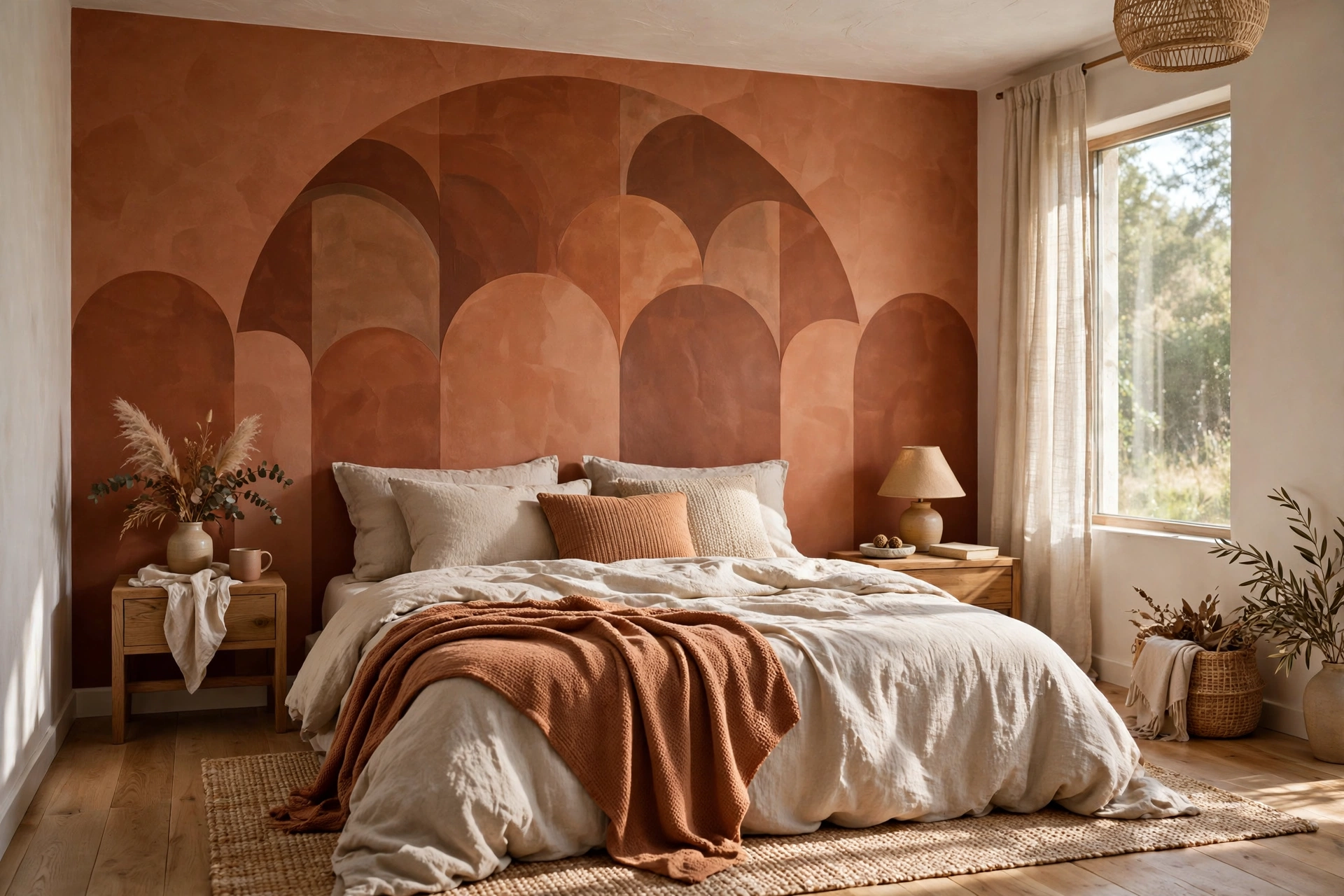
One wall, not four. Terracotta pattern on every wall of a small room turns warmth into a cage — the accent works because the other three walls stay quiet.
IDEA 09Terracotta + Sage Green Pairing — Earthy Calm
Terracotta and sage green are the pairing designers reach for when they want warmth without heat: terracotta brings the sun, sage brings the shade, and together they read as a garden, not a desert. In practice, this usually means a terracotta accent wall with sage in the soft furnishings — cushions, throws, plants, curtains — rather than two painted walls competing with each other. The sage cools the terracotta just enough to keep a small room balanced.
Technique: keep the terracotta as the single painted accent and let sage live in textiles and plants, which are easy to change. $30–$90 if the wall is already painted and you are only adding sage soft furnishings, half a day.
Live plants are the cheapest sage in the room — a trailing pothos or an olive tree against terracotta gives you the green pairing for free, and it grows.
IDEA 10Terracotta + Navy Pairing — Bold Warm-Cool Contrast
Terracotta and navy are opposites that behave: warm clay against deep cool blue is the contrast that makes both colors louder, and in a small room that contrast needs a referee — warm white. The working formula is a terracotta accent wall, navy in one or two pieces (a velvet cushion, a throw, a single chair), and warm white everywhere else. The navy stops the terracotta from feeling sleepy; the terracotta stops the navy from feeling cold.
Technique: navy belongs in furniture and textiles, not on a second accent wall — two strong accent walls in a small room fight each other. $30–$90, half a day. Keep the navy deep and the terracotta mid-tone: pale navy against pale terracotta washes out, and the contrast is the whole point.
Two painted accent walls — one terracotta, one navy — in a small room is a boxing match, not a design. One painted accent, one textile accent, warm white everywhere else.
IDEA 11Terracotta Brick-Look Wall — Rustic Texture
A brick-look wall in terracotta tones gives you the oldest warmth trick in the book: real or faux brick reads as shelter — a fireplace wall, a cottage wall, a wall that has stood for a hundred years. Faux brick panels in terracotta and clay tones deliver that texture without masonry work, and the mortar lines break the color into small fields, so the wall never feels like one flat block of orange.
Technique: faux panels cut to fit, glued or screwed to one wall, with seams filled and painted to match — the seams are the giveaway, so take time hiding them. $60–$180, a weekend. Whitewash the panels lightly if the terracotta reads too red in your light; the whitewash softens brick without erasing it.
Unfilled panel seams are the giveaway that turns a brick wall into a plastic wall. Fill, sand, and paint every seam before you call the wall done.
IDEA 12Terracotta + Rattan Boho Wall — Sunlit Natural Texture
Terracotta and rattan belong to the same world — sun, earth, natural fiber — and together they make the sunniest accent wall in this guide. A terracotta wall hung with rattan mirrors, woven baskets, or a rattan headboard reads as a warm room that breathes: the rattan’s open weave keeps the wall light, while the terracotta behind it glows through the gaps. This is the boho version of terracotta, and it suits bedrooms and living rooms equally.
Technique: hang rattan pieces on hooks or a single rail, spaced with breathing room between them — a wall crammed edge to edge with baskets reads as a shop display. $60–$200 depending on how many rattan pieces you buy, an afternoon. Keep the rattan natural-toned: painted rattan against terracotta loses the earthy contrast that makes the pairing work.

Breathing room is what makes a rattan wall look curated instead of cluttered — leave a hand’s width of terracotta visible between every piece, and the wall reads as a collection, not a pile.
IDEA 13Terracotta Gallery Wall — Art on a Warm Backdrop
Terracotta is one of the best backdrop colors for art, because warm walls make art pop the way white walls never do: black-and-white photography gains drama, botanical prints gain depth, and light-colored frames gain contrast. A terracotta gallery wall works when the art follows one discipline — same frame color, same mat color, consistent spacing — so the wall reads as a gallery, not as a noticeboard.
Technique: plan the layout on the floor first, then hang from the center outward, keeping 2 to 3 inches between frames. $30–$70 for the wall paint, plus whatever the art costs, half a day for the wall itself. Black frames are the classic choice on terracotta; natural wood frames are the softer one.
Mixed frame colors on a terracotta wall read as chaos faster than on a white wall — the warm backdrop amplifies every inconsistency. One frame color, one mat color, no exceptions.
IDEA 14Terracotta Geometric Pattern — Modern Edge
Terracotta does not have to be rustic. Painted in a geometric pattern — arches, half-moons, triangles, or tone-on-tone stripes — terracotta turns modern and graphic, and the pattern gives a small room something flat paint cannot: movement. The rule that keeps geometric terracotta from feeling busy is restraint: two tones only (terracotta plus warm white, or two terracotta tones one shade apart), matte finish, one wall only.
Technique: tape every shape with a level — a shape that drifts reads as a mistake from the doorway. Seal tape edges with the base color first, then paint the terracotta tone in two coats, peeling tape while the second coat is slightly damp. $30–$90, half a day. Start with arches if you are new to pattern: curves forgive small tape errors that straight lines expose.
Arches are the beginner-friendly geometric shape — a curve hides a millimeter of tape wobble that a straight stripe would announce to the whole room.
IDEA 15Terracotta in a Dark Small Room — Warmth Balanced With Light
Terracotta in a dark small room is the highest-risk, highest-reward move in this guide, because terracotta absorbs light — and a dark room has little to spare. The fix is a light budget: for every warm, light-absorbing choice, make a light-reflecting one. Terracotta on one wall, yes — but paired with a large mirror on the opposite wall, light furniture, a pale rug, and one lamp aimed at the terracotta itself so the wall glows instead of sulking.
Technique: pick a mid-tone terracotta, never the deepest shade, and keep the finish matte or limewash rather than flat dark paint — limewash’s cloudy texture catches what light exists and moves it around the wall. $30–$120, half a day. If the room has no window at all, skip full-wall terracotta and use the half-wall block (idea 5) instead — warmth at eye level, light above.
Terracotta in a windowless room with dark furniture and no mirror is a cave, not a cozy room. If you cannot add light, do not add terracotta — use the half-wall block instead.
Which Wall? Placement Rules for Terracotta
The wall you choose matters more with terracotta than with most colors, because terracotta is a strong color and strong colors punish bad placement. Rule one: the sofa wall or the bed wall first. The wall behind the largest piece of furniture is the natural focal point — it is the wall you see from the doorway, and it anchors the seating or sleeping arrangement. Our bedroom accent wall guide starts here for the same reason. Rule two: check the light before you commit. Terracotta needs daylight or a lamp washing it to glow; on a wall that never sees light, it reads as muddy brown. Stand in the doorway at 4 p.m. and pick the wall with visible light on it.
Rule three: never the window wall. A window cut into a terracotta wall breaks the color into fragments, and backlight flattens the warmth you painted it for. Rule four: the longest unbroken wall wins. Every doorway cut into an accent wall breaks the pattern and shrinks the effect. Rule five: one wall, full stop. Terracotta on two walls in a small room does not double the warmth — it halves the light. Rule six: keep furniture light against it. Cream sofas, pale wood, and light rugs let terracotta glow; dark furniture against a terracotta wall disappears into it.
The doorway test, terracotta edition: stand in the doorway at 4 p.m. and look at each wall. The first wall your eye lands on, with visible light on it and the fewest interruptions, is your terracotta wall. If no wall has light, add a lamp to the plan before you add paint.
A terracotta wall behind a door’s swing arc is a wasted accent — the door hides it half the time and bangs into it the rest. Pick a wall the door never touches.
The Terracotta Pairing Guide: Cream, Sage, Navy, and Undertones
Terracotta pairs with almost everything warm and exactly three things cool — and knowing which is which is the whole pairing game. Warm partners first: warm white and cream are the default companions, the colors that let terracotta glow without competing; light oak and rattan extend the earthy family; olive and sage (idea 9) cool the room just enough to stay balanced. Cool partners, used sparingly: navy (idea 10) is the bold contrast that works, charcoal is the moody one, and soft dusty blue is the quiet one — all three belong in textiles and furniture, not on a second painted wall.
Undertones decide the shade. Terracotta leans orange or red depending on the pigment: orange-leaning terracotta suits sunny rooms and pairs with cream and sage, while red-leaning terracotta suits cooler rooms and pairs with navy and charcoal. Finish rule: matte for paint and plaster, cloudy for limewash, glazed for tile — gloss belongs nowhere on a terracotta wall, because it turns baked clay into plastic. For the wider color system behind these pairings, see our accent wall colors guide.
North-facing rooms need warmer, slightly deeper terracotta — a pale terracotta that looks sunlit in the store turns cold and pink under north light. Warm the shade by one step and the room stops feeling washed out.
The most common terracotta pairing disaster: terracotta wall plus terracotta sofa plus terracotta rug. One terracotta statement per room — the wall is the statement, and everything else steps back.
Renter Rules: What You Can and Can’t Do
- Always safe: peel-and-stick terracotta wallpaper (idea 8), peel-and-stick terracotta tile sheets (idea 4), rattan pieces on hooks (idea 12), gallery art on a terracotta-painted wall you repaint at move-out (idea 13), and any light-to-mid terracotta repaint you reverse (ideas 1, 5, 6, 9, 10, 14, 15).
- Safe with care: terracotta limewash in a mid-tone (idea 2 — budget primer at move-out, since mineral finishes can ghost through one coat), wood slats on a backer panel that lifts off in one piece (idea 7), faux brick panels on adhesive strips (idea 11).
- Ask first, in writing: clay plaster (idea 3), zellige tile set in mortar (idea 4), anything drilled into tile or masonry. Photograph the wall on move-in day.
- Never: assume one primer coat hides a deep terracotta at move-out — deep reds and oranges ghost through paint for years — or apply plaster or tile to a damp wall. Keep the original paint color name for the move-out repaint.
Deep terracotta is the repaint landlords notice most — budget two primer coats at move-out, or the color ghosts through the new paint for years.
5 Mistakes to Avoid
- Two terracotta walls in a small room. One terracotta wall warms a tight room; two divide it and eat the light. The second wall competes with the first, the room feels smaller and darker, and the warmth turns into weight. One wall, one idea, full stop.
- The deepest shade on the swatch card. The darkest terracotta always looks richest in the store and heaviest on the wall. In a small room, a mid-tone terracotta glows; the deepest shade sulks. Buy a sample pot and live with it for a day before committing to the gallon.
- Terracotta on the window wall. A window cut into a terracotta wall breaks the color into fragments, and backlight flattens the warmth you painted it for. Terracotta belongs on a wall the light hits, not a wall the light comes through.
- Dark furniture against a terracotta wall. A dark sofa against a terracotta wall disappears into it — the furniture’s outline erases and the seating looks swallowed. Cream sofas, pale wood, and light rugs let terracotta glow instead of swallowing.
- Terracotta everything. Terracotta wall plus terracotta sofa plus terracotta rug plus terracotta cushions is not a theme — it is a monotone. One terracotta statement per room, warm white everywhere else, and one contrasting accent (sage, navy, or natural wood) to keep the room breathing.
FAQs
01What is the best terracotta accent wall idea for a small room?
The best all-round pick is a mid-tone terracotta paint wall or terracotta limewash, on one wall only, with the other three walls in warm white or cream. Mid-tone terracotta glows without shrinking the room, limewash adds cloudy depth without visual weight, and the light walls around it keep the space breathing. The half-wall block is the safest version of all: warmth at eye level, light above.
02Does a terracotta accent wall make a room look smaller?
Only when it breaks the rules. Terracotta on one wall, in a mid-tone, with light furniture against it, warms a room without shrinking it — the warmth reads as coziness, not confinement. Terracotta shrinks a room when it covers two walls, uses the deepest shade on the swatch card, sits on the window wall, or pairs with dark furniture that disappears into it.
03What colors go with a terracotta accent wall?
Warm white and cream are the default companions — they let terracotta glow without competing. Sage green and olive cool the room just enough to stay balanced, navy is the bold contrast that works in textiles, and light oak and rattan extend the earthy family. Keep cool colors in furniture and textiles, not on a second painted wall, and keep one terracotta statement per room.
04Which wall should be the terracotta accent wall?
Start with the sofa wall or the bed wall — the wall behind the largest piece of furniture, the one you see from the doorway. Then check the light: terracotta needs daylight or a lamp washing it to glow, so pick a wall with visible light on it at 4 p.m. Never the window wall — a window cut into terracotta breaks the color into fragments, and backlight flattens the warmth.
05What are the best renter-friendly terracotta accent walls?
Ranked by impact and reversibility: peel-and-stick terracotta wallpaper (peels off at move-out), peel-and-stick terracotta tile sheets (the tile look with no grout), rattan pieces on hooks (no holes beyond a hook), and any mid-tone terracotta repaint you reverse at move-out. Ask first, in writing, for clay plaster and mortar-set tile, and budget two primer coats to hide deep terracotta at move-out.
06How much does a terracotta accent wall cost?
For one standard wall, budget $30–$70 for paint-only ideas (classic paint, half-wall block, arch, geometric pattern, gallery wall), $40–$200 for wallpaper, plaster, and rattan ideas (peel-and-stick, limewash, clay plaster, brick-look panels, rattan), and $120–$400 for build ideas (wood slats, zellige tile).
Key takeaways
- Terracotta is a temperature, not just a color. It wraps a room in baked-clay warmth — but warmth without light, discipline, and light furniture turns into weight. The color is never the problem; the placement is.
- One wall, mid-tone, sofa or bed wall first. Pick the longest unbroken wall behind the largest furniture, keep the shade mid-tone rather than deepest, and let warm white, cream, and light wood do the breathing around it.
- Finish changes everything. Flat paint gives solid warmth, limewash gives cloudy depth, plaster gives raw earth, tile gives glazed light — pick the finish that fixes your room’s specific problem, not just the color you like.
- One terracotta statement per room. The wall is the statement. Sage, navy, rattan, or natural wood can support it — but terracotta everything is a monotone, and two terracotta walls in a small room halve the light.