 Casacrunched
15 Geometric Accent Wall Ideas With Lines That Actually Stay Crisp
Geometric walls are wallpaper looks for the price of paint — if the lines are clean. Fifteen geometric accent wall ideas, from triangles to arches to hexagon wood, with tape precision guidance.
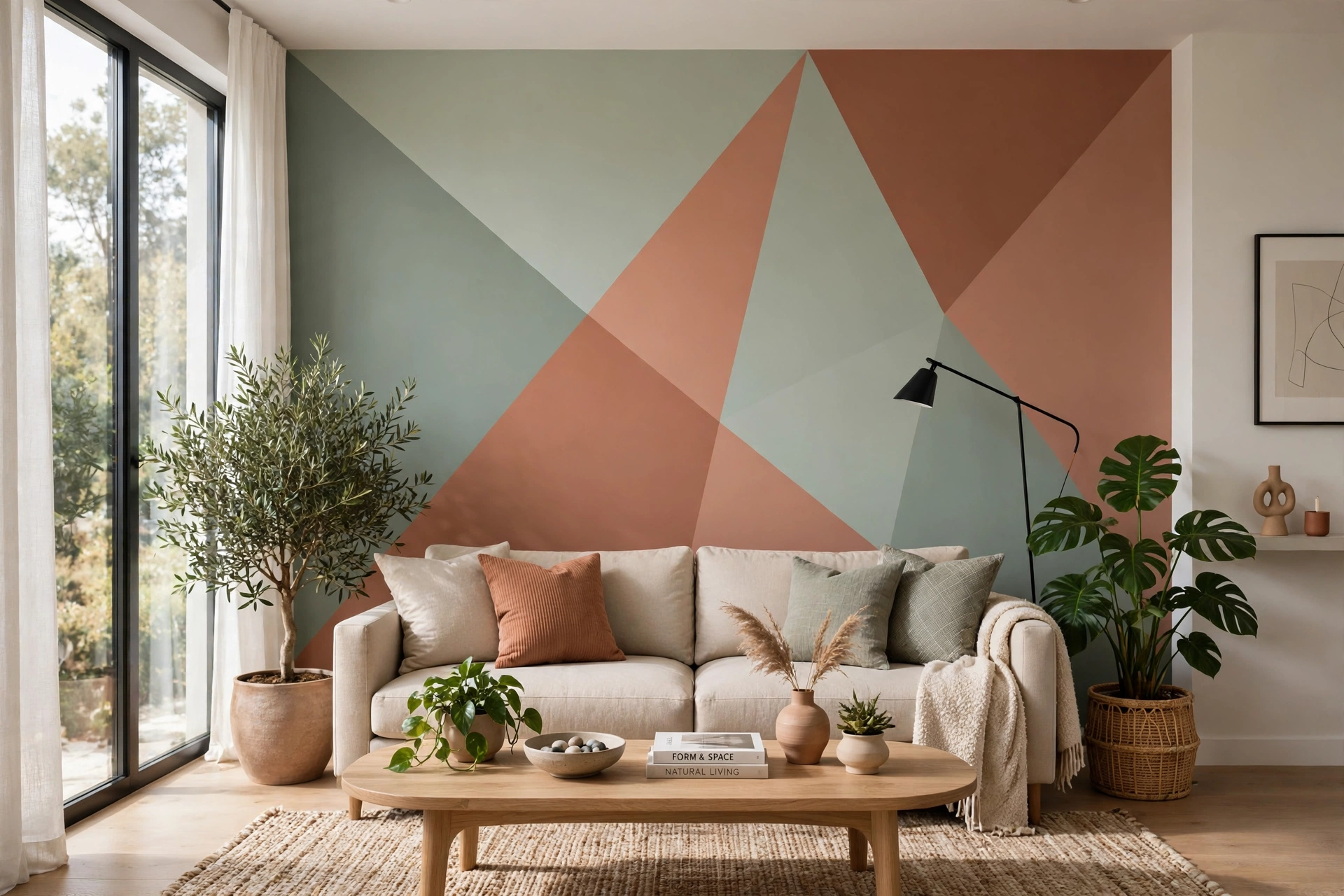
A geometric accent wall is wallpaper looks for the price of paint — a whole pattern, a whole personality, from a roll of tape and two cans of color. But geometry is unforgiving in a way plain paint never is: one wobbly line, one crooked angle, and the eye goes straight to it. The difference between a wall that looks designer-made and one that looks like a weekend accident is never talent. It’s tape discipline, measurement, and pattern scale — three things anyone can learn in an afternoon.
Fifteen geometric ideas, each with tape and precision guidance, honest costs, and renter notes — so your lines come out crisp the first time.
On this page
- Quick comparison table
- 1. Painted triangles
- 2. Painted arches
- 3. Chevron pattern
- 4. Herringbone wood
- 5. Hexagons
- 6. Diamond grid
- 7. Mountain mural
- 8. Color-block rectangles
- 9. Geometric wallpaper
- 10. Wood geometric panels
- 11. Half-wall geometric border
- 12. Oversized single shape
- 13. Thin-line geometric
- 14. Bold multicolor geometric
- 15. Geometric + mural combo
- Which wall for geometry?
- Geometric color rules
- Renter rules
- 5 mistakes to avoid
- FAQs
Quick comparison: cost, time, precision, renter score
| # | Idea | Difficulty / precision | Cost / wall | Time | Renter-friendly? |
|---|---|---|---|---|---|
| 1 | Painted triangles | Beginner / medium | $35–$70 | Half day | Yes (repaint) |
| 2 | Painted arches | Beginner / low | $30–$60 | Half day | Yes (repaint) |
| 3 | Chevron pattern | Intermediate / high | $40–$80 | Full day | Yes (repaint) |
| 4 | Herringbone wood | Advanced / high | $150–$400 | Weekend | Cleats: partial |
| 5 | Hexagons | Intermediate / high | $40–$120 | Full day | Peel-and-stick: yes |
| 6 | Diamond grid | Intermediate / high | $40–$80 | Full day | Yes (repaint) |
| 7 | Mountain mural | Beginner / low | $40–$90 | Half–full day | Yes (repaint) |
| 8 | Color-block rectangles | Beginner / medium | $35–$70 | Half day | Yes (repaint) |
| 9 | Geometric wallpaper | Beginner / low | $40–$150 | 2–4 hours | Peel-and-stick: yes |
| 10 | Wood geometric panels | Intermediate / high | $80–$250 | Weekend | Removable: partial |
| 11 | Half-wall geometric border | Beginner / medium | $25–$60 | Half day | Yes (repaint) |
| 12 | Oversized single shape | Beginner / low | $30–$60 | Half day | Yes (repaint) |
| 13 | Thin-line geometric | Intermediate / high | $30–$60 | Half–full day | Yes (repaint) |
| 14 | Bold multicolor geometric | Intermediate / medium | $50–$100 | Full day | Yes (repaint) |
| 15 | Geometric + mural combo | Intermediate / medium | $50–$110 | Full day | Yes (repaint) |
IDEA 01Painted Triangles — the Classic Geometric Starting Point
Triangles are where most people start with geometry, and for good reason: they’re bold, they’re forgiving of imperfect walls, and a single triangle field can carry a whole room. The trick is scale — triangles need to be big. Small triangles read as confetti and make a wall feel busy; triangles 18 inches or taller read as architecture.
Tape guidance: mark the grid lightly in pencil with a level on every horizontal line, tape the triangle edges with 1.5-inch painter’s tape, and seal each edge with the base wall color first so the triangle color can’t bleed underneath. Two coats, then pull the tape while the second coat is still slightly tacky. $35–$70, half a day. Renters: pure paint, fully reversible with primer.
Paint the triangles in one accent color against the existing wall color first — two colors total is the version that looks intentional. A third color can come later, once you trust your tape hand.
Triangles that stop at furniture height look cut off. Run the pattern full-height, floor to ceiling, or let the furniture sit fully inside one large triangle.
IDEA 02Painted Arches — Geometry’s Soft Side
Arches are geometry with the edges sanded off — one bold curve, one color, zero corners to tape perfectly. That’s why they’re the highest-impact beginner geometric: the eye forgives a curve’s tiny wobbles in a way it never forgives a crooked straight line. An arch behind a bed, a reading chair, or a console reads as a headboard, a frame, and a piece of art at once.
Tape guidance: almost none. Pin a string at the arch’s center point, sweep a pencil at full stretch for a perfect curve, and paint freehand to the line with a small angled brush — or tape the two straight sides and cut in the curve by hand. Keep the arch two-thirds of the wall’s width or wider; a narrow arch reads as decoration, not architecture. $30–$60, half a day.
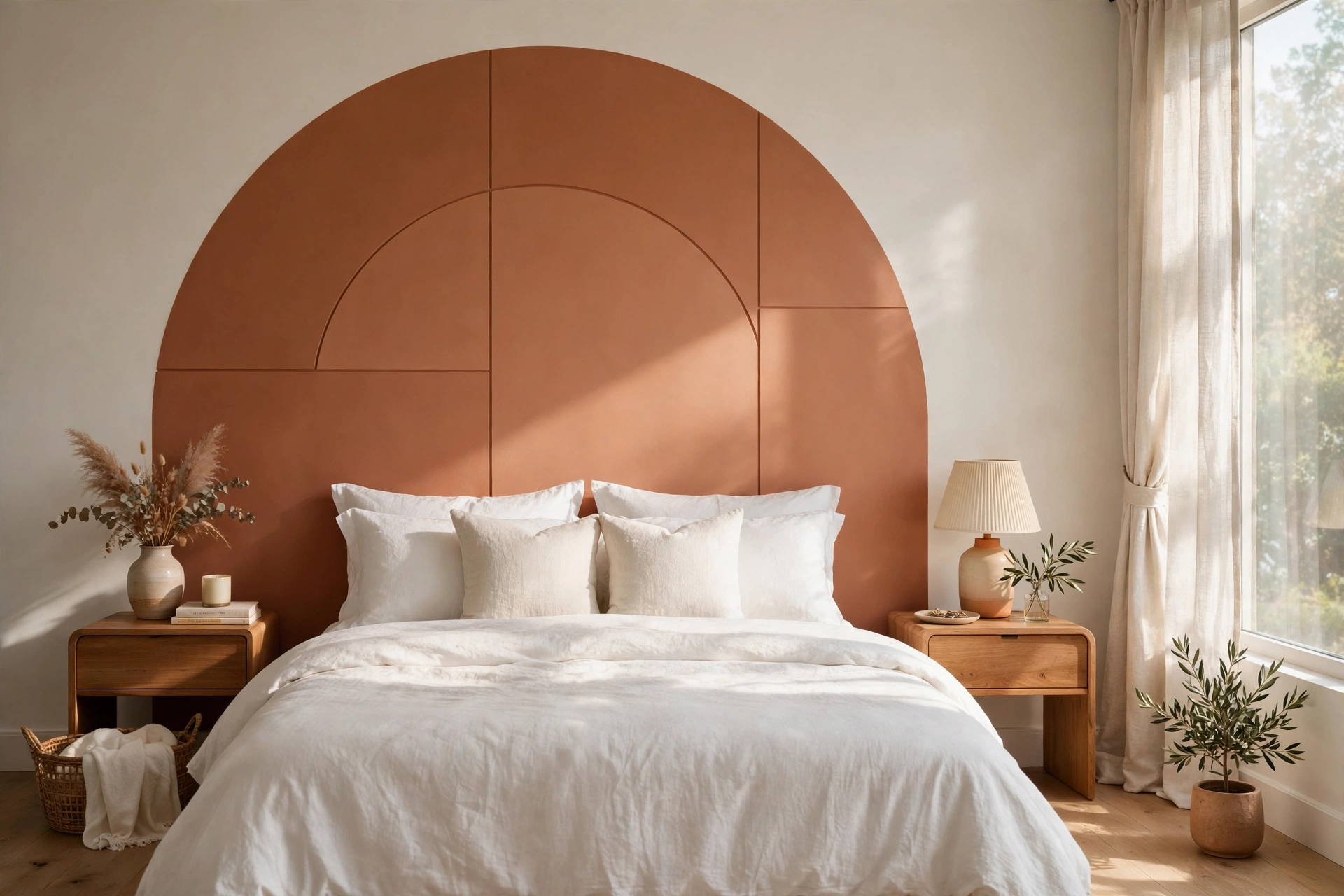
One arch, one color, centered on the furniture below it — that’s the whole formula. Two arches side by side need identical widths, so measure twice or stick to one.
An arch that’s too small for its wall looks like a sticker. If the arch is under half the wall’s width, scale it up or pick another wall.
IDEA 03Chevron Pattern — Energy in Zigzag
Chevron is geometry with momentum — the zigzag pulls the eye across the wall and makes a room feel longer and livelier. It’s also the pattern where sloppy measuring shows fastest: one chevron row a half-inch off, and every row below it drifts.
Tape guidance: draw the full grid in pencil first — chevron rows at a consistent depth (6–8 inches reads best) and a consistent angle (45 degrees is classic) — then tape one color’s zigzags, seal the edges with base color, and paint. Work top to bottom, one row at a time, and check each row against a level before taping the next. Two colors, $40–$80, a full day.

Make a cardboard chevron template for the row depth and angle — tracing the same template down the wall beats re-measuring every zigzag.
Chevron on a wall with a door or window cut into it breaks the zigzag mid-pattern and looks like a mistake. Pick a clean, unbroken wall.
IDEA 04Herringbone Wood — Geometry You Can Touch
Herringbone in wood is the most luxurious geometric on this list — the interlocking rectangles catch light and shadow in a way paint never can, and the pattern reads as craftsmanship from across the room. It’s also the most demanding: every piece must be cut to the same length, and the 45-degree angles must stay true across the whole wall.
Precision guidance: cut all pieces first from one jig setup so lengths stay identical, dry-lay the first three rows on the floor to confirm the pattern, and start from the center of the wall outward — that way any cut pieces land symmetrically at the edges instead of one ragged side. Glue plus brad nails, stain or paint after install. $150–$400, a full weekend, advanced skill. Renters: panels on a cleat-backed board come down in one piece.
Start herringbone from the center, never from a corner — center-out is what keeps the pattern symmetrical at both edges.
Herringbone with inconsistent piece lengths looks drunk, not designed. One jig, one length, zero exceptions.
IDEA 05Hexagons — the Honeycomb Wall
Hexagons are geometry’s sweet spot: organic enough to feel soft, structured enough to feel designed, and instantly recognizable as a deliberate pattern.
Precision guidance: use a hexagon stencil or template rather than freehanding six-sided shapes — hand-drawn hexagons drift, and drift is visible at a glance. For painted hexagons, stencil one row, let it dry fully, then stencil the next row offset by half a hexagon. For wood or tile hexagons, a spacer block between pieces keeps the gaps even. $40–$120 depending on material, a full day. Renters: peel-and-stick hexagon tiles are fully removable.
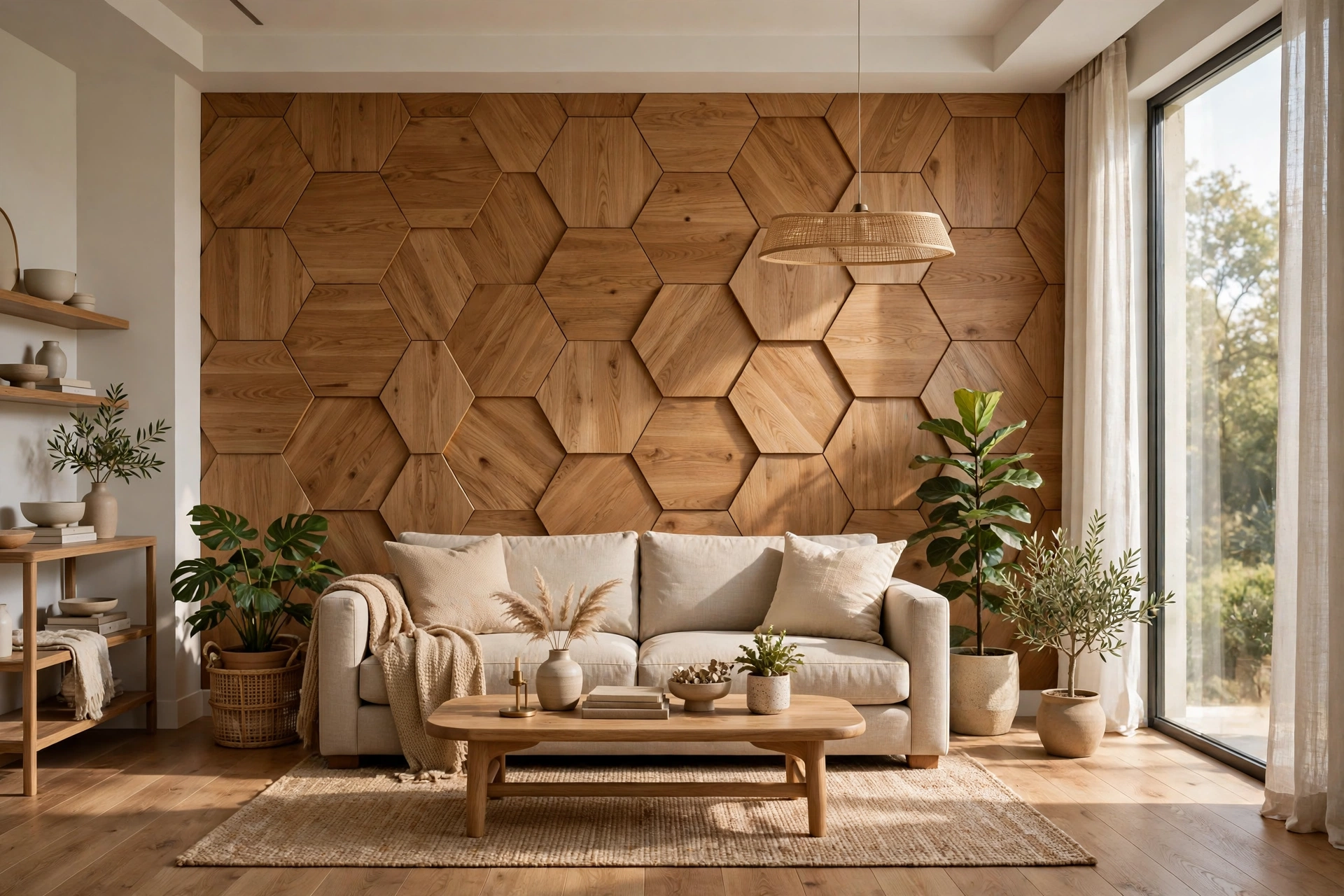
One accent color of hexagons scattered across a plain wall — a partial honeycomb, denser at one corner — reads more modern than a full wall of hexagons.
Full-wall hexagons in a tiny room can feel like a beehive closing in. In small rooms, keep the honeycomb to one section of the wall.
IDEA 06Diamond Grid — the Harlequin Classic
The diamond grid — harlequin — is the most traditional geometric pattern here, and the one that most rewards patience. A wall of evenly spaced diamonds in two tones reads as wallpaper from a distance and handcraft up close.
Precision guidance: the grid is everything. Mark the wall in pencil first: diamonds at a consistent width and height (tall diamonds, roughly twice as tall as wide, flatter the room best), with a level on every line. Tape one color’s diamonds, seal edges with base color, paint, and pull tape tacky. Two tones — tone-on-tone for subtlety, high contrast for drama — $40–$80, a full day.
Tall diamonds flatter a room; wide diamonds squat it. If your ceilings are under 8 feet, go taller and narrower.
A diamond grid that meets the ceiling or floor at a half-diamond looks unfinished. Plan the grid so full diamonds land at the top and bottom edges.
IDEA 07Mountain Mural — Painted Peaks, Zero Drawing Skill
Painted mountains are the geometric mural anyone can paint: a series of triangles in layered tones, and suddenly the wall has depth, horizon, and a view. No drawing skill required — the peaks are straight lines, and straight lines are tape’s home turf.
Tape guidance: mark the horizon line with a level, then tape each mountain’s two slopes, painting back to front, lightest peaks first. Three to four tones of one color family (sage to forest, blue-gray to navy) give depth without chaos; a single snowcap line of white on the tallest peak sells the whole scene. $40–$90, half to a full day, beginner-friendly.
Layer the tones back to front and let each layer dry before taping the next — wet layers peel, dry layers hold crisp edges.
More than four mountain tones turns a mural into a rainbow. Stay in one color family and let the lightest tone do the talking.
IDEA 08Color-Block Rectangles — the Modernist Wall
Color blocking is geometry at its most modern: large rectangles of flat color, arranged like a Mondrian without the black grid lines. It’s the fastest geometric to paint — every edge is a straight taped line — and the most forgiving, because a rectangle’s proportions hide small measurement slips that triangles and diamonds would expose.
Tape guidance: sketch the block layout on paper first, keeping two or three colors and one neutral field, then mark the wall in pencil with a level on every line. Tape each block’s edges, seal with base color, and paint the darkest blocks first so any touch-ups go lighter over darker, never the reverse. $35–$70, half a day.
Let one block run floor to ceiling — a single full-height rectangle anchors the whole composition and stops it reading as random squares.
Equal-sized blocks in equal colors read as a checkerboard, not a design. Vary the sizes: one large, two medium, one small.
IDEA 09Geometric Wallpaper — the Pattern, Done for You
Sometimes the smartest geometric is the one someone else drew: geometric wallpaper delivers perfect lines, perfect repeats, and patterns no hand could tape — intricate lattices, art-deco fans, and fine-line geometrics that would take a weekend to paint.
Precision guidance: the work moves from taping to pattern matching — line up each strip’s repeat at eye level before pasting, and keep a spare roll from the same dye lot for repairs. Small, busy geometrics shimmer and distract in small rooms; large, quiet geometrics read as texture. $40–$150 for 2–3 rolls, 2–4 hours. Renters: peel-and-stick geometric wallpaper is the obvious pick and fully removable.
Match the pattern at eye level, not at the ceiling — that’s where the eye actually checks the seams.
Geometric wallpaper with a strong repeat on a wall with a door cut into it wastes the pattern — pick the cleanest, most visible wall.
IDEA 10Wood Geometric Panels — Architecture in Timber
Wood geometric panels — triangles, diamonds, or chevrons cut from thin timber and mounted as a relief — turn a flat wall into something with real depth and shadow. The pattern changes through the day as light moves across it, which is a quality no paint can offer.
Precision guidance: cut all pieces from one template so angles stay identical, dry-lay the full pattern on the floor first, and mount with a level checked on every piece — wood shows a crooked angle even more brutally than paint. Natural stain keeps the wood reading as wood; one paint color over all pieces reads as modern architecture. $80–$250, a weekend. Renters: panels on a single backer board, hung on cleats, come down in one piece.
Dry-lay the whole pattern on the floor before a single piece touches the wall — floor mistakes are free, wall mistakes are holes.
Mixed wood tones in one geometric pattern look like offcuts, not design. One timber, one finish, throughout.
IDEA 11Half-Wall Geometric Border — the Low-Commitment Test
Not ready to commit a whole wall to geometry? A geometric border — one band of triangles, diamonds, or chevrons running at chair-rail height or just under the ceiling — gives the room a geometric accent with a fraction of the work and an easy exit.
Tape guidance: one level line is the whole project — mark the band’s top and bottom edges with a level, then tape the pattern inside the band. Keep the band 12–18 inches tall; thinner reads as trim, thicker starts competing with the wall. $25–$60, half a day, beginner-friendly. Renters: pure paint, fully reversible.
A geometric border at chair-rail height pairs beautifully with a chair rail or picture ledge — the trim hides the band’s lower edge, so only one taped line has to be perfect.
A border that stops at a doorway or jogs around a corner looks unfinished. Run it continuously, or end it cleanly at a corner with a vertical tape line.
IDEA 12Oversized Single Shape — One Shape, Whole Room
The boldest geometric is also the simplest: one enormous shape — a single triangle, circle, or arch filling most of a wall. No repeat to measure, no grid to keep true, just one confident form that turns the wall into art.
Tape guidance: minimal — one shape means one outline. For a triangle, mark three points with a level and straightedge and tape between them; for a circle, pin a string at the center and sweep the radius. Keep the shape at least two-thirds of the wall in both directions, or it shrinks into decoration. $30–$60, half a day, beginner-friendly.
Center the shape on the furniture below it, not on the wall itself — the eye reads the shape against the sofa or bed, and off-center against furniture looks like a mistake.
A single shape smaller than half the wall reads as a decal. Go big or pick a different idea — timid geometry is the only kind that fails.
IDEA 13Thin-Line Geometric — Minimalism in Pencil Lines
Thin-line geometric is the quiet luxury of this list: hairline outlines — triangles, grids, or abstract line drawings traced in a single color on a plain wall. From across the room it reads as texture; up close it reads as art.
Precision guidance: this is the highest-precision painted idea here, because thin lines show every wobble. Use thin 0.75-inch tape or a paint pen for the outlines, work slowly, and keep the design sparse — a few lines carry the whole wall, and every extra line dilutes it. One color, usually charcoal or deep green on white. $30–$60, half to a full day, intermediate patience.
Sketch the line design on paper at wall scale first — thin lines that look balanced on a phone screen can look lost or crowded at 10 feet wide.
Thin lines over textured walls bleed and blur. This idea needs a smooth wall — on orange-peel texture, pick a bolder pattern instead.
IDEA 14Bold Multicolor Geometric — the Statement Wall
Some rooms want a whisper; some want a shout. A bold multicolor geometric — triangles, diamonds, or blocks in four or five saturated colors — is the shout: a wall that becomes the room’s art collection, conversation piece, and personality in one weekend.
Precision guidance: with this many colors, organization is the skill — label every tape section with its color in pencil before painting anything, and paint one color across the whole wall before starting the next, rather than finishing one shape at a time. That keeps wet edges consistent and touch-ups simple. $50–$100, a full day, intermediate. Keep the rest of the room quiet: white walls, plain furniture, one rug.
Pick the palette first and buy all the paint at once — matching a discontinued color mid-wall is the one delay that kills a multicolor weekend.
Multicolor geometry on two walls turns a statement into a circus. One wall, full stop — the rest of the room stays calm so the pattern can shout.
IDEA 15Geometric + Mural Combo — Pattern Meets Picture
The most personal geometric on this list pairs a geometric field with a painted scene inside it — mountains inside an arch, a sun inside a triangle field, a moon over a diamond grid. The geometry frames the picture, the picture softens the geometry.
Precision guidance: paint the geometric field first and let it dry fully, then tape the mural shape inside it — never the reverse, because mural edges over fresh geometry smudge. Keep the mural simple and large: one sun, one mountain range, one moon. Detail smaller than a dinner plate disappears from across the room. $50–$110, a full day, intermediate. Renters: pure paint, fully reversible.
Let the geometry dry a full day before taping the mural inside it — tape on tacky paint lifts the field and ruins both layers at once.
A fussy, detailed mural inside a busy geometric field is visual noise. One simple shape inside one calm pattern — that’s the whole recipe.
Which Wall for Geometry? Placement Rules
Geometry is pickier about placement than plain paint, because a pattern cut by a doorframe or a window is a pattern ruined. Four rules decide whether it lands. Rule one: the flattest, cleanest wall. Geometry shows every bump and patch — pick the smoothest wall, or prep the chosen one properly (fill, sand, prime). Textured walls are the enemy of thin lines and crisp tape edges alike. Rule two: the wall you see first. Stand in the doorway — the first wall your eye lands on is your geometric wall, because pattern deserves the best sightline in the room.
Rule three: never a wall with doors or windows cutting the pattern. A chevron broken by a doorway, a diamond grid sliced by a window — both read as mistakes, not design. If every wall has an opening, pick the wall where the opening sits at the pattern’s edge, or choose a forgiving idea like arches or an oversized single shape that can sit clear of the opening. Rule four: one wall, full stop. Geometry’s power is focus; two geometric walls compete and exhaust the eye. The one exception: a half-wall border, which is quiet enough to run on two walls.
Before taping anything, photograph the wall and sketch the pattern over the photo — doors, outlets, and light switches you forgot about show up instantly on a photo and ruin a pattern planned from memory.
Geometry on a wall with a mounted TV or a tall headboard hides the pattern’s center — the part the eye wants most. Move the furniture or pick a wall the pattern can own.
Geometric Color Rules: 2–3 Colors, One Clear Winner
Geometric color has one iron rule: two to three colors, maximum — one dominant field color (usually the existing wall color), one accent, and optionally one deep tone for depth. Four or more colors is a different project (idea 14) and needs a whole room kept quiet to survive. Within that limit, two approaches work. Contrast — navy on white, charcoal on cream, forest on blush — makes the pattern pop and suits bold rooms and large patterns. Tone-on-tone — two shades of the same color, like sage and deep green — makes the pattern read as texture and suits small rooms, bedrooms, and anyone who wants geometry without shouting.
Palette guidance: bold palettes (navy, terracotta, mustard, forest) suit large patterns on large walls — the color carries the scale. Muted palettes (sage, clay, dusty blue, warm gray) suit small rooms and busy patterns, where bold color would overwhelm. Finish: matte or eggshell — gloss reflects light unevenly across taped edges and exposes every imperfection.
The 60-30-10 rule keeps geometric color honest: 60% field color (the wall), 30% main accent, 10% deep tone. Break it and the pattern starts competing with the room instead of decorating it.
Test the full palette as painted squares on the actual wall, side by side, before taping anything — colors that harmonize on chips can clash at wall scale.
Neon and ultra-bright colors in geometric patterns vibrate on the eye and fatigue a room fast. If you love brights, use them as the 10% accent, never the 60% field.
Renter Rules: What You Can and Can’t Do
- Always safe: repainting (primer covers everything), peel-and-stick wallpaper and tiles, washi-tape geometry, leaning panels, and any pattern painted over with two primer coats at move-out.
- Safe with care: wood geometric panels on a cleat-backed board (one piece, few holes), adhesive trim patterns (test hidden first), hexagon tiles on removable adhesive.
- Ask first, in writing: anything nailed directly into the wall across a large area, dark or multicolor patterns if your lease specifies repainting to the original shade. Photograph the wall on move-in day.
- Never: assume one coat of primer hides a multicolor geometric — bold patterns ghost through single primer coats for years. Budget two coats of quality primer, and keep the original paint color name for the move-out repaint.
Bold multicolor geometry is the pattern landlords notice most — budget two primer coats at move-out, or the triangles ghost through the new paint.
A $50 geometric wall in paint plus $15 of primer is the cheapest room transformation in existence — and a tasteful geometric accent is the one repaint landlords rarely object to, since it reads as an upgrade.
5 Mistakes to Avoid
- Sloppy tape lines. Paint bleeding under tape is the single most common geometric failure, and it’s entirely preventable: seal every tape edge with the base wall color first, paint two thin coats instead of one thick one, and pull tape while the final coat is still slightly tacky.
- Pattern too small for the room. Tiny triangles, tight diamonds, and dense chevrons on a large wall read as visual static. Scale the pattern to the wall: big walls need big shapes, and a pattern that looks busy from the doorway will only get busier up close.
- Too many colors. Four or five colors in a geometric pattern without a disciplined palette turns a design into confetti. Two to three colors, one dominant — or commit fully to a multicolor statement (idea 14) and keep the rest of the room silent.
- Pattern cut by furniture. A geometric field hidden behind a tall headboard, a mounted TV, or a bookshelf loses its center and reads as leftover pattern. Plan the pattern around the furniture, or move the furniture so the pattern owns the wall.
- Skipping the level. Eyeballing horizontal lines, grid rows, or chevron angles is how patterns drift — and drift compounds row by row until the bottom of the wall disagrees with the top by inches. A $15 level and a pencil grid are the cheapest insurance in this entire article.
FAQs
01How do I paint a geometric accent wall?
Start with a pencil grid: mark the pattern on the wall with a level, keeping shapes large — triangles 18 inches or taller, chevron rows 6–8 inches deep. Tape the edges with 1.5-inch painter’s tape, seal each edge by painting over it with the base wall color first, then apply two thin coats of the pattern color. Pull the tape while the second coat is still slightly tacky for the crispest lines. Total cost is usually $35–$80 for one wall, and the whole project takes half a day to a full day depending on the pattern.
02What is the best painter’s tape for geometric walls?
Use a medium-adhesion blue or green painter’s tape in 1.5-inch width for most patterns — it seals better than wide tape and removes cleanly. For thin-line designs, use 0.75-inch tape or a paint pen. The tape brand matters less than the technique: seal every tape edge with the base wall color before painting the pattern color, use two thin coats instead of one thick coat, and pull tape while the final coat is tacky. On freshly painted walls, wait at least 24 hours before taping, or the tape lifts the base coat.
03Does a geometric accent wall work in small rooms?
Yes — with the right scale and palette. Choose large, simple shapes (oversized triangles, arches, or color blocks) in tone-on-tone or muted colors like sage, clay, or dusty blue, which read as texture rather than noise. What fails in small rooms: tiny, dense patterns and high-contrast multicolor fields, which make walls feel closer and busier. One geometric wall only, on the flattest wall, with the rest of the room kept plain.
04Should I use geometric wallpaper or paint my own geometric wall?
Choose wallpaper if you want intricate patterns, perfect repeats, or zero tape skill — it delivers lattices and art-deco fans no hand could tape, and peel-and-stick versions are fully renter-friendly. Choose paint if you want a custom pattern, a lower cost ($35–$80 versus $40–$150 for wallpaper), or a pattern scaled exactly to your wall. Painted geometry also repaints cleanly at move-out, while pasted wallpaper needs steaming or stripping.
05What are the best renter-friendly geometric accent walls?
Ranked by impact and reversibility: peel-and-stick geometric wallpaper or hexagon tiles (fully removable, biggest transformation), any painted geometric (primer plus two coats restores the wall at move-out), washi-tape geometry (peels off in minutes, best for borders and thin lines), and wood panels on a cleat-backed board (one piece, few holes). Photograph the wall on move-in day, and keep the original paint color name for the move-out repaint.
06What colors work best for a geometric accent wall?
Stick to two to three colors: one dominant field color (usually the existing wall color), one accent, and optionally one deep tone. Contrast pairings — navy on white, charcoal on cream, forest on blush — make patterns pop and suit large walls. Tone-on-tone pairings — two shades of sage, clay, or dusty blue — read as texture and suit small rooms and bedrooms. Bold palettes suit large patterns; muted palettes suit busy patterns. Finish in matte or eggshell — gloss exposes every taped edge.
Key takeaways
- Tape discipline is the whole skill. A geometric accent wall succeeds or fails on sealed tape edges, a pencil grid, and a level — not on artistic talent.
- Scale the pattern to the wall. Big walls need big shapes; tiny patterns on large walls read as static, and timid geometry is the only kind that fails.
- Two to three colors, one wall. Restraint in color and placement is what makes geometry look designed instead of chaotic.
- Pick a clean, flat wall. Geometry cut by doors, windows, or furniture loses its center — the pattern must own the wall it’s on.