 Casacrunched
15 Kitchen Accent Wall Ideas That Survive Grease & Steam
Kitchens are the messiest accent walls in the house — grease, steam, and food splashes. Fifteen kitchen accent wall ideas with cleanability ratings and zone rules so yours survives real cooking.
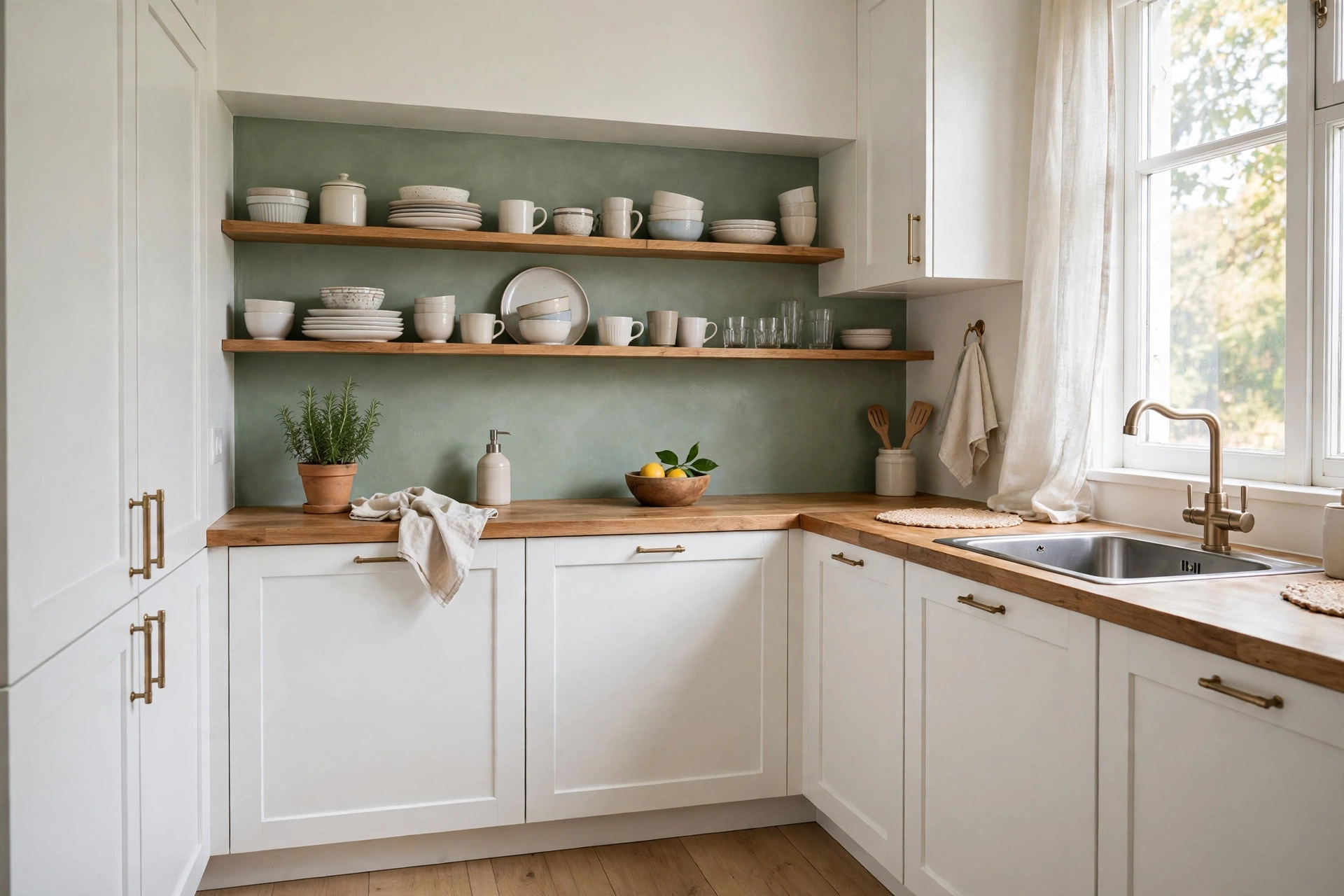
Every kitchen has one wall that takes the worst of it: grease from the stove, steam from the kettle, tomato sauce that somehow lands three feet from the pan. Most accent-wall advice pretends kitchens are like bedrooms. They’re not. Kitchen accent wall ideas have to survive the mess first and look good second — washable finishes, heat-safe materials, and placement that keeps the accent out of the splash zone.
Fifteen kitchen accent wall ideas built for real kitchens — each rated for cleanability, with heat and grease rules, honest costs, and renter-safe options.
On this page
- Quick comparison table
- 1. Washable paint
- 2. Tile backsplash extended
- 3. Peel-and-stick tile
- 4. Beadboard
- 5. Chalkboard wall
- 6. Open-shelf accent wall
- 7. Bold color, one wall
- 8. Shiplap away from stove
- 9. Washable vinyl wallpaper
- 10. Wood-look panels
- 11. Dark moody kitchen wall
- 12. Two-tone upper/lower
- 13. Brick veneer
- 14. Sealed limewash
- 15. Magnetic functional wall
- Kitchen wall placement
- Washable colors
- Renter rules
- 5 mistakes to avoid
- FAQs
Quick comparison: cost, time, cleanability
| # | Idea | Cost / wall | Time | Cleanability | Renter-friendly? |
|---|---|---|---|---|---|
| 1 | Washable paint | $35–$70 | Half day | Excellent (scrub) | Yes (repaint) |
| 2 | Tile backsplash extended | $100–$300 | Weekend | Excellent (wipe) | No (adhesive: partial) |
| 3 | Peel-and-stick tile | $40–$120 | 2–4 hours | Very good | Fully removable |
| 4 | Beadboard | $60–$150 | Full day | Good (sealed) | Adhesive: partial |
| 5 | Chalkboard wall | $30–$60 | Half day | Good (wipe) | Yes (repaint) |
| 6 | Open-shelf accent wall | $60–$180 | Half–full day | Fair (dust + grease) | Yes (patch holes) |
| 7 | Bold color, one wall | $35–$70 | Half day | Excellent (satin) | Yes (repaint) |
| 8 | Shiplap away from stove | $80–$200 | Full day | Good (sealed) | Adhesive: partial |
| 9 | Washable vinyl wallpaper | $40–$150 | 2–4 hours | Very good | Peel-and-stick: yes |
| 10 | Wood-look panels | $80–$250 | Full day | Good (sealed) | French cleat: yes |
| 11 | Dark moody kitchen wall | $35–$70 | Half day | Excellent (satin) | Yes (repaint) |
| 12 | Two-tone upper/lower | $40–$80 | Half–full day | Excellent (lower scrubs) | Yes (repaint) |
| 13 | Brick veneer | $100–$300 | Weekend | Fair (sealed) | Adhesive: partial |
| 14 | Sealed limewash | $60–$110 | Half–full day | Good (sealed) | Yes (repaint) |
| 15 | Magnetic functional wall | $50–$150 | Half day | Excellent (wipe) | Yes (magnetic paint) |
IDEA 01Washable Paint — the Foundation Everything Else Builds On
The single most important kitchen accent decision is not color — it’s finish. Satin or semi-gloss paint turns an accent wall into a wipeable surface: grease splatter, sauce fingerprints, and steam marks come off with a damp cloth instead of taking the paint with them. Flat and matte finishes, beautiful in bedrooms, absorb kitchen grime and stain on first contact.
Pick a washable kitchen-and-bath formula in your accent color — sage, terracotta, dusty blue all work — and apply two coats over a stain-blocking primer if the wall was previously flat-painted. $35–$70 for a gallon and primer, half a day. This is the base layer for ideas 7, 11, and 12 too: get the finish right and every other kitchen accent gets easier.
Buy kitchen-and-bath paint, not generic satin — it carries mildewcide for steam and a harder film for scrubbing.
Never use flat or matte paint on a kitchen accent wall — one grease splatter becomes a permanent stain you can’t wipe without removing paint.
IDEA 02Tile Backsplash Extended — the Accent That Works Hardest
The smartest kitchen accent is often the one already there: run the backsplash tile all the way up the wall — to the ceiling, or at least to the underside of the upper cabinets and beyond. Subway, zellige, or large-format tile turns a working surface into a full accent wall that shrugs off everything a kitchen throws at it.
Tile is the cleanability champion: glazed surfaces wipe clean in seconds, grout sealed once a year stays stain-free, and heat is irrelevant — tile laughs at stove-adjacent walls. $100–$300 for a single wall in subway tile, a weekend with thinset and a wet saw (or a tiler for a day). Zone rule: tile is the only accent that belongs directly behind the stove — everything else on this list keeps its distance.

Run tile past the cabinets’ width on both sides — a tile field exactly cabinet-wide reads as a backsplash, not an accent wall.
Unsealed grout near the stove absorbs grease and yellows within months — seal grout before first use, and reseal yearly.
IDEA 03Peel-and-Stick Tile — the Renter’s Backsplash
Peel-and-stick tile sheets deliver the tile look — subway, mosaic, marble-look — with zero thinset and a clean exit. Stick them on a smooth wall, press out bubbles with a credit card, and peel off at move-out. For renters, this is the only tile-adjacent accent that doesn’t risk the deposit.
Cleanability is very good: vinyl faces wipe like glazed tile, though seams need attention — grease can creep into unsealed joints near the stove. $40–$120 for a single wall, two to four hours. Heat rule: keep peel-and-stick tile at least 12 inches from open burners — vinyl softens under direct high heat. Behind the sink or on the dining-side wall, it’s perfect.
Warm the sheets slightly with a hair dryer during install — they conform to minor wall bumps and bond tighter.
Peel-and-stick tile directly behind a gas hob will warp — that wall belongs to real tile (idea 2) or washable paint (idea 1).
IDEA 04Beadboard — Cottage Calm That Handles Humidity
Beadboard’s vertical grooves give a kitchen wall cottage texture that paint alone can’t — and painted in a washable satin, it handles steam and the occasional splash without complaint. White beadboard brightens a dark galley kitchen; sage or dusty blue turns it into a proper accent.
The grooves are the catch: grease settles into them near the stove, so beadboard belongs on the dining-side or sink-adjacent wall, not the cooking wall. Seal with two coats of satin paint over primer — unsealed MDF beadboard swells with steam. $60–$150, a full day. Renters: adhesive beadboard panels, removed with heat and a scraper.
Caulk the top edge where beadboard meets the ceiling — the shadow line there is where DIY beadboard looks unfinished.
Unsealed MDF beadboard in a steamy kitchen swells and buckles — prime every edge, including cut ends, before hanging.
IDEA 05Chalkboard Wall — the Kitchen’s Working Accent
A chalkboard accent wall is the only idea here that earns its keep daily: shopping lists, weekly menus, kids’ drawings, recipe notes — all on the wall, all erasable. Black or deep green chalkboard paint on one wall turns dead space into the kitchen’s command center, and the dark tone doubles as a bold accent.
Chalk dust is the trade-off: it settles on counters below, so keep the chalkboard wall away from food-prep surfaces — the dining-side wall or the wall by the fridge, not above the counter. Wipe with a damp cloth weekly; condition new chalkboard paint by rubbing chalk over the whole surface first, or first writings ghost permanently. $30–$60, half a day. Renters: it’s just paint.

Condition the wall before first use: rub a chalk stick sideways over the entire surface, then erase — this prevents ghosting forever.
Chalk dust drifts onto food-prep counters — never put a chalkboard wall directly above where you chop or plate.
IDEA 06Open-Shelf Accent Wall — Display That Doubles as Storage
Paint one wall a deep tone, then mount two or three open shelves — everyday dishes, glass jars, a trailing plant — and the wall becomes display and storage at once. The painted backdrop unifies shelves and objects into one composition, and open shelving makes a small kitchen feel larger than closed cabinets do.
The kitchen catch: open shelves collect grease and dust — everything on them needs wiping weekly, more near the stove. Keep shelves on the dining-side wall, never above the hob, and favor closed jars over open crockery near cooking zones. $60–$180 for paint plus two oak shelves, half to a full day. Renters: shelves mean anchor holes, but two holes per shelf patch cleanly.
Put daily dishes on open shelves and rarely-used items in closed cabinets — frequent handling keeps the daily set clean automatically.
Open shelves above the stove become grease-coated within a week — that wall is for tile, not display.
IDEA 07Bold Color, One Wall — Appetite in a Gallon
One wall in a bold, appetite-friendly color — terracotta, tomato red, deep mustard, paprika — is the fastest kitchen transformation there is. Warm colors are appetite stimulants (it’s why restaurants use them), and a single bold wall gives a white kitchen a pulse without repainting the whole room.
The finish rule from idea 1 applies double here: satin or semi-gloss, never flat — bold colors show every grease mark, and only a washable finish lets you wipe them away. $35–$70, half a day. Keep the remaining walls light and neutral so the bold wall reads as an accent, not a takeover — and test the color beside your cabinets at night, since kitchen lighting shifts warm tones dramatically.
Sample bold colors at night under your actual kitchen lights — warm LEDs deepen reds and oranges far beyond the daylight chip.
Bold color plus bold cabinets equals visual chaos — if your cabinets are already colorful, pick a muted accent instead.
IDEA 08Shiplap Away From the Stove — Farmhouse Lines, Kitchen Rules
Shiplap’s clean horizontal lines bring farmhouse warmth to a kitchen wall — painted white for coastal calm, sage for the middle path, charcoal for drama. The texture reads as architecture, and the wall gains presence without competing with the cooking zone.
The placement rule is absolute: shiplap never goes on the cooking wall. Grease settles into the plank gaps and wood near open flame is a fire concern. The dining-side wall, the breakfast-nook wall, or the wall by the fridge — those are shiplap territory. Seal with two coats of satin paint. $80–$200, a full day. Renters: adhesive planks, removed with heat.
Run shiplap horizontally to widen a narrow galley kitchen, vertically to lift a low ceiling — direction changes the room’s proportions.
Wood planks behind a gas hob are a fire risk and a grease trap — that wall belongs to tile, full stop.
IDEA 09Washable Vinyl Wallpaper — Pattern That Survives the Kitchen
Vinyl wallpaper is the only wallpaper that belongs in a kitchen: its plastic face wipes clean like tile, shrugs off steam, and comes in every pattern from subtle grasscloth-looks to bold botanicals. Paper-backed or non-woven wallpapers absorb grease and peel in steam — vinyl is the kitchen-grade exception.
Placement still matters: vinyl handles the dining-side wall and the wall by the fridge beautifully, but keep it out of the direct splash zone behind the sink and stove — seams can lift under constant water contact. $40–$150 for 2–3 rolls, two to four hours. Renters: peel-and-stick vinyl is fully removable and the obvious pick.
Seal wallpaper seams near the sink with a thin bead of clear silicone — it stops water creeping under edges and lifting them.
Paper-backed wallpaper in a steamy kitchen peels within months — if it doesn’t say vinyl or washable, it doesn’t belong here.
IDEA 10Wood-Look Panels — Warmth Without the Upkeep
Wood-look panels — slats, fluted boards, or large-format planks in oak, walnut, or whitewash — bring natural warmth to a kitchen wall without real wood’s maintenance. Sealed panels wipe clean, resist steam better than raw timber, and turn a plain wall into the kitchen’s warmest feature.
Sealing is everything: unsealed wood panels absorb grease and steam-stain permanently. Two coats of polyurethane or a factory-sealed finish, and the wall wipes like any painted surface. Keep panels off the cooking wall — heat and grease are still the enemy — and favor the dining-side or breakfast-nook wall. $80–$250, a full day. Renters: panels on a plywood backer hung from a French cleat come down cleanly.
Match panel tone to your cutting boards and stools — repeating one wood tone ties the kitchen together without trying.
Raw, unsealed wood panels in a kitchen absorb grease stains that never come out — seal before hanging, not after.
IDEA 11Dark Moody Kitchen Wall — Drama That Hides Mess
A dark wall in a kitchen sounds counterintuitive — until you realize dark hides mess. Charcoal, ink navy, or deep forest green in satin finish disguises splatter between cleanings, makes brass fixtures and wood tones glow, and turns an ordinary kitchen into a moody, restaurant-like space after dark.
The lighting rule is non-negotiable: dark walls demand good task lighting — under-cabinet strips, a pendant over the island, bright daylight. A dark wall in a windowless kitchen with one dim bulb feels like a cave. With proper light, it’s the most sophisticated wall on this list. $35–$70, half a day. Renters: it’s just paint.

Pair dark walls with brass or copper fixtures — warm metals against dark paint is the combination that makes the whole kitchen feel expensive.
Dark wall plus poor task lighting equals a cave — install under-cabinet strips before painting dark, not after.
IDEA 12Two-Tone Upper/Lower — the Practical Split
Split one wall horizontally — durable dark or bold color below, light color above — and you get an accent that’s also practical: the lower half, where splashes and fingerprints land, wears washable satin in a forgiving tone; the upper half keeps the room bright and airy.
The split line is the design: chair-rail height (about 36 inches) reads classic; a higher split at 48 inches feels modern. Seal the tape edge with the base color first so the accent coat can’t bleed under. $40–$80 for two quarts, half to a full day. The lower half takes the abuse, the upper half takes the light — the smartest division of labor on this list.
Align the split line with a countertop, windowsill, or shelf height — a line that matches existing architecture looks intentional, not random.
A wavy split line ruins the entire effect — laser level and sealed tape edges are not optional here.
IDEA 13Brick Veneer — Industrial Character, Sealed
Thin brick veneer gives a kitchen wall industrial character — exposed-brick warmth without structural work. Whitewashed brick brightens a dark kitchen; natural red brick adds rustic depth; painted brick in sage or charcoal modernizes the whole look.
The catch is porosity: raw brick absorbs grease like a sponge. Seal veneer thoroughly with a masonry sealer — two coats minimum — before it sees a single frying pan, and keep it off the cooking wall regardless. Sealed brick wipes acceptably; unsealed brick stains permanently. $100–$300, a weekend. Renters: adhesive veneer panels, removed with heat and patience.
Whitewash brick instead of painting it solid — the wash lets texture show through while lightening the wall dramatically.
Unsealed brick near a stove absorbs grease permanently — seal twice, and still keep it off the cooking wall.
IDEA 14Sealed Limewash — Old-World Texture, Kitchen-Proofed
Limewash’s hand-brushed, cloudy texture gives a kitchen wall old-world depth flat paint can’t match — warm white, clay, sage shifting through the day. Unsealed, it’s a bedroom finish. Sealed with a matte masonry sealer, it becomes kitchen-viable: wipeable enough for the dining-side wall, beautiful everywhere.
Sealing changes the look slightly — a touch more sheen, a touch deeper color — so sample sealed, not raw, before committing. $60–$110 for limewash plus sealer, half to a full day with a block brush; the technique is forgiving (the “mistakes” are the texture). Keep sealed limewash off the cooking wall — it’s wipeable, not tile.
Apply limewash in crisscross strokes, not straight lines — the crossing pattern is what creates the cloudy, old-world movement.
Unsealed limewash in a kitchen stains on first contact — the sealer coat is not optional, it’s the whole idea.
IDEA 15Magnetic Functional Wall — Knives, Notes, and Spice Jars
The most useful wall on this list: magnetic paint or a steel panel painted your accent color, holding knife strips, spice jars, shopping lists, and kids’ art — all off the counter and on the wall. The kitchen gains storage, the counter gains space, and the wall gains a working purpose.
Magnetic paint needs three to four coats to hold real weight — one coat holds paper, not knives. Alternatively, mount a thin steel sheet and paint over it for full magnetic strength. $50–$150, half a day. Keep magnets away from the stove’s heat (it weakens them over time) and favor the wall by the fridge or prep zone. Renters: magnetic paint repaints like any paint.
Use neodymium magnets for knives and heavy jars — ceramic fridge magnets won’t hold through multiple paint coats.
One coat of magnetic paint holds paper, not a chef’s knife — four coats or a steel sheet, or the knives end up on the floor.
Kitchen Wall Placement: Dining-Side First, Stove Wall Last
Kitchens have zones, and the accent wall’s job is to respect them. Zone one: the cooking wall — stove, oven, range hood. Only tile (idea 2) and washable paint (idea 1) belong here; everything else keeps its distance from heat and airborne grease. Zone two: the wet wall — sink and dishwasher. Tile, washable paint, and sealed vinyl handle splashes; raw wood, paper wallpaper, and chalkboard do not.
Zone three: the dining-side wall — the wall you see from the table, usually the largest uninterrupted surface. This is the accent wall’s natural home: every idea on this list works here, including the delicate ones (shiplap, beadboard, limewash, open shelves). Zone four: the fridge wall — short, often broken by the appliance, best for functional accents (chalkboard, magnetic) rather than visual ones. Rule of thumb: accent where you eat and look, protect where you cook and wash.
Stand at the stove and look around — any wall within arm’s reach of a burner is cooking-zone, no matter how nice it would look as an accent.
The most common kitchen accent mistake is treating the stove wall like a bedroom wall — grease and heat destroy in weeks what took a weekend to build.
Washable Colors: Appetite Tones in Scrubbable Finishes
Kitchen color follows two rules: appetite and washability. Warm tones — terracotta, tomato, mustard, paprika, warm sage — stimulate appetite and flatter food; cool clinical whites and icy blues can make a kitchen feel sterile. But color means nothing without finish: every kitchen accent color must be in satin or semi-gloss, or grease marks become permanent.
Small kitchens have a special rule: one bold wall, rest light. A dark or saturated accent on the dining-side wall adds depth without shrinking the room, while light cabinets and counters keep the workspace bright. Dark walls need task lighting — under-cabinet strips are cheaper than repainting. And sample every color at night under your kitchen lights: warm LEDs deepen reds and oranges far beyond the daylight chip, and the color you loved at noon can overwhelm at dinner.
The appetite test: hold a plate of food against the color swatch. If the food looks better, the color works; if the wall steals attention, it doesn’t.
Buy kitchen-and-bath paint in your accent color — it carries mildewcide for steam and a harder film that survives weekly scrubbing.
Flat paint in a bold kitchen color is the worst of both worlds — every mark shows, and wiping removes paint along with the stain.
Renter Rules: What You Can and Can’t Do
- Always safe: repainting in washable satin (primer covers everything), peel-and-stick tile and vinyl wallpaper, magnetic paint, chalkboard paint, freestanding shelves, adhesive hooks and rails.
- Safe with care: open shelves and rails on proper anchors (patch at move-out), adhesive beadboard, shiplap, or veneer panels on smooth walls (heat to remove), wood panels on a French cleat.
- Ask first, in writing: real tile (thinset is permanent), brick veneer with mortar, any plumbing or electrical moves for a feature wall. Photograph the wall on move-in day.
- Never: tile directly over a landlord’s tile, drill into a tiled wall without permission (cracked tile is an expensive repair), or assume grease damage near the stove is “normal wear” — clean cooking-zone walls before inspection.
The kitchen wall takes the most damage in a rental — grease, steam, and heat. Photograph everything on move-in day or you’ll pay for “damage” that was already there.
A $40 gallon of washable paint is the cheapest lease negotiation in existence — and a kitchen accent wall is the one repaint landlords rarely object to, since it reads as an upgrade.
5 Mistakes to Avoid
- Flat paint near the stove. Matte finishes absorb grease on first contact and stain permanently. Kitchen accents live in satin or semi-gloss — no exceptions, no matter how pretty the flat swatch looked.
- Wallpaper in the splash zone. Paper-backed wallpaper behind the sink or stove peels in steam and stains in splashes. Only vinyl belongs in a kitchen, and even vinyl stays out of direct water contact.
- Wood without sealing. Raw shiplap, beadboard, and wood panels absorb grease and steam-stain permanently. Seal every surface — including cut ends — before hanging, or don’t hang wood in a kitchen at all.
- Ignoring grease. Every kitchen accent needs a cleaning plan: tile wipes daily, satin paint weekly, shelves weekly, grout sealed yearly. An accent with no cleaning plan becomes a stain collection within a month.
- Dark walls plus poor task lighting. A moody dark accent without under-cabinet strips and good pendants turns a kitchen into a cave. Install the lighting before the paint, or the drama becomes gloom.
FAQs
01What is the best paint for a kitchen accent wall?
A kitchen-and-bath paint in satin or semi-gloss finish. Satin wipes clean without showing every mark; semi-gloss scrubs even harder and suits the cooking wall. Kitchen-and-bath formulas add mildewcide for steam and a harder film for scrubbing. What fails: flat or matte paint, which absorbs grease on first contact and stains permanently.
02Backsplash or accent wall — which should I do?
Do both, as one thing: extend the backsplash tile up the full wall (idea 2) and it becomes the accent wall — the hardest-working, easiest-cleaning accent a kitchen can have. If tile isn’t in budget, a washable painted accent on the dining-side wall plus a standard backsplash behind the stove gives you 90% of the look for a fraction of the cost.
03Is wallpaper safe in a kitchen?
Vinyl wallpaper is; paper-backed wallpaper is not. Vinyl’s plastic face wipes clean, resists steam, and survives kitchen life. Paper-backed and non-woven wallpapers absorb grease and peel in steam within months. Even vinyl stays off the direct splash zone — keep it on the dining-side wall, and seal seams near the sink with clear silicone.
04What are the best renter-friendly kitchen accent options?
Ranked by impact and reversibility: one-wall repaint in washable satin (primer covers everything at move-out), peel-and-stick tile or vinyl wallpaper (fully removable, biggest transformation), magnetic or chalkboard paint (just paint), open shelves on anchors (a few small holes patch cleanly). Avoid real tile and mortar veneer — both are permanent.
05What works as an accent wall in a really small kitchen?
Small kitchens reward one bold washable wall on the dining side — terracotta, sage, or deep mustard in satin — with everything else light. Tile extended up one wall also works: it reflects light and reads as architecture, not bulk. Skip heavy treatments like brick and dark walls without task lighting — both shrink a small kitchen visually. One accent, well lit, beats three competing ones.
06How do I clean a kitchen accent wall?
Match the method to the material: tile and vinyl — damp cloth with dish soap, daily near the stove; satin paint — damp cloth weekly, mild degreaser for splatter; sealed wood and brick — damp cloth only, never soaking; chalkboard — damp cloth weekly, felt eraser daily; grout — baking-soda paste monthly, reseal yearly. Never use abrasive pads on paint or vinyl — they strip finish along with grime.
Key takeaways
- Survival first, beauty second. Every kitchen accent wall idea here earns its place by handling grease, steam, or splashes — an accent that stains in week one is a failed project, however pretty.
- Finish beats color. Satin or semi-gloss, kitchen-and-bath formula, always. Flat paint in a kitchen is a stain waiting to happen.
- Accent where you eat, protect where you cook. The dining-side wall takes every idea; the stove wall takes tile and washable paint only.
- Seal everything porous. Wood, brick, limewash, grout — unsealed, they absorb grease permanently. Sealed, they wipe clean for years.