 Casacrunched
15 Accent TV Wall Ideas That Make the Screen Disappear
The TV wall is the hardest wall in the living room — a black rectangle you stare at for hours. Fifteen ideas that hide cables, kill glare, and turn the screen into part of the design.

Every living room has one wall that’s also a problem: the TV wall. It’s the wall you stare at for hours every evening — and staring back at you is a big black rectangle, usually flanked by dangling cables and a console that never quite hides them. Most accent-wall advice ignores the TV. That’s a mistake: accent tv wall ideas aren’t decoration layered around a TV — they’re design that solves it: glare, cables, visual weight.
Fifteen ideas built for the TV wall — each handling cable management, viewing glare, and TV-vs-wall scale — with honest costs, times, and renter-safe options.
On this page
- Quick comparison table
- 1. Dark wall, disappearing TV
- 2. Wood slat media wall
- 3. Floating shelves + paint
- 4. Shiplap media wall
- 5. Limewash behind TV
- 6. Gallery wall around TV
- 7. Board and batten media wall
- 8. Stone-look panels
- 9. Two-tone TV zone
- 10. Wallpaper behind TV
- 11. Built-in cabinet wall
- 12. LED backlight + dark paint
- 13. Peel-and-stick for renters
- 14. Vertical panels framing TV
- 15. Ceiling-to-floor color block
- TV wall placement
- Dark vs. light behind TV
- Renter rules
- 5 mistakes to avoid
- FAQs
Quick comparison: cost, time, renter score
| # | Idea | Cost / wall | Time | Renter-friendly? |
|---|---|---|---|---|
| 1 | Dark wall, disappearing TV | $35–$70 | Half day | Yes (repaint) |
| 2 | Wood slat media wall | $80–$250 | Full day | French cleat: yes |
| 3 | Floating shelves + paint | $60–$180 | Half–full day | Yes (patch holes) |
| 4 | Shiplap media wall | $80–$200 | Full day | Adhesive: partial |
| 5 | Limewash behind TV | $50–$90 | Half–full day | Yes (repaint) |
| 6 | Gallery wall around TV | $40–$150 | Half day | Command strips: yes |
| 7 | Board and batten media wall | $60–$150 | Full day | Removable trim: yes |
| 8 | Stone-look panels | $100–$300 | Full day | Adhesive: partial |
| 9 | Two-tone TV zone | $30–$60 | Half day | Yes (repaint) |
| 10 | Wallpaper behind TV | $40–$150 | 2–4 hours | Peel-and-stick: yes |
| 11 | Built-in cabinet wall | $200–$800 | Weekend+ | No (freestanding: yes) |
| 12 | LED backlight + dark paint | $60–$120 | Half day | Yes (repaint + strip) |
| 13 | Peel-and-stick for renters | $40–$120 | 2–3 hours | Fully removable |
| 14 | Vertical panels framing TV | $80–$250 | Full day | French cleat: yes |
| 15 | Ceiling-to-floor color block | $35–$70 | Half–full day | Yes (repaint) |
IDEA 01Dark Wall — Make the TV Disappear
The oldest TV-wall trick, and still the best: paint the wall behind the TV dark and matte — charcoal, deep forest green, ink navy — and the black screen stops reading as a black rectangle on a light wall. The wall recedes, the picture floats. $35–$70, half a day, the highest impact-per-dollar on this list.
A dark matte wall reflects almost no light back at the screen, so daytime viewing stays contrast-rich. Cables: a paintable raceway to the console, painted wall-color, vanishes on a dark wall. Scale rule: darker wall, bigger TV allowed — a 65-inch screen on white screams; on charcoal it sits quiet.
Use matte finish, not eggshell — any sheen on a dark TV wall bounces lamp light straight into your eyes.
Dark wall + bright white console = a new focal point you didn’t want. Match the console to the wall tone, or go dark wood.
IDEA 02Wood Slat Media Wall — Warmth That Hides Wires
Vertical wood slats are the TV wall’s best structural idea: the gaps between slats are natural cable channels. Mount the TV through the slats into studs, then drop power and HDMI cables behind the slat field — no raceway, nothing visible. Light oak keeps it calm; walnut stain turns it into the centerpiece.
Matte wood is kind to screens: no reflections. Scale rule: slats run wall-to-wall, not TV-width — a panel exactly the TV’s width reads as a plaque. $80–$250 in furring strips on a painted backer (paint it dark so gaps read as shadow). Renters: build the slat field on a plywood backer hung from a French cleat — the whole wall comes down at move-out.
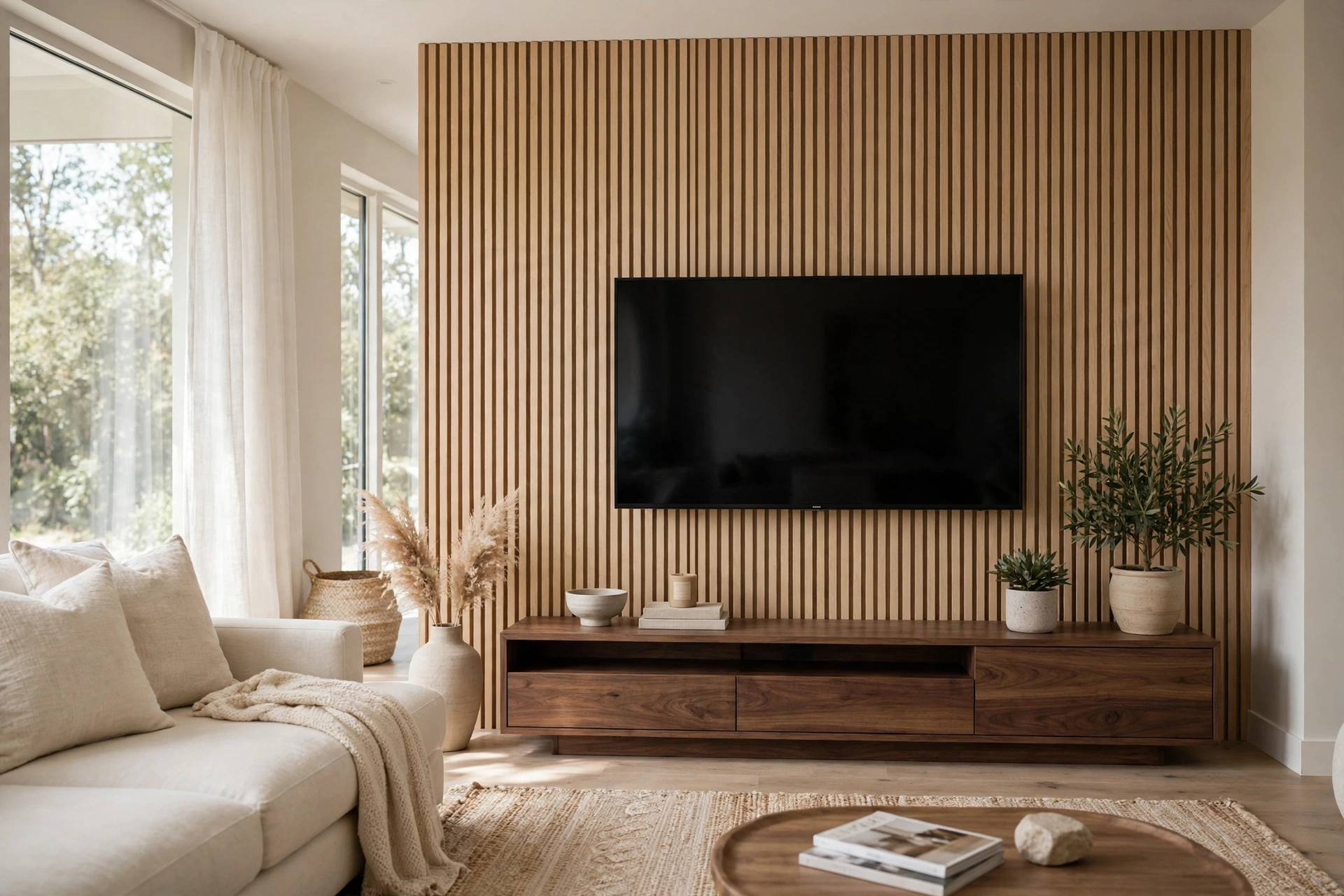
Mount a slim power strip behind the slat field at console height — one plug feeds TV, soundbar, and streamer, all invisible.
Slats spaced wider than 1 inch start reading as fence — and wide gaps show cables. Keep gaps tight and even.
IDEA 03Floating Shelves + Paint — the Balanced Composition
Paint the TV wall a mid-to-deep tone, then flank the TV with two or three floating shelves — books, a vase, a small plant on each side. The shelves break up the wall so the TV isn’t floating in a void and give the eye somewhere to rest during slow scenes; the paint unifies shelves, TV, and console into one composition.
Cables run down behind the console, or along a shelf’s underside in a painted channel. Keep shelf decor matte — glossy ceramics catch lamp light and compete with the screen. Height rule: shelves level with the TV’s top third, never above the TV’s top edge — high shelves make the TV look sunken. $60–$180 for paint plus two oak shelves. Renters: shelves mean anchor holes, but two holes per shelf patch cleanly.
IDEA 04Shiplap Media Wall — Texture the TV Can’t Fight
Shiplap’s clean horizontal lines give the TV wall texture that doesn’t compete: the eye reads planks as background, not content. That’s the key test for any TV-wall treatment — interest without pulling focus. Shiplap passes. Paint it white for coastal calm, charcoal for drama, sage for the middle path.
Mounting: the TV bracket screws through planks into studs — never into planks alone. Cables drop behind the planks via a small notch at console height, or a raceway painted plank-color. $80–$200, a full day. Horizontal planks widen a narrow room; vertical planks lift a low ceiling. Renters: adhesive planks, removed with heat.
Caulk the top edge where shiplap meets the ceiling — the shadow line there is where DIY shiplap looks unfinished.
A TV bracket fixed only into planks will eventually sag — find the studs first, every time, no exceptions.
IDEA 05Limewash Behind the TV — Movement Without Distraction
Limewash’s hand-brushed texture gives the TV wall movement flat paint can’t — subtle tonal shifts through the day — without pattern for the eye to chase. It’s the most artful quiet background on this list: warm white, clay, or sage behind the screen, Mediterranean calm in the living room.
Glare: limewash is dead matte, so it reflects nothing at the screen — ideal for bright rooms with windows opposite the TV. Cables: a slim raceway, limewash-tinted or painted to match. $50–$90, half to a full day with a block brush; the technique is forgiving (the “mistakes” are the texture). Keep wall decor minimal — limewash plus busy shelving fights for attention.
IDEA 06Gallery Wall Around the TV — the Screen Joins the Art
The boldest reframing here: treat the TV as one more frame in a gallery wall. Hang art around and above the screen — a tight grid or a salon mix — and the black rectangle stops being an intruder and becomes part of the composition. The eye stops isolating the TV: it reads the whole wall as one arrangement.
Scale rule: the gallery’s outer edges should roughly match the console’s width — sprawling past it makes the TV look lost. Keep frames slim and matte; use non-glare acrylic nearest the TV — glass reflects lamps into the screen. Cables: raceway painted wall-color, or a console tall enough to hide the drop. $40–$150 depending on frames. Renters: Command strips rated for each frame’s weight.
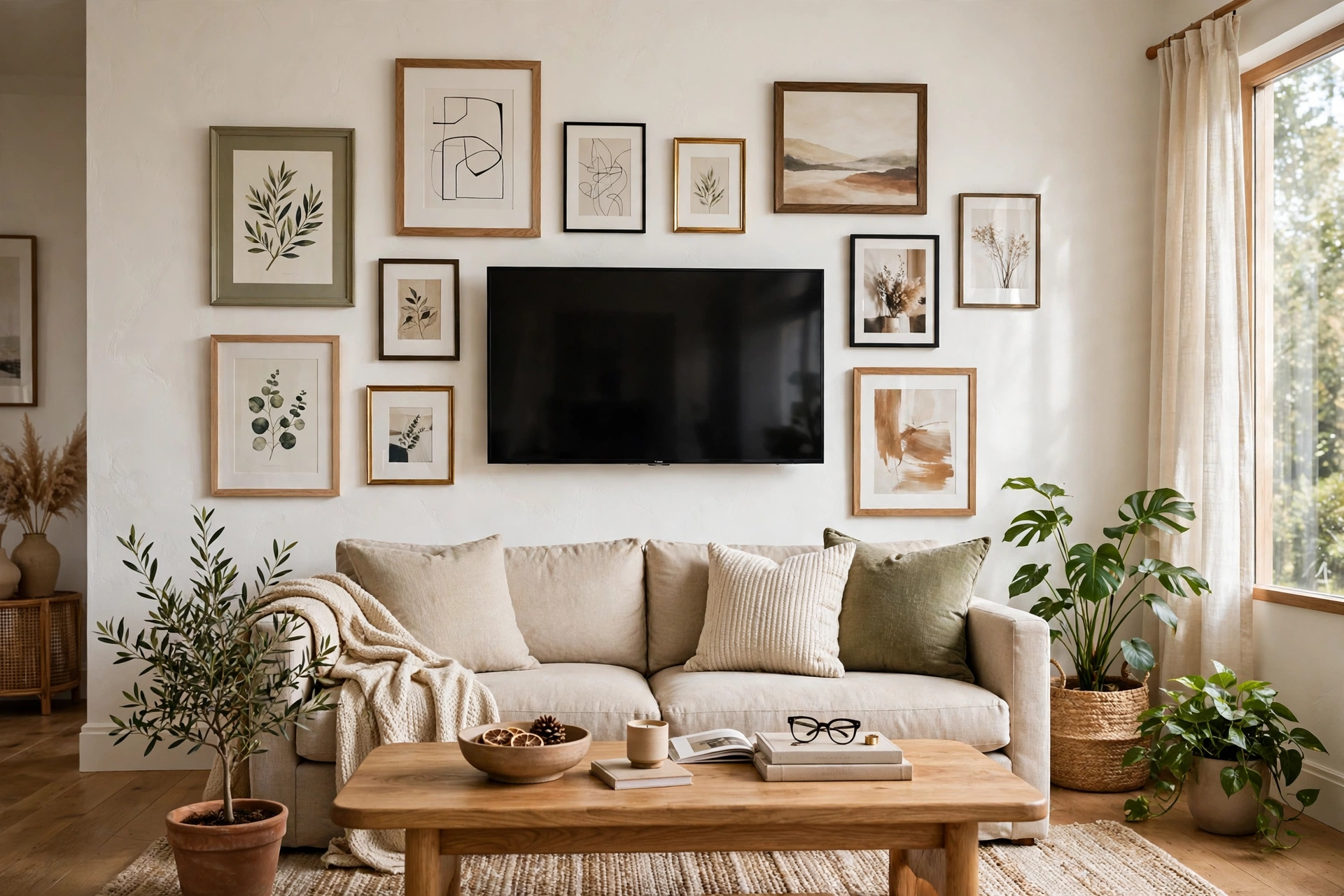
Lay the gallery on the floor first and photograph it — what looks balanced on the floor translates directly to the wall.
Glossy glass on frames beside the TV throws lamp reflections into the screen — use non-glare acrylic within arm’s reach of the TV.
IDEA 07Board and Batten Media Wall — a Frame for the Screen
Trim boxes applied to the TV wall read as a frame for the screen: the TV sits inside a paneled grid, and the whole wall gains tailored architecture. It suits traditional rooms where slats feel too modern — classic molding, wall-color for quiet luxury or a shade deeper for definition.
Layout: one large central panel sized to the TV plus 6–10 inches, flanked by narrower panels — the TV becomes the grid’s centerpiece. Cables: raceway inside a vertical trim piece, or behind the console. $60–$150 in lightweight trim, a full day. Renters: trim on heavy-duty removable strips, tested on a hidden spot first.
IDEA 08Stone-Look Panels — the Fireplace Effect, Without a Fireplace
Faux stone panels give the TV wall the gravitas of a fireplace surround — stacked stone, ledgestone, brick-look — presence enough that the screen doesn’t dominate by default. The texture reads as architecture, so the wall becomes a feature, not a blank with a TV bolted on.
Mounting: panels go up with adhesive and screws into studs; the TV bracket then fixes through the panels into studs with long lag bolts. Cables route behind the panels via a channel at console height, or a stone-tinted raceway. $100–$300 for one wall — the priciest paint-free idea here, but the most transformative. Confirm the wall is stud-framed before hanging stone plus a 65-inch TV.
Run panels past the console’s width on both sides — a stone field exactly TV-wide reads as a backsplash.
Stone plus TV plus soundbar is heavy — if the bracket isn’t in studs, the whole assembly will creep down over months.
IDEA 09Two-Tone TV Zone — a Dark Panel, Light Surround
Instead of painting the whole wall dark, paint only the TV’s zone — a rectangle or full-height band, 12–18 inches wider than the TV each side — in a deep tone, leaving the rest light. You get the dark wall’s glare-killing and screen-blending benefits without committing the whole room to darkness. Small living rooms love this compromise.
The zone’s edges are the design: laser level, quality tape, seal the tape edge with the base color first so the dark coat can’t bleed under. Cables: raceway painted the dark zone color — invisible inside the zone. $30–$60 for two quarts, half a day. Height: full floor-to-ceiling band reads architectural; TV-height rectangle reads like art. Renters: it’s just paint.
Make the zone’s width match the console below — aligned edges make TV, zone, and console read as one unit.
A wavy zone edge ruins the entire effect — this is the one idea where a $30 laser level isn’t optional.
IDEA 10Wallpaper Behind the TV — Pattern, Tamed
Wallpaper behind a TV breaks one rule — don’t distract from the screen — so it only works when the pattern is subtle: grasscloth, tone-on-tone geometrics, soft muted botanicals. Bold prints pull the eye during dark scenes; quiet texture adds depth without competing. The TV wall is where wallpaper discipline matters most.
Heat question, answered: modern LED/LCD TVs run cool, and wall-mounted sets have an air gap behind them. Wallpaper is safe behind any modern flat panel; just keep a 1-inch ventilation gap and don’t seal the TV tight against the wall. $40–$150 for 2–3 rolls, 2–4 hours. Renters: peel-and-stick is the obvious pick, fully removable.
Choose a pattern whose repeat is larger than the TV — small busy repeats shimmer on camera and distract during viewing.
High-contrast wallpaper behind a TV is the #1 pattern mistake on this list — during dark scenes your eye chases the print, not the plot.
IDEA 11Built-In Cabinet Wall — the TV Vanishes Into Furniture
The full-commitment answer: cabinetry around the TV — console, flanking towers, bridge shelf above — so the screen sits inside furniture, not on a wall. Cables live inside (drill discreet back-panel ports), consoles hide behind doors, and the TV reads as one element of a composed unit.
$200–$800 (stock-cabinet hack vs. custom); a weekend or more. Ventilation is non-negotiable: leave open backs or vent slots — never seal a streamer in a closed box. Scale: span at least the TV’s width plus 12 inches each side, or the TV overhangs. Renters: freestanding media walls (tall bookcases flanking a console) deliver 80% of the look with zero screws.
Cut cable ports with a hole saw before assembling cabinets — drilling finished joinery invites splinters and regret.
Sealed cabinets cook electronics — a streamer in a closed box overheats, throttles, and dies early. Vent everything.
IDEA 12LED Backlight + Dark Paint — the Halo Effect
An LED strip on the TV’s back edge, throwing a soft halo onto the wall, is the cheapest eye-strain fix in home theater — and paired with dark paint it’s genuinely beautiful. The halo (bias lighting) raises ambient light around the screen so pupils don’t constantly adjust between bright screen and dark room. Less fatigue, better perceived contrast — and the TV glows when off.
Color temperature matters: 6500K white is the reference for accurate viewing; warm 2700K looks cozier but shifts color perception. $60–$120 for paint plus a quality USB-powered strip (one afternoon for paint, ten minutes for the strip). Power it from the TV’s USB port so it switches with the TV; its wire tucks behind the TV — nothing new visible.
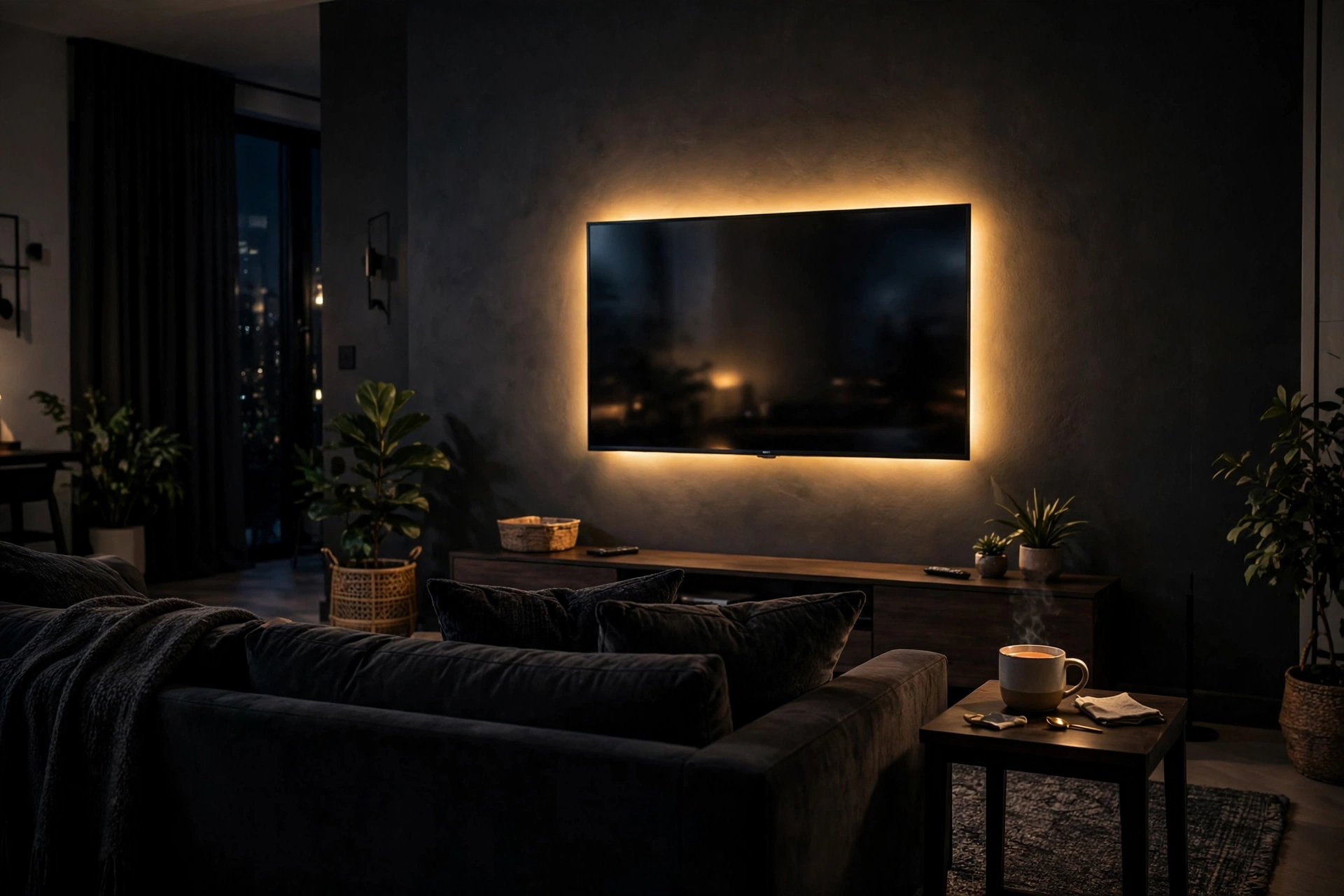
Set the strip 2 inches in from the TV’s edges — too close to the edge and the halo turns into a hard line.
Rainbow RGB modes are fun for ten minutes and terrible for viewing — stick to 6500K white for actual watching.
IDEA 13Peel-and-Stick Wallpaper — the Renter’s Power Move
The TV wall’s renter champion: vinyl peel-and-stick wallpaper delivers a finished accent wall with a clean exit. Grasscloth looks, subtle geometrics, faux linen — the TV wall is the perfect single-wall commitment because the screen and console ground even a bold choice, and the whole thing peels off at move-out.
$40–$120 for 2–3 rolls, two to three hours. TV-wall rules: hang with the TV dismounted (never wallpaper around a mounted screen — seams will show), and keep patterns subtle, per idea 10. Cables: adhesive raceways painted to match, or a console tall enough to hide the drop. Fully removable, zero repaint — no landlord conversation needed.
IDEA 14Vertical Panels Framing the TV — Architecture on Both Sides
Instead of treating the whole wall, flank the TV with vertical panels — fluted wood, acoustic felt, upholstered boards — floor to ceiling on both sides, leaving the center behind the TV painted dark. The panels frame the TV like a proscenium, the dark center blends the screen, and the whole wall gains rhythm without a single busy pattern.
Width rule: each panel bank roughly one-third the TV’s width — narrower reads as trim, wider swallows the screen. Acoustic felt panels add a bonus: they tame echo in hard-floored rooms. $80–$250 depending on material, a full day. Cables: raceway inside the dark center zone, invisible. Renters: panels on a plywood backer hung from a French cleat.
Run panels floor to ceiling, not TV-height — stopping at the TV’s top edge makes the wall read squat.
Panels that stop short of the ceiling chop the wall’s height — full height or don’t bother.
IDEA 15Ceiling-to-Floor Color Block — the Full-Height Panel
The boldest paint-only move: a full-height color block — floor to ceiling, 12–18 inches wider than the TV each side — in a deep tone, rest of the wall left light. Unlike idea 9’s zone, this goes full height: a dark slab anchoring the screen and stretching the room’s height.
$35–$70, half to a full day — just paint, taken one dimension further. Same color, matte finish (any sheen bounces light at the screen). Align the block’s edges with the console below, and keep its width generous — barely wider than the TV reads as a stripe. Renters: it’s still just paint, one repaint at move-out.
Paint the block’s edges with a loaded brush and a steady hand, or tape and seal the edge with the base color first — no bleeding.
A block barely wider than the TV reads as a stripe, not architecture — go at least 12 inches past the screen on each side.
TV Wall Placement: Viewing Distance, Glare, and the Seating Axis
The TV wall usually picks itself — it’s the wall the sofa faces — but three rules decide whether it works. Rule one: viewing distance. The sofa should sit roughly 1.5 to 2.5 times the screen’s diagonal away: a 55-inch TV wants 7–11 feet, a 65-inch wants 8–13. Too close and texture becomes noise at the screen’s edges; too far and the composition shrinks. Rule two: glare. Never put the TV wall opposite uncovered windows — daylight washes straight onto the screen. If the layout forces it, that’s when dark matte treatments (ideas 1, 9, 12, 15) earn their keep.
Rule three: the seating axis. The TV’s center should align with the sofa’s center, and the screen’s center should sit at seated eye height — roughly 42 inches from the floor. A TV mounted too high (the classic above-the-fireplace mistake) causes neck strain no accent can fix, and strands the composition: the treatment centers on the wall while the screen floats above it. Mount first, design around the mounted position, never the reverse.
Sit on the sofa and close one eye — if you can’t see the whole screen without moving your head, the TV is too high or too close, and no wall treatment fixes that.
The fireplace wall and the TV wall are often the same wall by default — and that’s the worst of both worlds: heat, height, and a mantel fighting the screen. If you must combine them, mount low and keep the mantel minimal.
Dark vs. Light Behind the TV: the Glare Science
This is the one accent-wall question with a scientific answer. Dark wins for viewing. A bright wall forces your pupils to constantly adjust between glowing screen and lit surround — eye fatigue, headaches, washed-out blacks. A dark matte wall keeps the surround dim, so the screen’s contrast reads true and your eyes relax. It’s the same reason cinemas are black inside.
Not every TV wall must be charcoal. Mid-tones work if matte and muted — sage, warm greige, dusty blue — especially where black would feel like a cave by day. What doesn’t work: bright white (maximum glare, maximum eye strain) and glossy finishes of any color (reflections bounce lamp light into the screen). Finish rule: matte everywhere behind a TV, no exceptions. Bias lighting (idea 12) is the cheat code: a soft halo raising surround brightness gently, cutting eye strain even on lighter walls.
The cinema test: pause a dark scene at night. If the wall glows brighter than the screen’s blacks, your wall is too light or too glossy for serious viewing.
Sample colors at night, with the TV on — hold the swatch beside the screen during a dark scene. Daylight chips lie about how a color behaves in viewing conditions.
White walls plus a big TV is the single worst combination for eye strain — if repainting is off the table, add bias lighting before anything else.
Renter Rules: What You Can and Can’t Do
- Always safe: repainting (primer covers everything), peel-and-stick wallpaper, adhesive raceways, freestanding media furniture, leaning panels, USB LED strips.
- Safe with care: floating shelves and TV brackets on proper anchors (patch at move-out), lightweight trim on removable strips (test hidden first), adhesive shiplap or stone panels on smooth walls (heat to remove).
- Ask first, in writing: large anchors, in-wall cable routing (cutting drywall is never a renter move), built-in cabinetry. Photograph the wall on move-in day.
- Never: assume spackle hides a TV bracket — bracket holes are large and need proper patching, and textured walls show repairs. Keep the original paint color name for the move-out repaint.
The TV wall takes the most hardware in a rental — bracket, shelves, raceways. Photograph everything on move-in day or you’ll pay for “damage” that was already there.
A $40 gallon of paint plus $15 of primer is the cheapest lease negotiation in existence — and a dark TV wall is the one repaint landlords rarely object to, since it reads as an upgrade.
5 Mistakes to Avoid
- Bright white behind the TV. Maximum glare, maximum eye strain, and the black screen screams against it. If you can change one thing about a TV wall, change the white — or add bias lighting (idea 12) as the minimum fix.
- Busy pattern distracting from the screen. High-contrast wallpaper or gallery clutter beside the TV pulls the eye during dark scenes. TV-wall patterns stay subtle, matte, low-contrast — texture, not content.
- TV mounted too high. The screen’s center belongs at seated eye height, about 42 inches. Above-the-fireplace height causes neck strain and strands the composition — fix the mount before decorating around it.
- Ignoring the cable mess. A beautiful wall with cables dangling down it is a failed project. Plan routing before the treatment goes up — behind slats, inside raceways, through cabinets — not after.
- Accenting the wrong wall while the TV wall stays blank. The TV wall is the living room’s focal wall whether you decorate it or not. Accenting a side wall while the TV stares off bare white splits the room’s focus and wastes the accent entirely.
FAQs
01What is the best color behind a TV?
A dark, matte tone — charcoal, deep forest green, ink navy, dark warm greige. Dark walls kill glare, blend the black screen, and let contrast read true. Mid-tones work if matte and muted. What fails: bright white (maximum glare and eye strain) and any glossy finish (reflections bounce lamp light into the screen). Finish rule: matte, always.
02Should the TV wall be the accent wall?
In most living rooms, yes — the TV wall is already the focal wall, since seating faces it. Accenting elsewhere while it stays blank splits the room’s focus. Exception: a fireplace that genuinely competes — then combine carefully (mount low, minimal mantel) or make the fireplace the accent and keep the TV wall quiet and dark.
03How do I hide cables on an accent wall?
Ranked by invisibility: behind slats or panels (ideas 2, 14) — the treatment is the channel; inside cabinets (idea 11) via back-panel ports; in-wall kits for owners (never a renter move); paintable raceways for everyone else — painted the wall color, they disappear, especially on dark walls. Plan routing before the treatment goes up.
04What works for a TV wall in a small living room?
Small rooms reward dark-and-simple: a dark matte wall (idea 1) recedes and blends the TV, a two-tone zone (idea 9) or color block (idea 15) gives architecture without bulk, and a wall-mounted TV plus floating console frees floor space. Keep decor minimal — one or two shelves, not a gallery — and skip heavy treatments like stone that eat visual space. Dark recedes; busy shrinks.
05Is wallpaper behind a TV safe with the heat?
Yes for any modern flat panel. LED and LCD TVs run cool, and wall-mounted sets have an air gap for ventilation. Wallpaper, including peel-and-stick vinyl, is safe behind them. Keep a 1-inch ventilation gap; don’t seal the TV tight against the wall. The old heat worry comes from plasma and CRT sets, long gone.
06What are the best renter-friendly TV wall ideas?
Ranked by impact and reversibility: one-wall repaint in dark matte (primer covers everything at move-out), peel-and-stick wallpaper (fully removable, biggest transformation), adhesive raceways painted to match, freestanding media furniture flanking the TV, USB LED strips for bias lighting. Brackets and shelves need anchor holes, but a few small holes patch cleanly — photograph the wall on move-in day.
Key takeaways
- The TV is the design problem, not an obstacle. Every accent tv wall idea here solves glare, cables, or visual weight — decoration solving none of the three is noise around a screen.
- Dark and matte wins for viewing. It kills glare, blends the black screen, rests the eyes. Never put bright white or glossy finishes behind a TV.
- Plan cables before the treatment. Behind slats, inside cabinets, through raceways — routing decided after the wall is finished is routing that stays visible.
- Mount at eye height, then design around it. Screen center near 42 inches, sofa 1.5–2.5× the diagonal away. No accent fixes a badly mounted TV.