 Casacrunched
15 Small Accent Wall Ideas That Make Tiny Rooms Feel Bigger
Small room? One wall is all you need. Fifteen ideas built on real small-space logic — light, scale, and reflection — every one rated for cost, time, and renter-friendliness.

Here is the paradox of small accent wall ideas: the smaller the room, the more it needs one — and the more people are afraid to try. The fear is that one strong wall will shrink the space. The truth is the opposite. A small room with four identical pale walls has no depth cues; your eye finds nothing to measure distance against, so the room reads as a flat, tight box. One deliberate accent wall gives the eye an anchor — a foreground, a middle ground, a background — and the brain reconstructs the room as deeper than it is. Designers have used this trick for decades; this guide translates it into fifteen ideas engineered specifically for under-500-square-foot spaces, each with the spatial logic explained, light and reflection notes, honest costs, and renter-safe options.
On this page
- Quick comparison table
- 1. Light warm white
- 2. Vertical stripes for height
- 3. Mirror accent wall
- 4. Single dark cozy wall
- 5. Half-wall color blocking
- 6. Wallpaper on the smallest wall
- 7. Alcove / nook accent
- 8. Behind-bed only
- 9. Open-shelf wall
- 10. Light wood slats
- 11. Pale sage
- 12. Curtain wall (fabric)
- 13. Gallery on one wall
- 14. Ceiling accent
- 15. Glass / mirrored panels
- Small-space placement rules
- Light vs. dark, settled
- Renter rules
- 5 mistakes to avoid
- FAQs
Quick comparison: cost, time, renter-friendliness
All costs are DIY estimates for one small-room accent wall (roughly 8×10 ft, about 80 sq ft — smaller than the standard wall used in our other guides, because small rooms mean small walls and small bills).
| # | Idea | Cost / wall | Time | Renter-safe? |
|---|---|---|---|---|
| 1 | Light warm white | $30–$60 | Half day | Yes (repaint) |
| 2 | Vertical stripes | $40–$80 | Half–full day | Peel-and-stick: yes |
| 3 | Mirror accent wall | $120–$400 | 2–4 hours | Leaning mirror: yes |
| 4 | Single dark cozy wall | $35–$70 | Half day | Yes (repaint) |
| 5 | Half-wall color blocking | $25–$50 | Half day | Yes (repaint) |
| 6 | Wallpaper, smallest wall | $60–$150 | 2–4 hours | Peel-and-stick: yes |
| 7 | Alcove / nook accent | $20–$50 | 2–3 hours | Yes (repaint) |
| 8 | Behind-bed only | $25–$60 | Half day | Yes (repaint) |
| 9 | Open-shelf wall | $60–$180 | Half day | Yes (patch holes) |
| 10 | Light wood slats | $80–$200 | Full day | French cleats: yes |
| 11 | Pale sage | $30–$60 | Half day | Yes (repaint) |
| 12 | Curtain wall (fabric) | $50–$150 | 1–2 hours | Fully removable |
| 13 | Gallery on one wall | $40–$150 | 2–3 hours | Yes (patch holes) |
| 14 | Ceiling accent | $30–$60 | Half–full day | Yes (repaint) |
| 15 | Glass / mirrored panels | $100–$300 | Half day | Leaning: yes |
IDEA 01Light Warm White — the Invisible Accent
This sounds like no accent at all, which is exactly the point. Paint one wall a warm white — Benjamin Moore White Dove, Sherwin-Williams Alabaster — while the other three stay a cooler, flatter white. The spatial logic: the warm wall advances almost imperceptibly while reading as intentional, and its LRV near 85 keeps every lumen bouncing. Guests won’t name the trick; they’ll just feel the room has depth.
Why it tops a small-space list: it is the only accent with zero visual risk. No pattern to date, no dark corner, no landlord conversation beyond a standard repaint. Add a limewash-look finish or a barely-there plaster texture and the wall catches light differently through the day — subtle movement that flat white never gives. Cost is one gallon ($30–$60) and half a day. In rentals, warm white over existing white is the easiest approval you’ll ever get, and reversing it is one more coat.
Paint the warm white on the wall opposite the window — it catches and softens daylight instead of competing with it.
IDEA 02Vertical Stripes for Height — the Oldest Trick, Still True
The eye follows a vertical line upward; an 8-foot ceiling with floor-to-ceiling stripes reads half a foot taller. That half-foot is enormous in a 200-square-foot room — it changes the room’s proportions from squat to gracious. Wide stripes (4–6 inches) in two close tones — say, warm white and pale greige — feel modern and calm; tone-on-tone keeps the trick invisible.
The small-space rule: stripes must run unbroken from baseboard to ceiling. Breaking them with a chair rail or stopping short kills the lift. Peel-and-stick striped wallpaper ($25–$40 a roll, 2–3 rolls for a small wall) is the renter’s version and the cheapest striped accent on this list; painted stripes need only painter’s tape, a level, and patience. Either way the first stripe must be perfectly plumb — a drifting stripe looks drunk by the fourth repeat. Best wall: the narrowest tall wall, or the wall behind a low bed where the stripes rise uninterrupted.
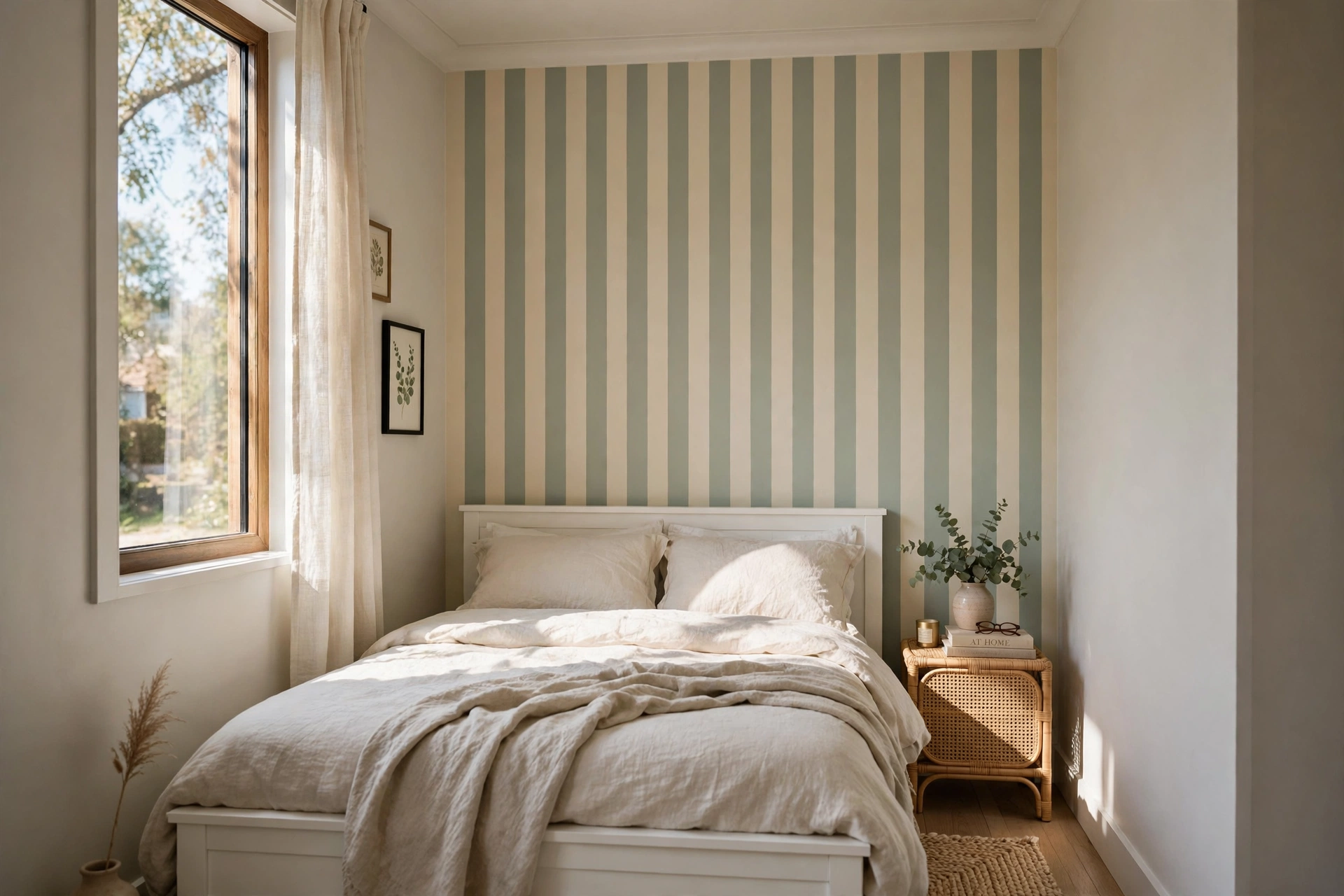
Stripes wider than 8 inches stop reading as stripes and start reading as color blocks — keep them under 6 inches in rooms under 150 sq ft.
IDEA 03Mirror Accent Wall — Double the Light, Double the Room
A wall of antiqued mirror tiles or a grid of large square mirrors does two things no paint can: it doubles the visible light and it doubles the view, borrowing the room’s own space back. In a dark 10×12 living room, a mirrored wall opposite the window is the single highest-impact change per dollar after paint — designers call it the oldest small-space cheat because it never stops working.
The full tile wall ($120–$400 depending on tile quality, hung with mirror adhesive or French cleats) is the commitment version. The renter version is better: one oversized leaning floor mirror ($80–$200) against the accent wall, styled like intention rather than apology. Antiqued or smoked mirror reads warmer and hides fingerprints; plain mirror reads brighter. Either way, keep what the mirror reflects curated — it will double your clutter exactly as faithfully as your light. Hang art or place the plant where the mirror catches it.
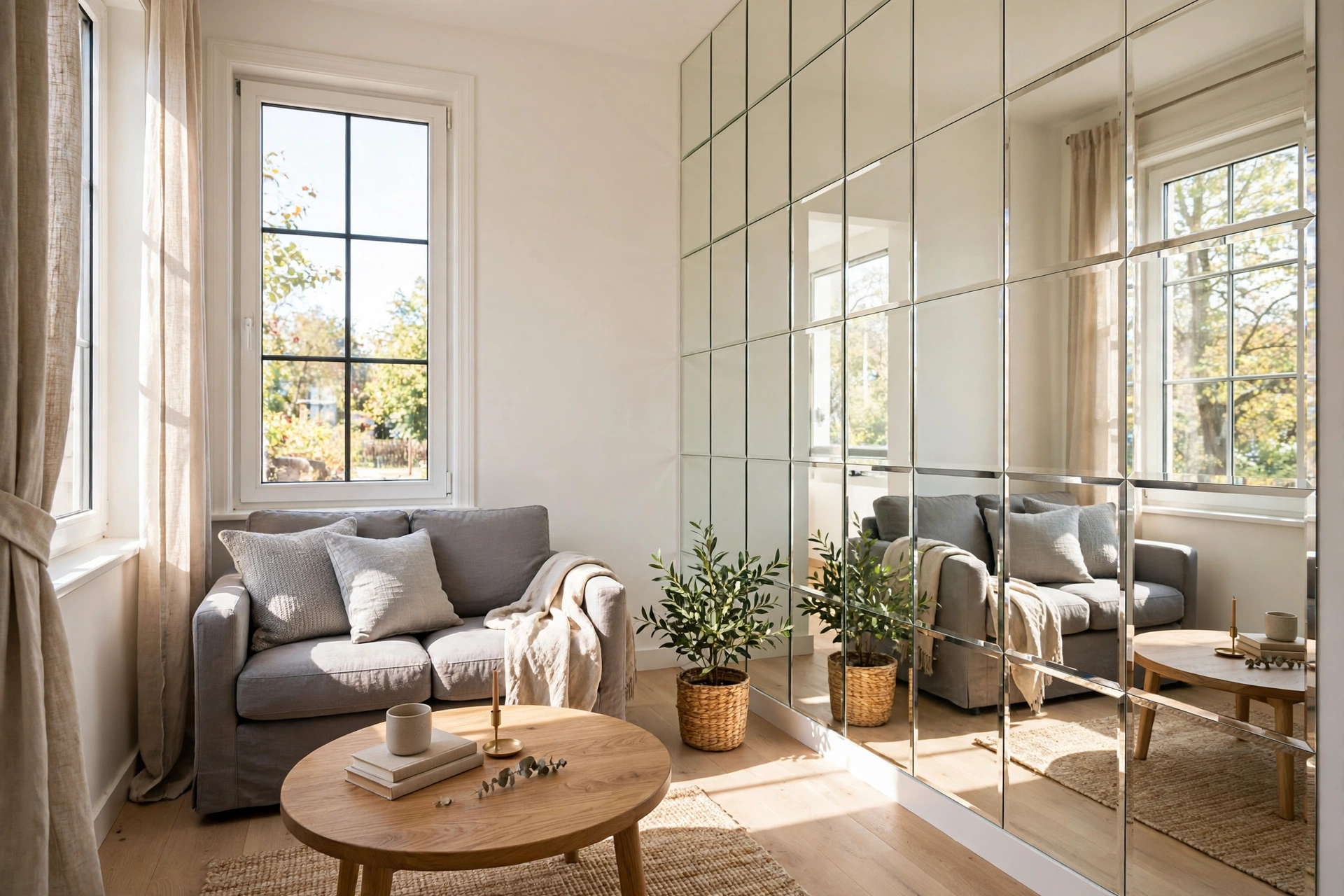
Place the mirror wall opposite the window, not adjacent — opposite placement throws daylight deepest into the room.
IDEA 04Single Dark Cozy Wall — the Paradox That Works
Here is the paradox, stated plainly: dark walls recede. A deep forest green or charcoal wall behind the bed doesn’t close in — its edges blur in low light, the corners disappear, and the brain reads the wall as farther away than a pale wall whose every corner is sharply drawn. Small bedrooms go from shoebox to cocoon on one wall of Farrow & Ball Hague Blue or Sherwin-Williams Iron Ore.
The non-negotiable condition: light. Dark accents need either a decent window or committed artificial light — a dark wall in a dark room with one dim bulb is a cave, full stop. Give it warm 2700K lamps, keep the other three walls pale, keep the ceiling bright white, and the dark wall becomes jewelry. One gallon ($35–$70), half a day, and the most dramatic before-and-after on this list. Renters: dark paint needs two primer coats on move-out, so photograph the original wall color first — or use a dark peel-and-stick mural and skip the primer marathon entirely.

Dark wall + low light + no lamps = a cave. If the room gets under 3 hours of direct sun, budget two warm lamps before you buy the paint.
The LRV rule of thumb: below LRV 35, a dark accent needs real light. Above LRV 50, almost anything works in almost any room.
IDEA 05Half-Wall Color Blocking — Architecture You Paint On
Paint the lower half (or third) of one wall a color — sage, clay, dusty blue — and leave the upper half white. The horizontal division does two jobs: it gives the room a custom, architectural feel for the price of half a gallon, and the white upper half keeps the ceiling line bright, so the room reads taller, not chopped. It is the cheapest way to make a rental look designed.
The line height matters. In small rooms, run the color lower than you think — 36 to 42 inches, roughly chair-rail height — so the white dominates and the color reads as a base, not a lid. A crisp line needs good painter’s tape and a level; a soft, hand-painted wavy line is forgiving and currently fashionable. Cost: $25–$50 and half a day. Renter math is unbeatable: half the paint, half the repaint, and landlords rarely object to a two-tone wall that photographs well.
Run the color line at 36 inches and align it with the windowsill height — the room’s horizontal lines will rhyme instead of fighting.
IDEA 06Wallpaper on the Smallest Wall — Maximum Drama, Minimum Commitment
Counterintuitive but correct: put the boldest pattern on the smallest wall. A 6-foot wall needs 2 peel-and-stick rolls ($60–$150 total), takes an afternoon, and concentrates all the drama where the eye lands on entry — while the big walls stay calm and quiet. Small wall, small bill, small risk, outsized payoff.
Pattern scale still applies: on a small wall, choose medium-scale motifs — big enough to read across the room, small enough that the repeat isn’t awkwardly cropped at the edges. Botanicals, small geometrics, and arch prints all sing on narrow walls. This is also the lowest-stakes way to test whether you actually like living with pattern: if it’s too much, you’ve papered 40 square feet, not 400. Renters: this is your move — two rolls of peel-and-stick, one Saturday, zero landlord drama.
Wallpaper the wall you face when you enter the room — small walls are often entry walls, which is why this trick pays off double.
IDEA 07Alcove & Nook Accent — Depth You Paint In
Every small home has dead geometry — the recess beside a chimney breast, the reading nook, the weird 2-foot jog in the hallway. Paint only the inside of that recess a deeper tone and something magical happens: the nook reads as farther back than the wall around it, manufacturing depth the floor plan never gave you. It is trompe l’oeil for the price of a sample pot.
This is the smallest paint job on the list — often under 20 square feet, $20–$50, two to three hours — which makes it the perfect first accent for the nervous. Go one or two shades deeper than the room color, or pick a contrasting jewel tone for a jewelry-box nook. Behind open shelves, a darker nook makes every object on the shelf pop like a gallery. Renter note: alcoves repaint in one coat; nobody has ever lost a deposit over a painted nook.
IDEA 08Behind-Bed Only — Frame the Bed, Free the Room
Don’t paint the whole wall — paint only the bed’s width plus a foot each side, floor to ceiling. The bed gets a custom headboard-wall that looks built-in; the rest of the wall stays light, so the room keeps every inch of its airiness. In a 10×10 bedroom this is the difference between a designed room and a dark one.
Rectangles read modern; a painted arch behind the bed reads soft and current, and arches are forgiving to freehand with a nail, string, and pencil as a compass. Either way, extend the color a few inches wider than the mattress — bedding overhangs, and paint that stops exactly at the mattress edge looks like a mistake. Cost: $25–$60, half a day. For renters it’s ideal: a contained shape repaints in one coat, and it photographs like a renovation.
Paint the shape 6 inches wider than the bed on each side — bedding always overhangs, and the margin is what makes it look intentional.
IDEA 09Open-Shelf Wall — Texture Without a Drop of Paint
Two or three floating oak shelves, styled with books, ceramics, and one trailing plant, are an accent wall — no paint, no paper, no landlord email required. The spatial logic: shelves add layered depth (objects at three distances from the wall), and the eye reads layered depth as spaciousness. A flat wall is a flat wall; a styled shelf wall is a landscape.
The small-room discipline is ruthless editing: fewer, larger objects beat many small ones. Five chunky ceramics read as calm; fifteen trinkets read as clutter, and clutter shrinks rooms faster than any paint color. Leave 40% of each shelf empty — negative space is what makes it design instead of storage. Cost: $60–$180 for shelves and brackets, half a day including styling. Renter reality: floating shelves need wall anchors, but the holes patch with a dab of filler in minutes — the most reversible “renovation” on this list.
The 40% rule is non-negotiable: a shelf packed edge-to-edge is storage, not an accent — and storage walls make small rooms feel smaller.
Style in odd numbers and varying heights — the eye moves across the shelf instead of stopping, which stretches the wall visually.
IDEA 10Light Wood Slats — Warmth Without Weight
Vertical slats in pale oak or ash deliver everything dark wood does — rhythm, texture, craft — at a fraction of the visual weight. The vertical lines lift the ceiling the way stripes do, while the pale tone keeps the LRV high, so the wall adds warmth without absorbing light. In a small Scandinavian-style room it is the single most flattering accent available.
Budget route: thin pine lath strips ($1–$2 each) stained pale, spaced with a spacer block for perfect rhythm — $80–$200 for one small wall and a genuinely satisfying weekend build. Keep slats narrow (1–2 inches) in small rooms; chunky 4-inch slats suit big walls and overwhelm small ones. Renter version: mount the slats on a plywood backing board hung on French cleats — the whole panel lifts off at move-out, holes and all, leaving four screw holes to fill.
Stain the slats before mounting — staining in place drips onto the wall behind and doubles the masking work.
IDEA 11Pale Sage — the Can’t-Go-Wrong Small-Space Green
If small rooms had a default accent color, it would be pale sage — Benjamin Moore October Mist, Sherwin-Williams Clary Sage. The logic: green sits in the middle of the visual spectrum, so the eye rests on it without effort; pale sage’s LRV near 60 keeps rooms bright; and its gray undertone harmonizes with both warm woods and cool grays, the two things every small rental already contains.
It works in every small room — bedrooms (calm), living rooms (fresh), home offices (focus without sterility), even tiny bathrooms. One gallon ($30–$60), half a day, and the safest color commitment in this guide. Pair it with warm white trim and light oak; avoid pairing it with more green — one green accent plus green plants is plenty. Renter note: sage repaints in one coat, which is why it’s the color landlords complain about least.
Test sage on the wall you’ll face most — its undertone shifts green-gray with light direction, and you want to love the version you see daily.
IDEA 12Curtain Wall — the Renter’s Secret Weapon
Floor-to-ceiling curtain panels hung across an entire wall — not a window, a wall — is the most underused small-space accent in existence. Fabric adds softness no paint can match, the vertical folds stretch the ceiling visually, and behind the curtain you can hide anything: a bad paint color, a clunky radiator, a wall of landlord-beige you’re not allowed to touch.
The execution is gloriously simple: a ceiling-mounted track or a tension rod ($20–$40), two to three linen-look panels ($30–$110 total), hung as close to the ceiling as possible and kissing the floor. Choose a color one shade deeper than the walls for subtle depth, or a natural linen for texture. When you move, the whole thing comes down in twenty minutes with zero trace — the only accent on this list with literally nothing to reverse. Bonus: fabric absorbs sound, so small echoey rooms go quiet.
Hang the rod 2–3 inches below the ceiling and let panels kiss the floor — high-and-long is what manufactures the height illusion.
IDEA 13Gallery on One Wall — Art as the Accent
A curated cluster of framed prints is an accent wall — color, pattern, and personality with zero paint. The small-space advantage: art adds visual interest at eye level only, leaving the wall’s base and top quiet, so the room keeps its airiness while gaining a focal point. It’s also the only accent here that’s genuinely free if you print at home.
Scale is the whole game. On a small wall, one large piece beats nine small ones — a single 24×36 print anchors a wall; nine 5×7s read as clutter from across a 10-foot room. If you go gallery-style, keep frames consistent (all black, all oak) and spacing tight (2 inches) so the cluster reads as one composition, not scattered decor. Map it on the floor first with painter’s tape. Cost: $40–$150 depending on frames. Renter tip: picture-hanging strips hold surprising weight and remove cleanly — save the nails for owned walls.
Nine tiny frames on a small wall read as clutter, not curation — go big or go tight. One hero piece plus two small is the small-room formula.
IDEA 14Ceiling Accent — Lift the Room From Above
The fifth wall is the most underused surface in small homes. A ceiling painted pale sky blue, soft blush, or even a whisper of the wall color draws the eye upward on entry — and whatever the eye does on entry sets the room’s perceived size. White ceilings disappear; tinted ceilings perform.
The rule: keep it pale. Ceilings darker than the walls press down; ceilings a touch lighter or equal lift up. A quart is often enough for a small room ($15–$30), though a gallon ($30–$60) covers generously with trim included. Cut in carefully — the ceiling line is the most visible edge in the room — and use flat finish to hide imperfections. Best in bedrooms and living rooms with decent height already; in genuinely low rooms (under 8 feet), stick to white and get your accent from the walls.
Paint the ceiling the wall color mixed 50% with white — related but lighter, so the room feels wrapped rather than boxed.
IDEA 15Glass & Mirrored Panels — the Light Multiplier
Where a full mirror wall feels commercial, framed mirror panels — a grid of large squares in thin black or brass frames — read as intentional design while still bouncing light around the room. Each panel catches a different slice of window light, so the wall shimmers subtly through the day instead of glaring.
Budget version: IKEA LOTS mirrors ($7 each) in a 3×3 grid — $63 plus frames or paint, one afternoon, enormous payoff in a dark hallway or entry. Premium version: custom antiqued panels ($100–$300). Either way, keep the reflected view curated and the frames consistent. Renter-safe as leaning panels or adhesive-mounted tiles; the grid format means removing one damaged tile doesn’t doom the wall. In windowless rooms, angle the panels to catch lamplight — even artificial light doubles visually.
Small-Space Placement Rules: Which Wall Gets the Accent
Small rooms punish wrong placement harder than big rooms do — there’s nowhere for a mistake to hide. Four rules decide it. One: the entry sight line. Stand in the doorway — the wall your eyes land on first is your accent wall. Accents work by greeting; a wall you never face is decoration for no one. Two: the smallest wall. In rooms under 150 sq ft, accent the smallest uninterrupted wall, not the largest — less paint, less risk, and the focal point stays proportional to the room. Three: furniture-anchored. The accent belongs behind the room’s anchor piece — bed, sofa, desk — never floating on a random wall, which reads as indecision. Four: never the window wall. Daylight washes out color and fights pattern; curtains argue with every accent. The window wall’s job is light, not drama.
Apply the one-wall discipline strictly: from any single viewpoint, only one accent should be visible. In a studio where the bed, sofa, and desk share sight lines, that means one accent total — pick the bed wall or the sofa wall, not both. Two accents in one sight line don’t double the design; they halve the calm. These small accent wall ideas all assume the discipline — each one is engineered to carry a room solo.
The phone-photo test: photograph the room from the doorway. If the accent wall is the first thing your eye finds in the photo, placement is right. If you have to hunt for it, it’s on the wrong wall.
Open-plan studios break the one-wall rule most often — a “bed zone” accent plus a “living zone” accent visible together reads as two rooms colliding. One zone gets the accent; the other stays quiet.
Light vs. Dark, Settled: Color Logic for Small Rooms
The internet argues endlessly about dark colors in small rooms. Here’s the settled version. Light accents (warm white, pale sage, light stripes — LRV 60+) are unconditionally safe: they add depth through undertone and texture while reflecting maximum light. If you’re nervous, start here; you cannot go wrong. Dark accents (forest green, charcoal, navy — LRV under 35) work beautifully under conditions: the room needs real light (a decent window or committed warm lamps), the other walls stay pale, and the ceiling stays bright white. Dark recedes and blurs edges — but only where there’s enough light for the eye to perceive the recession instead of just darkness.
Between them sits the sweet spot most small rooms actually want: mid-tone accents (terracotta, dusty blue, olive — LRV 35–60) with white trim. Enough color to feel designed, enough reflectance to stay bright. Whatever depth you choose, obey the undertone rule: match the accent’s undertone to your floor — warm oak floors want warm accents, gray tile wants cool ones. And always sample: paint a 2-foot square, live with it 48 hours through all your room’s light, then decide. The sample pot is the cheapest design insurance ever sold.
LRV (Light Reflectance Value) runs 0–100 on every paint chip. For small rooms: accent LRV 60+ is worry-free, 35–60 is the sweet spot, under 35 needs good light. When in doubt, go one shade lighter than your instinct.
North-facing small rooms: choose warm undertones (warm white, terracotta, warm sage) — cool northern light chills blue-gray accents into gloom. South-facing rooms can carry anything.
Renter Rules: What You Can and Can’t Do
- Always safe: repainting one wall (even dark — primer covers it), peel-and-stick wallpaper and murals, curtain walls, leaning mirrors, gallery walls on hanging strips, styled shelves with patched holes. This covers 13 of the 15 ideas here.
- Safe with care: floating shelves and mirror tiles with proper anchors — fill and sand the holes on move-out; keep the original paint color name (photograph the can if there is one) for touch-ups.
- Ask first: anything adhesive on fresh paint (under 30 days cured — it can pull the paint off), wallpapered ceilings, French-cleat panels. Get permission in writing; photograph walls on move-in day.
- Never: apply paste wallpaper or construction adhesive directly to unprimed drywall — removal tears the drywall facing and the repair comes out of your deposit. Prime first (with permission) or stick to removable options.
The studio trap: your lease may limit “alterations” per room, and a studio is legally one room. One accent per studio keeps you inside every reasonable lease — two starts looking like a renovation.
Deposit math: a $50 gallon of paint plus $15 of primer beats a $200 “repaint fee” deducted from your deposit. Keep receipts and before-photos; they’re your dispute armor.
5 Mistakes to Avoid
- Accenting the biggest wall. In small rooms the biggest wall is usually the longest, flattest expanse — accenting it maximizes paint, maximizes risk, and unbalances the room. Accent the smallest or the most-seen wall instead.
- Dark color + low light. The dark-recedes trick needs light to work with. A charcoal wall in a north-facing room with one 40-watt bulb doesn’t recede — it just goes black. Match the color’s LRV to the room’s actual light, not the Pinterest photo’s light.
- Busy pattern in a tiny room. Small high-contrast prints at high density turn walls into visual static. In rooms under 120 sq ft, choose large-scale motifs, subtle texture, or solid color — calm patterns, not confetti.
- Ignoring scale. Oversized art dwarfing a loveseat, chunky 4-inch slats on a 7-foot wall, a mural cropped awkwardly — small rooms magnify proportion errors. Measure the wall, then choose the element to fit it, not the reverse.
- Too many accents. The #1 small-room sin: an accent wall plus a gallery wall plus bold curtains. Each idea here is designed to carry a room alone. Pick one, commit, and let the other walls be quiet — restraint is what makes small rooms feel designed rather than decorated-at.
FAQs
01Do accent walls actually work in really small rooms?
Yes — and small rooms need them more than big ones. Four identical pale walls give the eye no depth cues, so a tiny room reads as a flat, tight box. One deliberate accent wall creates foreground, middle ground, and background, and the brain reconstructs the room as deeper. The rules that make it work: one wall only, keep the ceiling bright, and match the accent’s boldness to the room’s light. Done right, the smallest bedroom in the house becomes the one with the most character.
02What is the best accent wall color for a tiny bedroom?
Pale sage is the safest answer — calm, bright enough (LRV near 60), and harmonious with both warm woods and cool grays. Warm white with subtle texture is the zero-risk answer. If you want drama and the room gets decent light, a single dark wall in forest green or charcoal turns a tiny bedroom into a cocoon — dark recedes, edges blur, and the room reads deeper. Whatever you choose, keep the other three walls pale and the ceiling white; the contrast is what makes the accent work.
03Can I use a dark accent wall in a small space?
Yes, under two conditions. One: the room needs real light — a decent window or committed warm lamps (2700K). Dark paint in a dark room is a cave; dark paint in a lit room is depth. Two: keep everything else bright — pale other walls, white ceiling, light bedding or upholstery against the dark wall so it reads as intentional contrast. Forest green, navy, and charcoal all work in rooms as small as 10×10 with good light. Without good light, choose the mid-tone sweet spot (terracotta, dusty blue) instead.
04What are the best renter-friendly options for a studio apartment?
Studios need maximum reversibility, so rank by “trace left behind”: curtain walls (zero trace — rod comes down, wall untouched), peel-and-stick wallpaper or murals (clean removal with a hair dryer), leaning oversized mirrors (no holes at all), gallery walls on hanging strips, and one-wall repaints (primer covers everything). Remember the studio rule: one accent total across all zones, since bed, living, and work areas share sight lines. And check the lease — a studio is legally one room, so two accents can read as a renovation.
05Should I do one accent wall or more in a small apartment?
One. This is the strictest rule in small-space design and the most broken. From any single viewpoint, only one accent should be visible — two competing focal points don’t double the design, they halve the calm. In a studio, that means one accent across the entire space. In a one-bedroom, one per room maximum, and never on walls visible together through a doorway. Every idea in this guide is engineered to carry a room solo — pick your favorite, commit fully, and let the other walls stay quiet.
06What is the cheapest small-space accent wall I can do?
A half-wall color block at $25–$50 — half a gallon of paint, painter’s tape, half a day, and it looks custom. Runner-up: an alcove or nook accent in sample pots ($20–$50) if your room has the geometry. For zero paint, a curtain wall from a tension rod and two panels ($50–$100) is fully reversible. The honest advice: spend the savings on the sample pot stage — a $6 sample that prevents a $50 wrong gallon is the best value in all of DIY.
Key takeaways
- Small rooms need accents more, not less. One deliberate wall gives the eye depth cues a boxy small room lacks — the paradox that makes these small accent wall ideas work.
- One wall, strictly. From any viewpoint, a single accent should be visible. Restraint is what separates designed from decorated-at.
- Match boldness to light. LRV 60+ is worry-free anywhere; mid-tones suit most rooms; dark accents need real light and pale surroundings.
- Renters have every option. Curtain walls, peel-and-stick, leaning mirrors, and one-wall repaints cover 13 of 15 ideas with zero deposit risk.