 Casacrunched
15 Living Room Accent Wall Ideas That Make Small Spaces Feel Designed
One wall, one weekend, under $100. Every idea rated for cost, time, and renter-friendliness — so you can pick yours and be done by Sunday night.
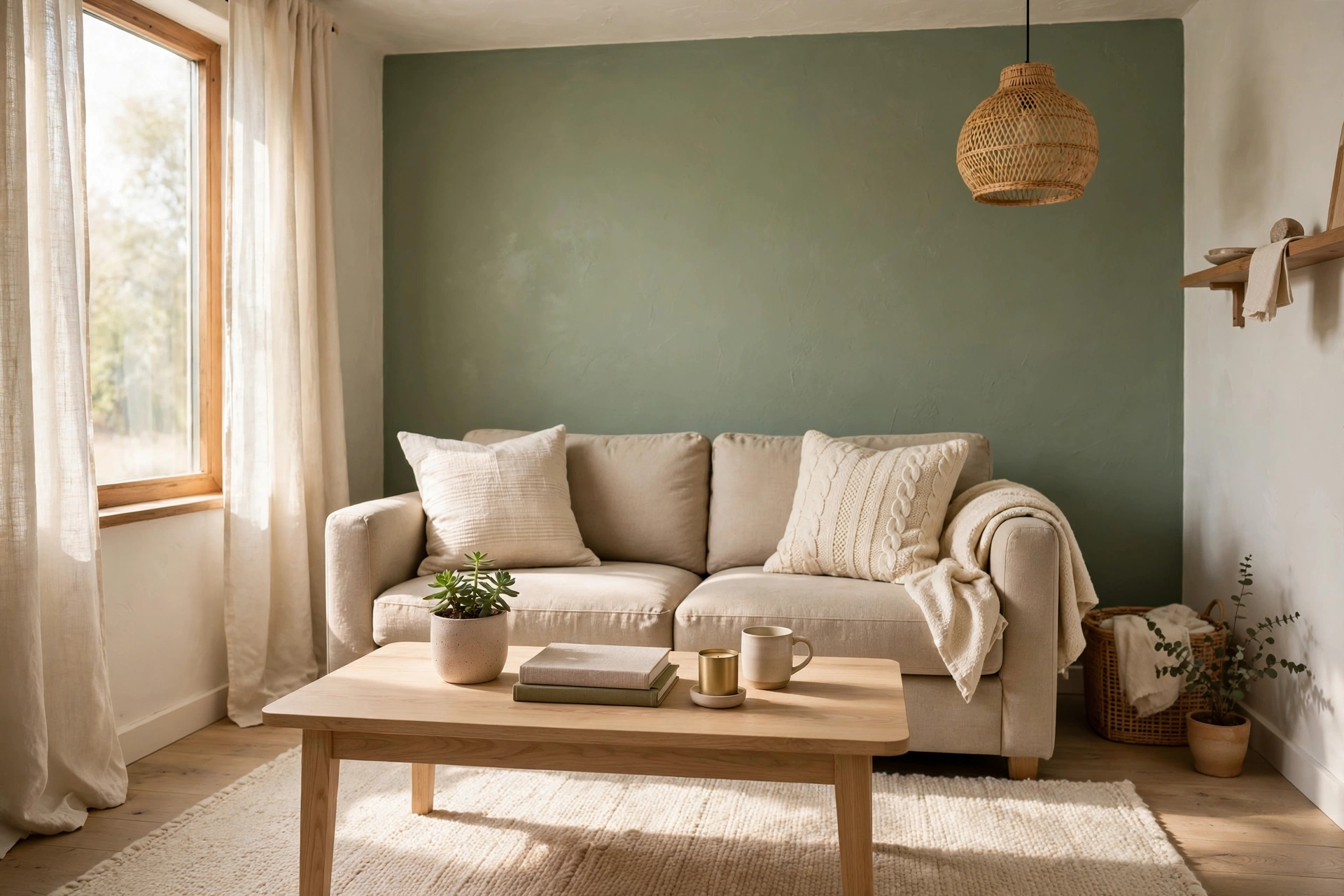
A living room accent wall is the fastest way to give a small living room a point of view. If you’re collecting accent wall ideas for living room makeovers, start here: every idea below is built for real constraints — rental apartments you can’t drill into, open-plan rooms that need visual zoning, and budgets under $150. Each one lists what it costs, how long it takes, and whether your landlord will hate it — so you can pick one this weekend and be done by Sunday night.
On this page
- Quick comparison table
- 1. Sage green sofa wall
- 2. Charcoal TV wall
- 3. Terracotta clay limewash
- 4. Wood slat media wall
- 5. Botanical peel-and-stick wallpaper
- 6. Fireplace chimney-breast accent
- 7. Gallery wall above the sofa
- 8. Color-drenched board and batten
- 9. Painted arch reading corner
- 10. Emerald library wall
- 11. Faux brick loft wall
- 12. Two-tone horizontal split
- 13. One-wall mural
- 14. Fabric wall hanging
- 15. Painted ceiling
- Which wall should be the accent?
- What color works best?
- Renter rules
- 5 mistakes to avoid
- FAQs
Quick comparison: cost, time, renter-friendliness
All costs are DIY estimates for one standard 10×12 ft living room wall, paint and basic tools included. Hiring a painter roughly doubles the paint-idea budgets.
| # | Idea | Cost | Time | Renter-safe? |
|---|---|---|---|---|
| 1 | Sage green sofa wall | $30–$50 | 1 afternoon | Repaint later |
| 2 | Charcoal TV wall | $30–$65 | 1 afternoon | Repaint later |
| 3 | Terracotta limewash | $50–$70 | 1 afternoon | Repaint later |
| 4 | Wood slat media wall | $80–$200 | 1 weekend | Yes (leaning panels) |
| 5 | Botanical peel-and-stick | $60–$120 | 2–3 hours | Yes |
| 6 | Fireplace breast accent | $30–$50 | 1 afternoon | Repaint later |
| 7 | Gallery wall | $40–$100 | 1–2 hours | Yes |
| 8 | Board and batten | $40–$80 | 1 weekend | Ask landlord |
| 9 | Painted arch corner | Under $20 | 2 hours | Repaint later |
| 10 | Emerald library wall | $50–$120 | 1 weekend | Repaint later |
| 11 | Faux brick wall | $80–$150 | 3–4 hours | Yes (peel-and-stick) |
| 12 | Two-tone split | $30–$50 | 1 afternoon | Repaint later |
| 13 | One-wall mural | $100–$300 | 2–4 hours | Yes (peel-and-stick) |
| 14 | Fabric hanging | $30–$120 | 30 min | Yes |
| 15 | Painted ceiling | $30–$50 | 1 afternoon | Repaint later |
IDEA 01Sage Green Sofa Wall — the Small-Living-Room Classic
Sage is the living room’s answer to forest green — desaturated enough to stay calm, light enough for a room you live in all day. The design logic most listicles skip: living rooms are social spaces, and muted green flatters skin tones, plants, and oak alike — exactly what you want behind the sofa where everyone sits.
Sage sits halfway between gray and green, bridging cool and warm furniture without committing to either. Two coats of matte or eggshell on the sofa wall, warm white elsewhere. In open-plan rooms it does quiet zoning work — the sage wall claims the seating area without moving a single piece of furniture. Renters: one weekend of repainting erases it completely.
Hold your swatch against the sofa fabric, not just the wall — sage shifts dramatically next to gray versus beige upholstery.
IDEA 02Charcoal TV Wall — Make the Black Box Disappear
Every small living room has the same unsolved problem: a black TV rectangle that dominates the wall even when it’s off. The fix isn’t a prettier TV — it’s camouflage. Paint the TV wall charcoal (softer than pure black, more forgiving of drywall flaws) and the screen visually dissolves into the wall. Your eye stops registering it as an object, and the room’s focal point becomes the room again.
Two details make or break this. Mount the TV with its center about 42 inches off the floor — eye level from a standard sofa. A TV craned toward the ceiling ruins the illusion and your neck. Then add a $15 USB LED strip behind it for bias lighting: the soft halo cuts eye strain and makes the charcoal glow instead of going flat. Matte paint only — any sheen turns the wall into a mirror for window reflections.
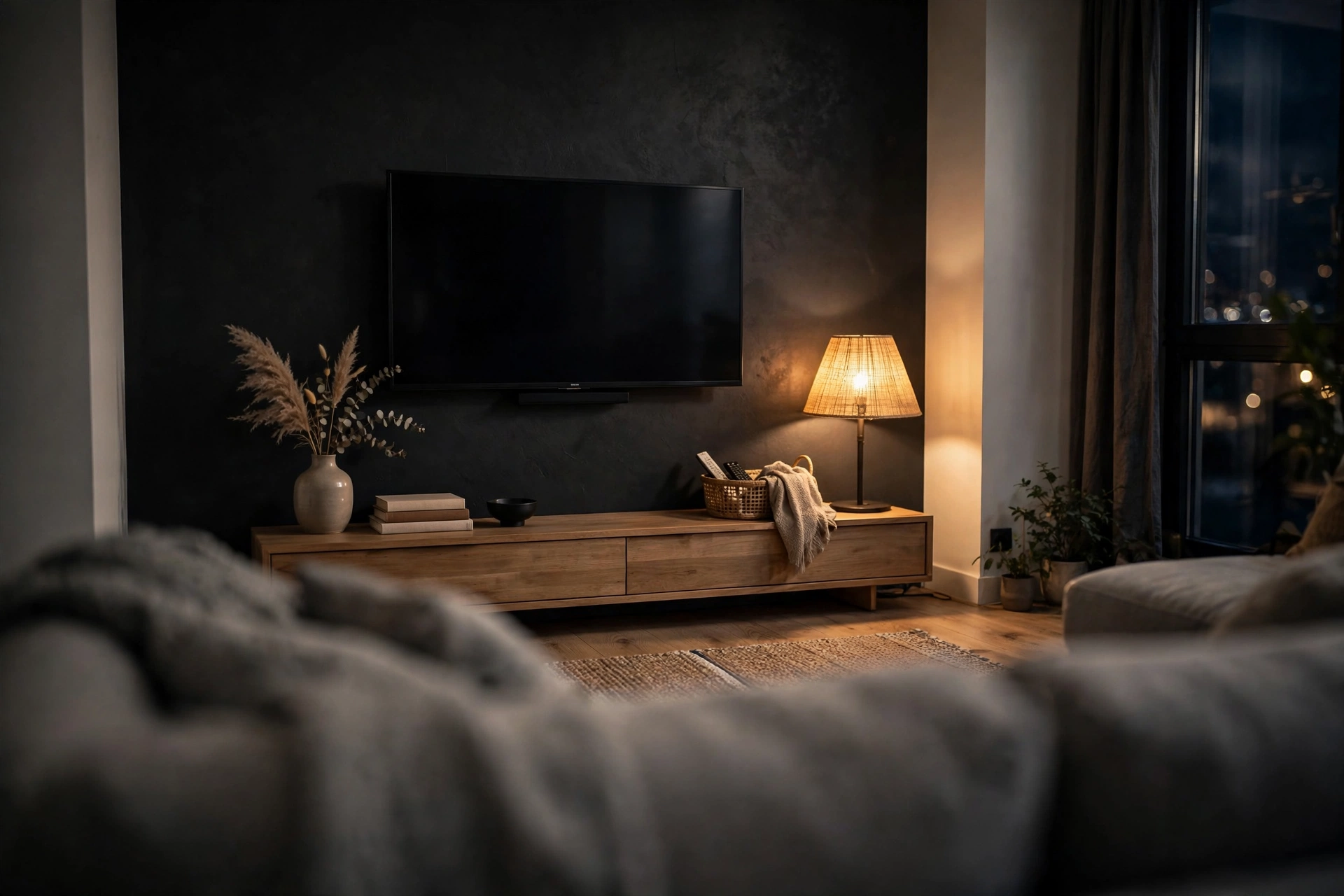
Run cables through a paintable cord raceway before painting — on a dark wall, white cables scream and black cables vanish.
Charcoal, not black. Pure black shows every roller mark and dust speck; charcoal is deep enough for camouflage and forgiving enough for DIY.
IDEA 03Terracotta Clay Limewash — Warmth That Glows in Daylight
Living rooms get the most daylight in the house, and limewash was practically invented for daylight — its cloudy, mineral texture comes alive as sun moves across it. Terracotta and warm clay turn that light golden, which is why Mediterranean rooms feel warm with minimal furniture. In a small living room, that glow does the decorating for you.
Application is forgiving by design: loose criss-cross brush strokes are the finish, so there’s no wrong technique to learn. Two coats with drying time between them, and judge the color only when fully dry — limewash dries dramatically lighter than it looks wet. One honest note: limewash isn’t scrubbable like eggshell, so keep it off the wall behind the snack zone if you have kids.
Prime with a tinted primer close to your topcoat — it deepens the cloudy movement and saves you a third coat.
IDEA 04Wood Slat Media Wall — Warmth Plus Quieter Sound
Wood slats behind the TV or sofa do something paint can’t: they dampen sound. Small living rooms with hard floors echo — dialogue sounds harsh, music sounds thin. The slats’ ridges break up reflections just enough to take the edge off, while vertical rhythm pulls eyes upward and wood tones warm up rental-white boxes.
Run them floor-to-ceiling; a half-height slat wall reads unfinished. The detail that matters most is the shadow gap — a consistent half-inch between slats. Touching slats look like fencing; gapped slats with shadow lines look designed. Renters aren’t locked out: build two or three freestanding panels, finish all faces, and lean them against the wall. Zero holes, same silhouette.

Stain before mounting — including edges and backs. Unstained wood flashing between slats ruins the whole effect.
Slats also hide a multitude of sins: mount a slim soundbar or LED strip in the shadow gaps and cables disappear completely.
IDEA 05Botanical Peel-and-Stick Wallpaper — the Renter’s Superpower
Peel-and-stick wallpaper is the single most renter-safe accent on this list — it comes down cleanly years later. For living rooms the scale rule is everything: choose a large-scale botanical. Small ditsy prints turn busy at sofa distance and make the room feel restless; one oversized leaf or arch motif reads calm and deliberate from across the room.
Hang it on the sofa wall or the wall you face most — wallpaper you never look at is wasted money. It’s a two-person job: one aligns from the top, one smooths downward with a plastic smoother (never hands, which stretch the paper). Order one extra roll beyond your math — pattern matching eats 10–15% more than square footage suggests, and a mid-wall shortfall can’t be fixed.
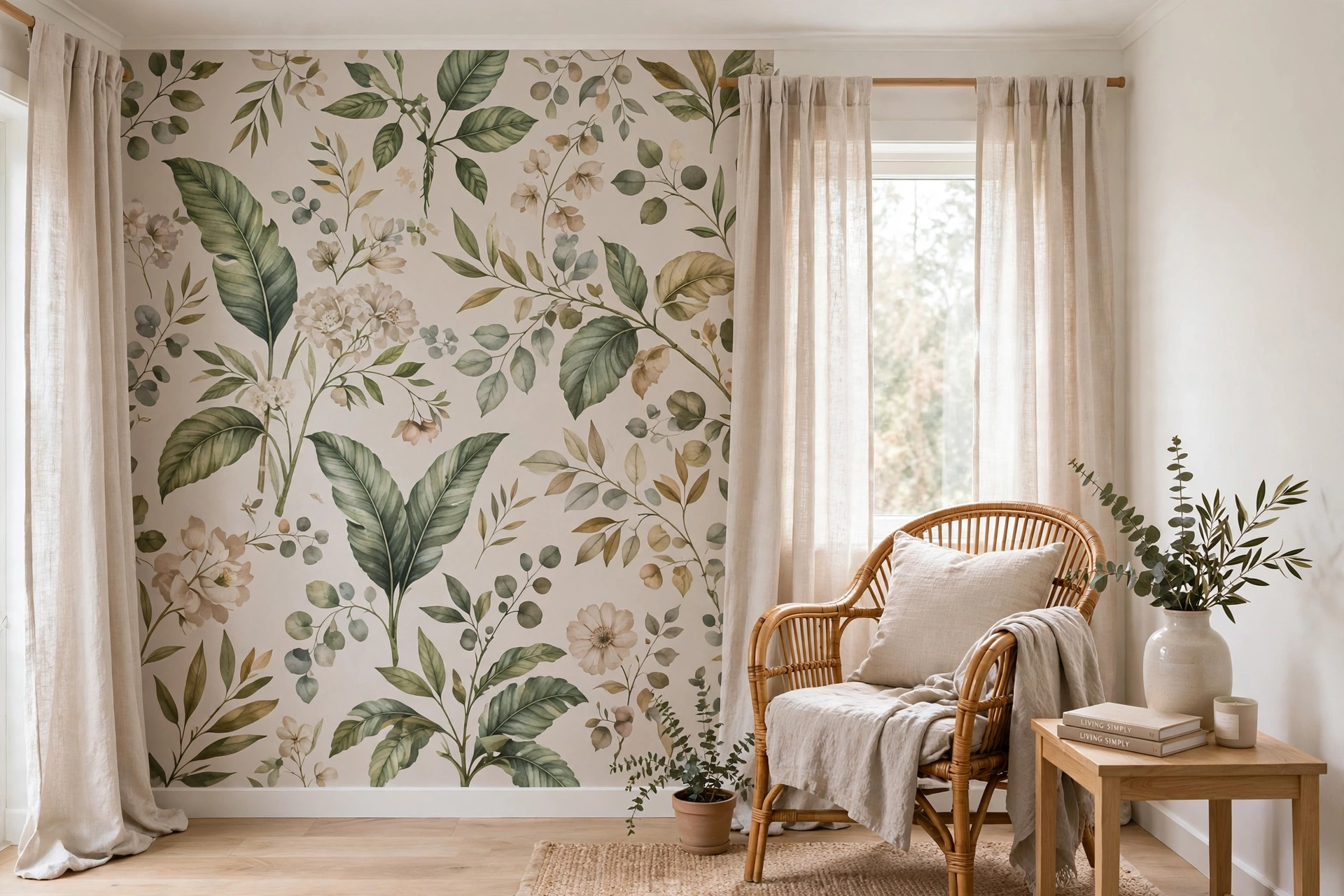
Test a sample square behind the sofa for a week first — cheap papers can pull paint on removal, and you want that discovery on a hidden spot.
IDEA 06Fireplace Chimney-Breast Accent — Your Free Focal Point
If your living room has a fireplace — working or not — you already own an accent wall: the chimney breast. It juts into the room and it’s naturally the focal point, so painting it a deep, confident color costs one gallon and one afternoon. Charcoal, deep green, or oxblood turns a plain rental fireplace into the room’s anchor, and makes the mantel pop like a gallery ledge.
No fireplace? A freestanding electric stove ($100–$200) against a painted column fakes the whole effect — paint a 4-foot-wide vertical band floor-to-ceiling, set the stove in front, and the eye reads “fireplace” instantly. Keep the breast darker than the surrounding walls so it advances toward you; that forward push is what gives small rooms their sense of depth.
Paint the inside of the firebox matte black too — it adds depth even when the fireplace is purely decorative.
IDEA 07Gallery Wall Above the Sofa — the Zero-Commitment Accent
No paint, no wallpaper, no decisions you’ll regret: a gallery wall above the sofa is an accent wall made of art. It’s endlessly rearrangeable, it costs whatever thrifted frames cost, and it’s the only idea here that gets better the longer you live with it. For strict leases and chronic redecorators, nothing beats it.
The layout rule that separates gallery from waiting room: the arrangement should span roughly two-thirds the sofa’s width, centered, with its center at eye level (about 57 inches off the floor). Start with the largest piece slightly off-center, then build outward. Thrift mismatched frames and spray them one unifying color — mismatched frames in matching paint look intentional; matching frames in mismatched finishes look accidental.
Lay the whole arrangement on the floor first and photograph it — rearranging on the floor is free, rearranging on the wall costs spackle.
IDEA 08Color-Drenched Board and Batten — Instant Architecture
Board and batten is thin trim in a grid — and the trick that makes it look expensive is color-drenching: wall and battens painted the exact same deep color. A flat rental wall suddenly reads as custom millwork, and because everything is one color, the wall stays visually calm — critical in small living rooms where contrasting trim would chop the space into fussy pieces.
This works hardest behind the sofa or media console, where the grid frames your furniture like architecture. Measure the grid on paper first — even spacing matters more than the number of boxes, and two or three wide panels beat six fussy ones. Attach with brad nails (owners) or heavy-duty removable strips (renters, with written landlord approval), caulk the seams, then roll two coats over everything. One color, one weekend, rooms that photograph like they cost ten times more.
Anything nailed or glued needs written landlord approval — “it looked easy on YouTube” won’t save your deposit.
Carry the same color across the ceiling line by 6 inches — the blurred edge makes standard 8-foot ceilings read taller.
IDEA 09Painted Arch Reading Corner — a Room Within a Room
One large painted arch behind an armchair and floor lamp creates a “room within a room” — and in open-plan living rooms, that’s gold. It carves a reading corner out of undifferentiated space without moving a single piece of furniture. The curve also breaks up the boxy right angles small rooms are made of; eyes read curves as softer and more spacious than corners.
The perfect arch is easier than it looks: pin a string at your center point, tie a pencil at the radius, sweep. Size it generously — the arch should clear the chair and lamp with breathing room, roughly 5 feet wide for a standard armchair. Two overlapping arches in slightly different tones (clay over sand, sage over cream) add depth for the cost of a second sample pot. Under $20, two hours, fully paint-overable.
Center the arch on the chair, not the wall — furniture is rarely perfectly centered, and the arch should frame the seat.
IDEA 10Emerald Library Wall — Moody, Bookish, Brilliant
Deep emerald green plus bookshelves is the most atmospheric combination in this guide. Books already add visual texture, and emerald behind them makes spines glow like jewels while the dark wall recedes — so a wall of storage reads as depth instead of clutter. It’s the rare accent that makes a small living room feel both cozier and more considered.
You don’t need built-ins. Two or three floating shelves ($15–$30 each) on an emerald wall hold a surprising number of books. Style them at 70% full — mix horizontal stacks with vertical rows, leave breathing room, let a plant or framed print break up the spines. Keep brackets minimal and dark so they vanish into the wall. Paint first, mount second — touching up around installed shelves is miserable work.
Style shelves at 70% full — crammed shelves read as storage, breathing shelves read as design.
No books? The same emerald wall works behind a bar cart, a record player setup, or a plant collection — the formula is deep green + curated objects.
IDEA 11Faux Brick Loft Wall — Urban Texture, Zero Masonry
Exposed brick is the most borrowed look in interiors — and peel-and-stick brick panels have gotten good enough that guests won’t know until they touch it. One brick wall gives a plain living room instant urban character: the texture catches light beautifully, the warm red-brown tones play well with leather and wood, and it makes new-build boxes feel like they have history.
Restraint is the whole game. Brick is a loud texture — one wall is character, two walls is a theme restaurant. Keep everything else quiet: solid sofa, simple rug, minimal clutter. The panels go up like wallpaper (measure twice, order 10% extra), and the good ones remove cleanly — so you probably don’t even need to ask the landlord.
Warm up the brick with wood tones nearby — a wooden coffee table or oak frame stops brick from feeling cold and industrial.
One wall only. Brick on two walls stops looking like character and starts looking like a pizza oven.
IDEA 12Two-Tone Horizontal Split — Ground the Sofa
Paint the lower half of the wall a rich color, keep the upper half and ceiling white, and something useful happens: the sofa visually locks into the colored band, like it was designed for that exact spot. The white upper half keeps the room airy — the coziness of a dark wall with none of the cave feeling.
Split at roughly half to two-thirds height — align it with the top of your sofa back or a touch above. The crisp line is the entire job, so seal your painter’s tape: paint over the tape edge with the base color first, let it dry, then roll your accent color. Any bleed matches the wall underneath and the line comes out razor sharp.
Match the lower color to a tone already in your rug — the wall and floor start talking to each other and the room feels designed.
IDEA 13One-Wall Mural — a View You Don’t Have
A single large-scale mural — misty hills, abstract washes, oversized botanicals — gives a small living room something no paint can: a view. Murals are sold sized to your wall, so there’s no pattern-repeat waste and no roll math. In windowless or courtyard-facing rooms, a landscape mural genuinely changes how the room feels to sit in.
Scale discipline matters most here: the mural should read as one calm composition from the doorway — misty and abstract outperform busy and literal in small rooms. Keep the sofa solid and the rug quiet; the wall is doing all the talking, and a patterned sofa next to a mural is two voices arguing. Peel-and-stick mural panels make this fully renter-safe.
Order the mural 2–3 inches wider than the wall — trimming excess is easy, stretching a shortfall is impossible.
IDEA 14Fabric Wall Hanging — the Softest Accent
A large textile on the living room wall — block-print quilt, woven hanging, flatweave rug — adds pattern and fixes the echo problem small hard-walled living rooms all share. Bare walls bounce TV dialogue into harshness; fabric absorbs just enough to make the room sound as good as it looks. It comes down with zero damage — the gold standard for strict leases.
Scale it like art: the textile should span roughly two-thirds the sofa’s width — too small looks like an afterthought, too large overwhelms. Hang it from a simple curtain rod at picture-ledge height, and steam it before hanging — fold creases are the difference between “curated textile” and “blanket nailed to the wall.” A flatweave rug with a bold pattern is the insider pick: cheaper than art, bigger than most hangings.
Try the textile behind the sofa first, then the wall opposite the TV — fabric opposite the screen also kills glare-bouncing reflections.
IDEA 15Painted Ceiling — the “Fifth Wall” Move
In a truly tiny living room, the boldest accent might not be a wall at all. Paint the ceiling your accent color and keep the walls pale: guests look up, the room feels wrapped and intentional, and you lose zero inches of wall space to visual weight. It’s the only idea here that adds drama without touching a single wall.
The pro move is the blurred edge: carry the ceiling color about 6 inches down onto the walls instead of cutting a hard line at the corner. The soft transition erases the harsh ceiling line and paradoxically makes the ceiling feel higher. Use flat paint only — any sheen spotlights every drywall flaw under overhead light. Yes, your neck will ache; a roller on an extension pole makes it one afternoon.
Deep green or navy ceilings with warm white walls is the classic combo — cozy overhead, airy at eye level.
Which Wall Should Be the Accent Wall in a Living Room?
You have two strong candidates. The TV wall if you want the screen to disappear into the design. The sofa wall if you want the seating area to feel anchored and intentional. If you have a fireplace, it wins automatically — the chimney breast is already the focal point, so dressing it is never wrong.
For open-plan rooms, add the sight-line test. Stand in the doorway — and in the kitchen, if it’s visible — and notice which wall your eyes land on. That’s your accent wall: the one that defines the living zone. One rule for open plans: a single accent per sight line. Two competing accent walls visible at once don’t look bold, they look busy. And skip the window wall — daylight will fight your color all day and usually win.
What Color Works Best for a Living Room Accent Wall?
Living rooms get more daylight than bedrooms, so test your color at noon and at 9pm — a shade you love in sunlight can turn muddy under lamps. North-facing rooms need warmth (terracotta, warm green, creamy greige); south-facing rooms can handle cooler shades (navy, charcoal, sage) because the light warms them for you.
The undertone rule beats every trend: match the accent’s undertone to your largest furniture piece, usually the sofa. Warm-gray sofa? Terracotta, olive, warm greige. Cool-gray sofa? Navy, charcoal, sage. And if your room is open-plan, pull the accent color from something already in the space — a rug, a piece of art — so the color feels discovered, not imposed. The best accent wall ideas for living room spaces are always the colors that echo something already in the room.
Renter Rules: What You Can and Can’t Do
- Always safe: peel-and-stick wallpaper and murals, fabric hangings, gallery walls on strips, leaning slat panels
- Safe with repaint: any paint project — budget one weekend to restore the original color before moving out
- Ask first: anything nailed or glued (battens, mounted shelves, brick panels)
- Never: textured plaster, skim coats, or anything that permanently changes the wall surface
Photograph your walls — including the exact original paint shade — on move-in day. “Landlord white” has fifty variants, and matching it later is how you get your deposit back.
The deposit math: a $40 gallon of original-color paint and one weekend beats a $300 professional-repaint deduction every time.
5 Mistakes to Avoid
- Mounting the TV too high. Center of the screen 42 inches off the floor — eye level from your sofa. A craned neck ruins movie night faster than any color choice.
- Accenting the window wall. Daylight washes out your color all day, and curtains compete with it. Accent the wall you face, not the one light comes through.
- Matching the accent to the sofa. Gray wall behind a gray sofa looks flat, not coordinated. Contrast is what makes an accent wall work.
- Forgetting lighting. An accent wall with no light on it goes dead after sunset. One lamp or LED strip is the difference between dramatic and dingy.
- Three loud voices. Accent wall plus busy rug plus patterned curtains is visual shouting. Let the wall talk; keep the rest quiet.
FAQs
01Should the TV go on the accent wall?
Usually yes — and the reason is camouflage, not decoration. A TV is a black rectangle that dominates a small living room even when it’s off; painting that wall charcoal, deep green, or navy makes the screen visually dissolve instead of shouting. Mount it right while you’re at it: center of the screen about 42 inches off the floor (eye level from a standard sofa), cables hidden in a paintable raceway, and a $15 USB LED strip behind the set for bias lighting that cuts eye strain. The one exception: if the TV wall holds your room’s big window, don’t fight daylight — put the accent behind the sofa instead and let the TV live on a quiet wall.
02What color accent wall goes with a gray sofa?
Good news first: gray is a neutral, so almost anything works — the trick is matching undertones. A warm-gray sofa (beige lurking underneath) pairs beautifully with terracotta, olive green, and warm greige. A cool-gray sofa (blue lurking underneath) loves navy, charcoal, and sage. The one combination to avoid is gray-on-gray: a mid-gray wall behind a mid-gray sofa doesn’t look coordinated, it looks flat — like the room ran out of ideas. When in doubt, go one clear step darker or warmer than the sofa and follow the 60-30-10 rule: 60% dominant neutral walls, 30% secondary (sofa), 10% accent wall doing the talking.
03Will a dark accent wall make my small living room feel smaller?
Usually the opposite — with the same physics as bedrooms. Deep, muted colors visually recede, so your eye reads the dark wall as sitting slightly further away than it is, and the room gains depth. Three things have to be true for the trick to work: keep it to one wall, keep the other walls light so the contrast does its job, and light the accent wall itself — a dark wall with no lamp on it goes dead after sunset. What genuinely shrinks a small living room isn’t color at all — it’s clutter, bad lighting, and furniture pushed against every wall.
04Can I do an accent wall in a rental apartment living room?
Absolutely — living rooms are actually the easiest rental rooms to accent because so many options need zero wall damage. Tier 1, always safe: peel-and-stick wallpaper or murals, fabric hangings, gallery walls on picture-hanging strips, and leaning slat panels — all fully reversible. Tier 2, safe with repaint: any paint project, as long as you photograph the original shade on move-in day and budget one weekend to restore it. Tier 3, ask first: anything nailed or glued, in writing. Skip textured plaster entirely — it permanently changes the wall surface and no deposit survives it.
05Which wall should be the accent wall in an open-plan living room?
The wall that anchors your sofa zone — because in an open plan, the accent wall’s real job is zoning, not just decoration. Stand where you enter the space and notice which wall your eyes land on when you think “living room”; that’s the one. Then apply the sight-line rule: from any single viewpoint (sofa, kitchen counter, front door), only one accent wall should be visible — two competing accents in one sight line read as chaos. Reinforce the zone with a rug that sits under the sofa’s front legs; rug plus accent wall together draw a room boundary no furniture arrangement can.
06Is it better to paint or use wallpaper for a living room accent wall?
Decide on durability first, because living rooms take abuse bedrooms don’t. Paint wins for households with kids or pets: a washable eggshell or satin finish wipes clean, it costs $30–$50, and repainting is trivial when tastes change. Wallpaper wins for pattern and texture paint can’t produce — and peel-and-stick versions are the renter’s best friend — but budget $60–$300 per wall and choose scrubbable, wipeable papers if little hands live nearby. The hybrid answer many designers land on: paint the accent wall now (cheap, fast, reversible), and upgrade to wallpaper later once you’re sure about the color family.
Key takeaways
- Renting? Peel-and-stick wallpaper, gallery walls, and fabric hangings are fully reversible — zero deposit risk.
- TV wall or sofa wall? TV wall makes the screen disappear; sofa wall anchors the seating — pick the problem you most want solved.
- Light the accent. One lamp or LED strip on the wall is the difference between dramatic and dingy after sunset.
- Sample everything. Noon sunlight and 9pm lamplight are two different colors — test both.