 Casacrunched
15 Bedroom Accent Wall Ideas That Make Small Rooms Feel Intentional
One wall, one weekend, under $100. Every idea rated for cost, time, and renter-friendliness — so you can pick yours and be done by Sunday night.

A bedroom accent wall is the fastest way to give a small bedroom a point of view. These bedroom accent wall ideas are built for real constraints: rentals you can’t drill into, rooms under 120 square feet, and budgets under $100. Every idea below lists what it costs, how long it takes, and whether your landlord will hate it — so you can pick one this weekend and be done by Sunday night.
On this page
- Quick comparison table
- 1. Deep green painted wall
- 2. Black accent wall
- 3. Warm clay limewash
- 4. Board and batten
- 5. Peel-and-stick wallpaper
- 6. Wood slat wall
- 7. Painted arch
- 8. Two-tone split
- 9. White shiplap
- 10. One-wall mural
- 11. Textured plaster
- 12. Art-ledge wall
- 13. Navy + brass
- 14. Fabric hanging
- 15. Painted ceiling
- Which wall should be the accent?
- What color works best?
- Renter rules
- 5 mistakes to avoid
- FAQs
Quick comparison: cost, time, renter-friendliness
All costs are DIY estimates for one standard 10×12 ft wall, paint and basic tools included. Hiring a painter roughly doubles the paint-idea budgets.
| # | Idea | Cost | Time | Renter-safe? |
|---|---|---|---|---|
| 1 | Deep green paint | $30–$50 | 1 afternoon | Repaint later |
| 2 | Black accent wall | $30–$50 | 1 afternoon | Repaint later |
| 3 | Clay limewash | $50–$70 | 1 afternoon | Repaint later |
| 4 | Board and batten | $40–$80 | 1 weekend | Ask landlord |
| 5 | Peel-and-stick wallpaper | $60–$120 | 2–3 hours | Yes |
| 6 | Wood slat wall | $80–$200 | 1 weekend | Yes (leaning panels) |
| 7 | Painted arch | Under $20 | 2 hours | Repaint later |
| 8 | Two-tone split | $30–$50 | 1 afternoon | Repaint later |
| 9 | White shiplap | $100–$250 | 1 weekend | Faux peel-and-stick |
| 10 | One-wall mural | $100–$300 | 2–4 hours | Yes (peel-and-stick) |
| 11 | Textured plaster | $40–$80 | 1 weekend | No (owners) |
| 12 | Art-ledge wall | $40–$100 | 1–2 hours | Yes |
| 13 | Navy + brass | $30–$60 | 1 afternoon | Repaint later |
| 14 | Fabric hanging | $30–$120 | 30 min | Yes |
| 15 | Painted ceiling | $30–$50 | 1 afternoon | Repaint later |
IDEA 01Deep Green Painted Wall — the Small-Bedroom Classic
Nothing cocoons a small bedroom like a deep, desaturated green — think forest, eucalyptus, or olive. Here’s the design logic most listicles skip: dark, muted colors recede visually. Your eye reads the deep green bed wall as sitting slightly further away than it is, which means the room feels deeper instead of smaller. It’s the same reason theater lobbies and old libraries feel grand in modest footprints.
Green has a second advantage in bedrooms: it’s the least stimulating of the dark colors. Navy can feel formal, charcoal can feel cold, but green — especially with a warm or neutral undertone — reads as calm and organic. That matters in the room where you sleep. Pick your shade carefully though: a green with strong yellow undertone can go swampy next to gray bedding, while a blue-leaning green pairs beautifully with white cotton and light wood.
Paint a large foam board first and live with it for 48 hours — check it in morning light and under your bedside lamp before you commit to the gallon.
IDEA 02Black Accent Wall — Bold, But Make It Cozy
A black bedroom accent wall sounds dramatic, but in a small room it’s secretly the most forgiving choice you can make. Uneven drywall, old roller marks, patched holes — black swallows them all. It also makes white or cream bedding look impossibly crisp by contrast, which is why nearly every moody bedroom photo you’ve saved uses this exact formula.
The rules that separate a cozy black wall from a cave: keep the other three walls a warm white (not stark blue-white), use a matte or eggshell finish — gloss black shows every flaw and reflects light harshly — and warm up your lighting. Swap cool daylight bulbs for 2700K warm ones; black walls under warm light feel like a cocoon, under cool light they feel like a basement.
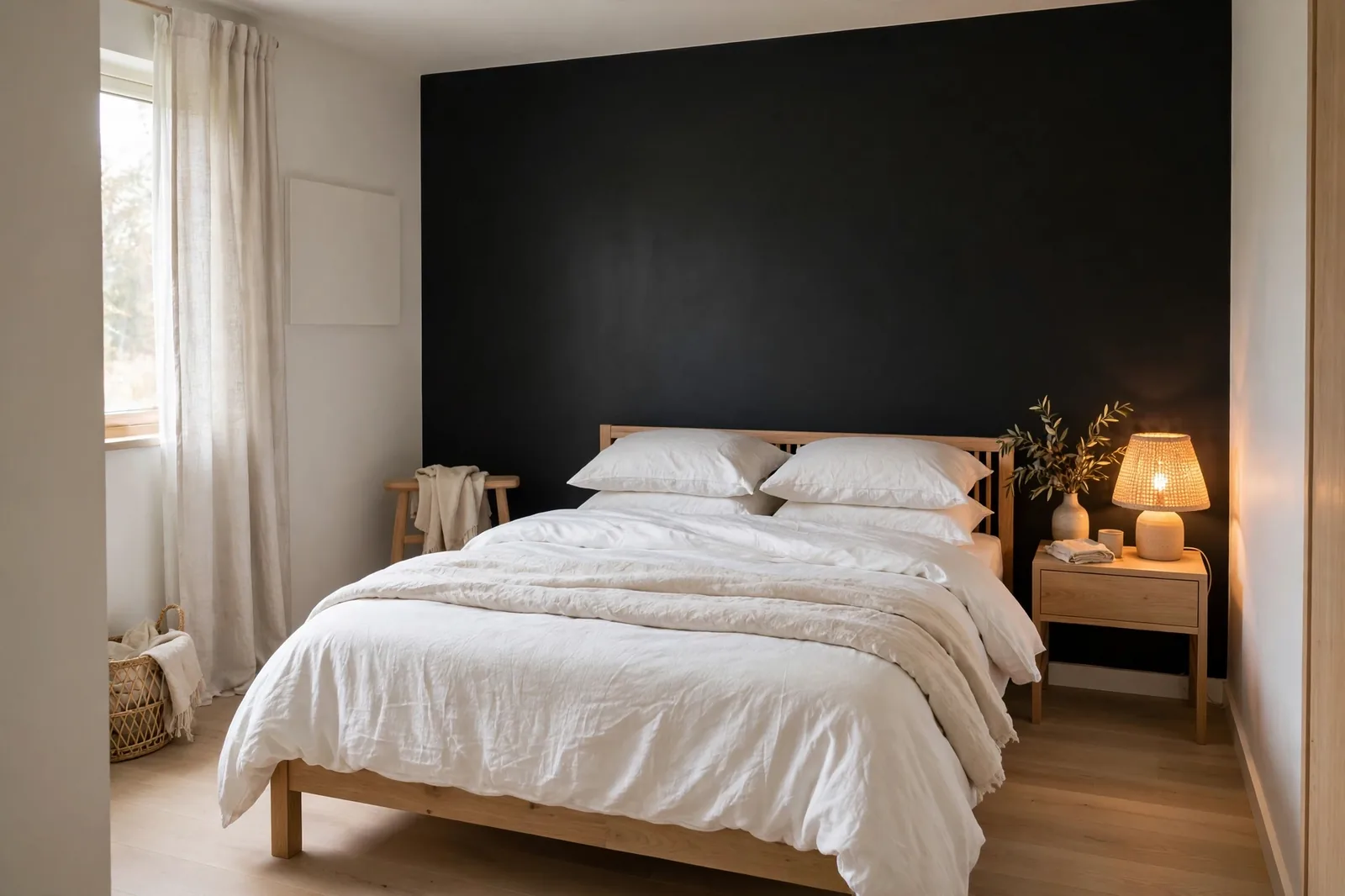
Cut in edges with a high-quality angled brush and do two full coats — black shows patchy coverage more honestly than any other color.
One wall only. Painting all four walls black in a room under 100 sq ft doesn’t look moody — it looks like you gave up.
IDEA 03Warm Clay Limewash — Texture Without Wallpaper
Limewash is paint made with crushed limestone, and it dries with a soft, cloudy movement that flat paint can’t fake. In a small bedroom that texture does real work: it gives the wall depth without pattern, so the room gains visual interest without gaining visual clutter. Terracotta, clay, and warm sand tones sit perfectly in a small-space palette because they warm up rooms that get little natural light.
The application is more forgiving than it looks. You brush it on in loose, random criss-cross strokes — the overlapping marks are the finish, so there’s no such thing as a wrong stroke. Plan for two coats with drying time between them, and know that limewash looks dramatically lighter when wet. Judge the color only once it’s fully dry, and buy from a brand that sells actual limewash rather than “limewash-effect” latex if you want the real mineral texture.
Limewash over a colored primer close to your topcoat shade — it deepens the cloudy effect and you’ll need fewer coats.
IDEA 04Color-Drenched Board and Batten — Architecture on a Budget
Board and batten is just thin trim arranged in a grid — but the trick that makes it look expensive is color-drenching: painting the wall and the battens the exact same color. Suddenly a flat rental wall reads as custom millwork. And because everything is one color, the wall stays visually calm — critical in a small room, where contrasting trim would chop the space into busy pieces.
Measure your grid on paper first: even spacing matters more than the number of boxes. Attach battens with brad nails (owners) or heavy-duty removable adhesive strips (renters), caulk the seams for a built-in look, then roll two coats over everything. For maximum effect, carry the same color onto the ceiling — when the ceiling “disappears” into the wall color, an 8-foot ceiling reads noticeably taller.
Anything nailed or glued needs written landlord approval first — “it looked easy on YouTube” won’t save your deposit.
Keep batten boxes large — two or three wide panels beat six fussy small ones on a bedroom wall.
IDEA 05Peel-and-Stick Wallpaper — The Renter’s Superpower
Modern peel-and-stick wallpaper is nothing like the border strips of the 90s. Applied to smooth, primed walls, it peels off cleanly years later — which is why it’s the single most renter-safe accent on this list. For small bedrooms, scale is everything: choose a large-scale print. Small ditsy florals make a tiny room feel busy and restless, while one oversized botanical or arch motif feels deliberate and calm.
Installation is a two-person job: one holds and aligns, one smooths. Start at the top center of the wall and work outward, smoothing with a plastic smoother as you go — never with your hands, which stretch the paper. The number everyone gets wrong is quantity: pattern matching eats 10–15% more than the wall’s square footage suggests, so order one extra roll. Unopened rolls can usually be returned; a half-wall shortfall can’t be fixed.
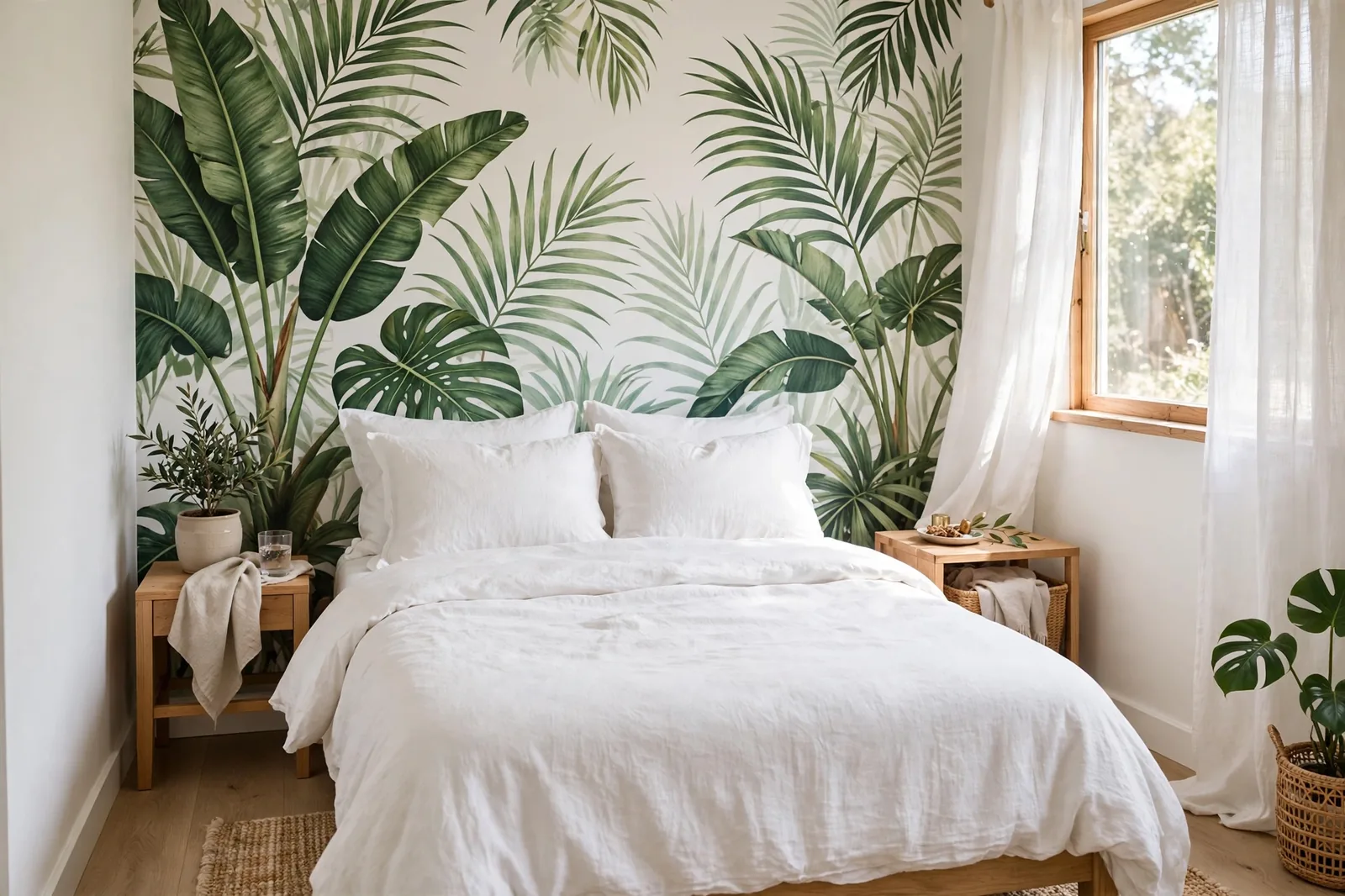
Test a sample square behind furniture for a week — cheap papers can pull paint on removal, and you want to discover that on a hidden spot.
IDEA 06Wood Slat Wall — Warmth You Can Feel
Vertical wood slats do three things at once: they add rhythm (the repeating lines calm a busy eye), warmth (wood tones soften the hard edges of a small room), and height — vertical lines pull your gaze upward, so the ceiling feels higher. Run them floor-to-ceiling rather than stopping at headboard height; a half-height slat wall looks like an unfinished project.
Real oak battens are the premium choice, but budget pine stained to taste gets you 90% of the look. The detail that separates designed from DIY: leave a consistent ½-inch shadow gap between slats. Tight, touching slats look like fencing; gapped slats with shadow lines look architectural. Renters aren’t locked out — build two freestanding panels, finish them properly, and lean them against the wall. Zero holes, same silhouette.

Stain all slats before mounting, including the back faces — unstained edges flashing between slats ruin the effect.
No-drill option: build two freestanding slat panels and lean them against the wall — zero holes, same look.
IDEA 07Painted Arch Behind the Bed — No Headboard Needed
A painted arch is the highest-impact-per-dollar idea on this list. One large arch centered behind the bed creates a “headboard” where none exists, and the curve does something subtle but powerful in small boxy rooms: it breaks up all the right angles. Our eyes read curves as softer and more spacious than corners, so a single arch can make a rigid little bedroom feel less like a box.
The perfect curve is easier than it looks: pin a string at your center point, tie a pencil at the radius length, and sweep. Two overlapping arches in slightly different tones (say, clay over sand) add depth for the cost of a second sample pot. Renters love this one — it’s just paint, so one primer coat erases it on move-out day.
Center the arch on the bed, not the wall — beds are rarely perfectly centered, and the arch should frame the bed.
IDEA 08Two-Tone Horizontal Split — The Ceiling Trick
Paint the bottom two-thirds of the wall a rich color and keep the top third — plus the ceiling — white. Your eye reads the continuous white band as “more ceiling,” so a standard 8-foot ceiling suddenly feels like 9. It’s an old decorator’s trick that works hardest in exactly the kind of boxy, low-ceilinged bedrooms small homes tend to have.
Placement matters: split at roughly two-thirds height (around picture-rail level), not at chair-rail height — a higher split suits bedrooms, while a low split reads dining-room. The crisp line is the whole job, so seal your painter’s tape: paint over the tape edge with the base color first, let it dry, then paint your accent color. Any bleed matches the wall underneath and the line comes out razor sharp.
Try the dark color on the bottom for coziness, or flip it — dark on top with white below feels more modern and airy.
IDEA 09White Shiplap — Calm, Coastal, Timeless
If dark colors scare you, make texture your accent instead of color. White shiplap adds shadow lines and quiet interest while keeping the room bright — ideal for north-facing bedrooms that never get strong light. It’s also the safest choice for resale or strict landlords, since white-on-white never offends anyone.
Orientation changes the effect: run boards horizontally in narrow rooms to visually widen them, vertically in rooms with low ceilings to add height. MDF shiplap is the budget pick and paints beautifully. Renters have a genuinely good fallback now — peel-and-stick faux shiplap wallpaper has gotten convincing enough that guests won’t know until they touch it.
Paint shiplap in a warm white, not a blue-white — cool whites turn gray and dingy in low light.
IDEA 10One-Wall Mural — Art You Live Inside
A single large-scale mural — misty forest, abstract arches, oversized florals — turns the bed wall into art you sleep inside. Murals have a practical edge over regular wallpaper: they’re sold sized to your wall dimensions, so there’s no pattern-repeat waste and no guessing how many rolls to buy.
Scale discipline is everything. In a small bedroom the mural should read as one composition from the doorway, not a collection of competing details — misty landscapes and abstract washes outperform busy illustrated scenes. Keep bedding solid and quiet; the wall is doing all the talking, and patterned bedding next to a mural is visual shouting. Peel-and-stick mural panels make this fully renter-safe.
Order the mural 2–3 inches wider than the wall — trimming excess is easy, stretching a shortfall is impossible.
IDEA 11Textured Plaster Effect — The Artisan Look
Venetian plaster — or its DIY cousin, tinted joint compound — gives walls an old-world depth that flat paint physically can’t produce. Light moves across the troweled surface differently from every angle, so the wall feels alive in a way that makes small bedrooms feel collected rather than decorated — the exact quality designers charge thousands to fake.
This is a two-day project: texture day, then glaze day after it cures. Practice the trowel motion on cardboard for twenty minutes first — the technique is genuinely easy to learn, but your first square foot will look different from your tenth, and you want the learning curve hidden on cardboard. Be honest about the renter question: this permanently changes the wall surface, so it’s owners only.
Textured plaster, skim coats, and anything that changes the wall surface itself are never renter-safe — this one is for owners only.
Tint your glaze slightly darker than the base — the contrast settling into the low spots is what creates the depth.
IDEA 12Art-Ledge Accent Wall — The Zero-Commitment Accent
No paint, no wallpaper, no decisions you’ll regret: mount two picture ledges and layer framed art along them. It’s an accent wall made of art — endlessly rearrangeable, and it doubles as a headboard alternative in rooms where a real headboard would eat precious inches. For chronic redecorators and strict leases, nothing beats it.
The styling rule that separates gallery from waiting room: overlap frames at different depths and vary the sizes. A single neat row of identical frames looks institutional; a layered, slightly overlapping arrangement looks collected. Thrift the frames and spray-paint them one unifying color — mismatched frames in matching paint look intentional, matching frames in mismatched finishes look accidental.
Lean the largest piece and hang the smaller ones — mixing lean and hang adds the depth that makes ledges look designed.
IDEA 13Navy + Brass — The Classic That Always Works
Deep navy behind the bed, warmed up with brass — a thrifted lamp with a $15 spray-paint job, picture frames, drawer pulls. It’s the most reliable color pairing in interiors for a reason: navy recedes like all deep colors (hello, visual depth), while brass’s warmth stops the cool blue from feeling cold. It works in rooms from 80 to 300 square feet without modification.
One critical test most people skip: check your navy swatch at night under your actual bulbs. Navy goes purple under warm light, and the swatch you loved at noon can look like a bruise at 9pm. If it shifts too far, look for navies with a gray rather than violet base — they stay true under warm bulbs.
Brass doesn’t have to be real — a $6 can of metallic spray paint over thrifted frames and lamp bases fools everyone.
IDEA 14Fabric Wall Hanging — The Softest Option
A large textile behind the bed — block-print quilt, woven hanging, even a flatweave rug — adds pattern and softens the room’s acoustics, which hard-walled small bedrooms desperately need. It comes down with zero damage, making it the gold standard for dorms and strict leases where even peel-and-stick is questioned.
Scale it like art: the textile should span roughly two-thirds the bed’s width — too small looks like an afterthought, too large overwhelms. Hang it from a simple curtain rod mounted at the width of the window frame for a finished look, and don’t be afraid of a rug on the wall; flatweaves with bold patterns make spectacular, cheap headboards.
Steam or iron the textile before hanging — fold creases are the difference between ‘curated textile’ and ‘blanket nailed to wall.’
IDEA 15Painted Ceiling — The “Fifth Wall” Trick
In a truly tiny bedroom, the smartest accent wall might not be a wall at all. Paint the ceiling your accent color and keep the walls pale: guests look up, the room feels wrapped and intentional, and you lose zero inches of wall space to visual weight. It’s the only idea on this list that adds drama without touching a single wall.
The pro move is the blurred edge: carry the ceiling color about 6 inches down onto the walls instead of cutting a hard line at the corner. The soft transition erases the harsh ceiling line and paradoxically makes the ceiling feel higher, not lower. Yes, your neck will ache — use a roller on an extension pole and it’s one afternoon, ache included free.
Use flat/matte paint on ceilings only — any sheen on a ceiling highlights every drywall flaw under overhead light.
Which Wall Should Be the Accent Wall in a Bedroom?
The wall your bed sits against — nine times out of ten. It’s the natural focal point, it’s the wall you see least while sleeping (so bold choices won’t overstimulate you), and it frames the bed like art.
The tenth time? Skip walls with a large window (daylight fights your color all day and usually wins) and walls broken up by two or more doors (the accent gets chopped into pieces and loses all impact). If your bed can’t move off a bad wall, accent the largest unbroken wall instead — the principle is “biggest clean canvas,” not “behind the bed or bust.”
What Color Works Best in a Small Bedroom?
Forget “dark colors make rooms smaller” as a blanket rule — it’s about undertone and finish, not darkness. Deep green, navy, and charcoal all recede and add depth; what actually shrinks a room is clutter and bad lighting, not color.
- Safest darks: deep green, navy, charcoal — muted, not electric
- Safest lights: warm white, greige, pale clay — keep light bouncing in dim rooms
- Avoid: pure bright white on all four walls (stark, not spacious) and high-gloss finishes (every flaw shows)
Always sample on a foam board, move it around the room, and check it morning and night. A color you love at noon can betray you at 9pm — $8 sample pots have saved more rooms than any design blog.
Renter Rules: What You Can and Can’t Do
- Always safe: peel-and-stick wallpaper, fabric hangings, art ledges, leaning panels
- Safe with repaint: any paint project — budget one weekend for repainting on move-out
- Ask first: anything nailed or glued (slats, battens, shiplap)
- Never: textured plaster, skim coats, or anything that changes the wall surface permanently
Read your lease’s “alterations” clause before you start. “Normal wear and tear” covers nail holes in most places — but painted walls usually must go back to the original color, so photograph the original shade before you paint.
Moving out? A fresh coat of the original color plus a magic eraser on scuffs returns most deposits in full — budget one weekend, not one evening.
5 Mistakes to Avoid
- Accenting the wrong wall. The window wall or a door-covered wall chops the effect into pieces — the accent needs one clean canvas to work.
- Stopping at one coat. Deep colors need two full coats, sometimes three. Patchy coverage doesn’t look “rustic” — it looks unfinished, and it’s the most common reason DIY accent walls disappoint.
- Ignoring undertones. A green with yellow undertone next to cool gray bedding will clash all day long. Match undertones first, color second.
- Forgetting the ceiling. Bright white ceiling + dark walls can feel like a lid pressing down. Carry the color up — even 6 inches softens the line.
- Skipping the sample test. Light changes everything. The $8 sample pot is the cheapest insurance in all of DIY.
FAQs
01Will a dark accent wall make my bedroom feel smaller?
Usually the opposite happens — and there’s a reason. Deep, muted colors visually recede: your eye reads the dark bed wall as sitting slightly further away than it really is, so the room feels deeper. This works best with desaturated shades (forest green, navy, charcoal) rather than electric ones, and it depends on three supporting choices: keep the other three walls light, use warm 2700K lighting instead of cool daylight bulbs, and keep clutter off the floor. Get those right and most small bedrooms genuinely feel larger with a dark accent wall, not smaller. What truly shrinks a room isn’t color — it’s visual chaos.
02Which wall should be the accent wall in a bedroom?
The wall behind your bed, nine times out of ten. Three reasons: it’s the natural focal point when you enter, it’s the wall you see least while lying down (so bold choices won’t overstimulate you at night), and it frames the bed the way a mat frames a photograph. The exceptions matter though — skip any wall dominated by a large window, because daylight will fight your color all day and usually win, and skip walls broken up by two or more doors, where the accent gets chopped into pieces and loses all impact. If your bed can’t move off a bad wall, the fallback rule is simple: accent the largest unbroken wall in the room.
03Can renters do an accent wall?
Absolutely — renters just need to pick from the right tier. Tier 1, always safe: peel-and-stick wallpaper, fabric hangings, art ledges, and leaning slat panels — all come down without a trace. Tier 2, safe with repaint: any paint project, as long as you budget one weekend to restore the original color before moving out (photograph the original shade first — “landlord white” has fifty variants). Tier 3, ask first: anything nailed or glued. Get written permission, not verbal. The deposit math is simple: a $40 gallon of original-color paint beats a $300 repaint deduction every time.
04How much paint do I need for a bedroom accent wall?
One gallon — and buy the gallon, not the quart. A gallon covers roughly 350–400 sq ft, which is two full coats on a standard 10×12-foot wall with paint to spare for touch-ups. Deep or dramatic colors (black, navy, forest green) often need a third coat for truly even coverage, because dark pigments show every thin spot — that third coat is where the spare paint goes. If you’re going very dark over a light wall, one coat of tinted primer first will save you from needing a fourth coat of the expensive stuff.
05Is it better to paint or use wallpaper for an accent wall?
Decide on three factors: budget, timeline, and how often you refresh. Paint wins on price ($30–$50), speed (one afternoon), and flexibility — it’s also the cheapest way to learn what you actually like, since repainting is trivial. Wallpaper wins on pattern and texture that paint physically can’t produce, and peel-and-stick versions are the renter’s best friend because they remove cleanly — but expect $60–$300 per wall and a slower install. If you redecorate often, paint. If you want the look to last years and you rent, peel-and-stick wallpaper.
06Can a small bedroom handle a bold wallpaper?
Yes — and this is the rule most people get backwards. In a small room, large-scale prints (oversized florals, arches, murals) work better than small busy patterns, which read as visual noise up close and make the walls feel like they’re closing in. One confident large motif feels deliberate; a hundred tiny motifs feel chaotic. Keep the wallpaper to one wall, let the other three stay calm, and keep bedding solid and quiet — the wall is doing the talking, and patterned bedding next to a bold wall is two voices arguing.
Key takeaways
- Renting? Start with peel-and-stick wallpaper, art ledges, or fabric — fully reversible, zero deposit risk.
- One gallon covers a standard bedroom wall with two coats — and deep colors genuinely need both.
- The bed wall is your accent wall nine times out of ten — biggest clean canvas wins.
- Sample everything. Morning light and 9pm lamplight are two different colors.